Aug 23, 2020 | Homily
By Fr. Marcel Uzoigwe, CSSp.
(Is.22:19-23, Ps.138:1-8, Rom.11:33-36 & Matt.16:13:20)
Beloved friends in Christ,
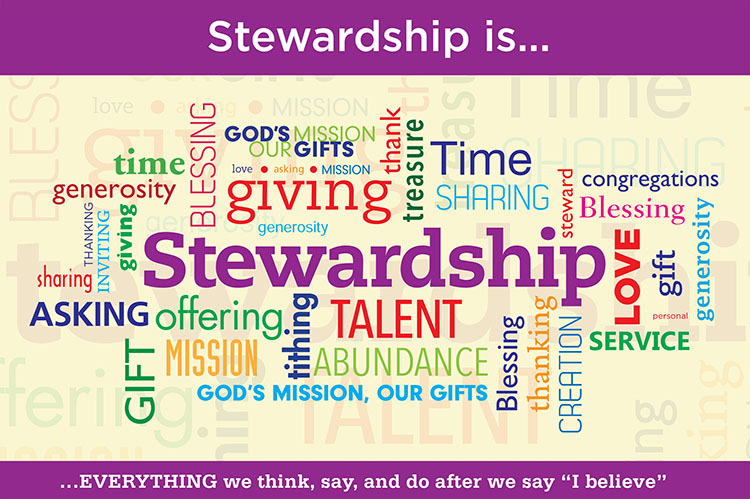
The readings of today invite us to review the basic foundation of our stewardship. This is necessary given that stewardship in God’s household is a vocation. God calls and choses us for various functions in the body of Christ. Only when our stewardship is inspired by the knowledge and love of God rather than love of wealth and vain glory can we be true partners with God in fulfilling his desires for his people.
The first reading is a continuation of the prophecy of Isaiah concerning Jerusalem at a time it was facing possible external attack and internal corruption. The portion we read is a prophecy concerning the disgrace and replacement of Shebna, a great officer entrusted with the treasury and the management of the revenue, and the choice of Eliakim to take over the post of honour. Shebna was described as a man of boundless ambition and covetousness, proud and treacherous to the point of having secret correspondence with the enemies of Israel. Eliakim, on the other hand, was the opposite of everything that Shebna represented in his behaviour. He was God-fearing, humble and diligent. Having proved himself a faithful servant of God in other employments, God approved him for the high position of taking charge of his household. Eliakim did not undermine Shebna, nor made an interest against him, nor did he intrude into his office; but God called him to it: and what God calls us to we may expect he will own us in.
God will place the keys of David on the shoulder of Eliakim such that when he opens no man shuts, and when he shuts, no man opens. He will also fasten him as a nail in a sure place, not to be removed or cut down. These statements point to the vast extent and long duration of the authority that God was going to confer on Eliakim. By diligent discharge of his office, he will be a great blessing in his family, and a father to the inhabitants of Jerusalem and to the house of Judah. He shall take care not only of the affairs of the king’s household, but of all the public interests in Jerusalem and Judah. In Eliakim we see that the honour men reflect by their piety and usefulness is more to be valued than that which they derive from their titles. Indeed the glory of this world which Shebna sought in his covetousness gives no intrinsic worth or excellency, but hangs like a cloth which will soon be dropped. But that which God bestows is eternal.
Jesus confers similar, but even greater authority, to Peter in the gospel reading. In the account of the events leading to Jesus’ statement, Jesus sought feedback from his disciples regarding who the people say he is. Since there are usually as many opinions as there are persons, the people’s opinion regarding the identity of Jesus varied from being John the Baptist or Elija to one of the ancient prophets that has come back to life. Jesus then threw the question directly to his disciples, “But who do you say that I am?” There is a wide gap between knowing about a person and knowing a person. Knowledge about a person is based on available information, which could be false. A woman once heard a gossip about her husband. While the gossiper was expecting the woman to get elated and react furiously, she calmly turned to her and said, “I know him. You better go home and fix your family and stop spying on my husband.” Eventually, she was right because the gossip turned out to be false. Knowing a person is based on first-hand personal experience of the person. The woman in the story was unwilling to exchange her experience of her husband with rumours flying around about him.
Having been with his disciples for a long time, one would not expect Jesus to throw such a question to them. But there is more to it because it borders on the question of identity, and how we arrive at it. The people guessed the identity of Jesus based on what they saw: the authority of his teaching was similar to that of John the Baptist; the signs he performed likened him to Elija, etc. It was necessary for Jesus to know if his disciples trully understand who they were following and what they were doing by following him. Without such a knowledge, it would be nearly impossible for them to face the challenges that will follow.
Peter, guided by the Holy Spirit, spoke up, “You are the Christ, the Son of the living God.” That was the first public proclamation of the identity of Jesus by his disciples. Such knowledge from on high cannot be mediated by information gathering without personal faith and commitment. We must realize that by this question Jesus is as well asking us individually today, who am I to you? Do you really know me? Why are you following me? It is not enough to have a knowledge of Jesus based on what other people say or write about him without having your own personal experience of who Jesus is to you. By building a personal relationship with Jesus, we grow in discovering who he is on first-hand bases.
In response to Peter’s declaration of faith, Jesus pronounces: “You are Peter, and on this rock I will build my Church.” Of course the true rock, the “cornerstone” is, and remains, Jesus himself. But once he has risen and ascended into heaven, this cornerstone, though present and active, is invisible. It is necessary for a sign to represent him, a sign that makes Christ, who is the “unshakeable foundation,” visible and efficacious in history. This sign is Peter and, after him, his successor, the Pope, as head of the college of apostles.
Thereafter follows Jesus’ assurance that the Church will endure against all assaults of evil. This has been remarkably kept through twenty centuries down to our own day, a testimony to the firmness of a foundation whose strength basically comes from Truth and Love. As long as these divinely originating qualities are in the Church, and any part of it, there is nothing to fear. Peter is then given a special stewardship and responsibility for the community: “I will give you the keys of the kingdom of heaven. Whatever you bind on earth shall be considered bound in heaven”.
The leadership of Peter and his successors is not one of dictatorship but of example and service. We see in the first reading the contrast between the stewardship style of Shebna who was dethroned and that of Eliakim whom God promoted to replace Shebna. Thus, the Pope is not a dictator. He is limited by the faith of the whole Church. He is thus the focal point of unity of that one faith, the unity in the Spirit. In our fragmented Church of today, with so many conflicting theologies and spiritualities, there has never been a greater need for a focal point of Christian unity as we creatively search for new understandings of what it means to be a disciple of Christ in a constantly changing world.
Though Eliakim and Peter were God-fearing, diligent and committed, the choice of them and the authority conferred on them came directly from God. Like Eliakim and Peter, each one of us has been chosen and entrusted with certain responsibility in the church community, family, work place or in the society. We need to recognize and appreciate the trust God has vested in us in calling us to his service, and allow it to inspire us to seek even deeper knowledge and commitment with him. Such personal experinces of God in our lives would help us to be good steawards in God’s household.
Jul 27, 2020 | Homily
By Fr. Marcel Uzoigwe, CSSp.
(1Kigs.3:5,7-12, Ps.119, Rom.8:28:30 & Matt. 13:44-52)
Dear Friends in Christ,
Wisdom makes a lot of differences in life. Wisdom enable us, not just to have knowledge and right judgement, but also proper understanding and right application of reason in every situation. The ability to understand and allign our reasoning or knowledge to the will of God is all that is needed to discover and possess the treasures of the Kingdom. Consequently, James 1:5 advises that “If any of you lacks wisdom, you should ask God, who gives generously to all without finding fault, and it will be given to you.“ The readings of today invite us to reflect on the need for wisdom and its appropriate application in life matters.
The first reading presents King Solomon’s request to God. After Solomon was made a king in succession of his father David, God appeared to him in a dream and urged him to ask for whatever he desires. Being mindful of his enormous responsibility as a king, to judge and rule over the people entrusted to his care, Solomon decided to ask God for a heart of Understanding and Discernment to enable him decipher what is good and what is evil in discharging his leadership duties. God was so pleased that, instead of asking for long life, wealth or the life of his enemies, Solomon requested for understanding and a discerning heart that he gave him a heart so wise and understanding that it can never be equaled by anyone.
There is something about this request of Solomon. He did not ask for something that is solely for his personal benefit. He asked for something that will benefit the people he governs. He treasured good leadership above personal wealth and selfish desires. He, therefore realized that he needed wisdom to achieve it. When the opportunity came, he went straight to ask for it. There are three important points to be noted in the comment preceding his request. First, he recognized that it was God who placed him on the King’s stool, and not out of his own individual qualification. Secondly, he quickly acknowledged that he was a little boy, lacking experience. But the task before him, i.e. leadership, was great. Thirdly, he noted that the people whom he was chosen to govern were God’s chosen people, great and numerous, thereby expressing the need for vigilance and care in discharging his duties.
This humble attitude displayed by Solomon on ascending the throne is an example to all, whether called to take up leadership responsibility or not. Solomom’s request was informed by his lofty sense of duty and responsibility based on his love and regard for God. He got his priorities right. His primary preocupation at this point was to execute his duties with utmost diligence to the satisfaction of all. The love of God that was examplified in the life of his father, David, was still very much in him. We know that when Solomon got old and his value system changed, he married several wives and was led away to worship foreing idols. This points tot he fact that people could sheaply give away what was treasurable to them, just the way Esau gave away his birthright for a pot of porridge (Genesis 25: 29-34).
The gospel presented this theme with the three parables of the kingdom of Heaven as treasure buried in the field, as a fine pearl found by a marchant, and as a net thrown into the sea that collected all kinds of fish. A very important fact in the three parables is the choice made by the actors – the one who found the hidden treasure went and sold everything he owed and bought the field; the marchant who found the fine pearl sold everything he had and bought the pearl; and the fisher took his time to select the good fish out of the bad. They all gave away their time and treasure to acquire the kingdom which is of a higher value. The persons who sold the field with the hidden treasure and the fine pearl may not have known what value they were giving away. They may have made wrong choices out of ignorance.
Our everyday life is filled with the issue of making choices. We choose the cloth to wear, which food to eat, who to call, which friend to make, where to go, what to buy, which television channel or program to watch, how much to spend for what, etc. We also choose how and when to do what, what to believe, who to marry, what job to apply for, and so on. We could choose to live in the service of God and humanity or to be selfish; to live according to the values of the kingdom of God or to live as if God does not exist. Every choice is governed by what value we attach to them, and every choice has its own consequences.
It is not always easy making choices, especially among two apparant good options. Yet we must always strive to make right choices. One way to evaluate the value that governs our choices and set them right is to check the thought of our heart, because every other thing flows from it (cf. Proverbs 4: 23). What we treasure occupies our mind and influences our choices. Consequently, Jesus said to the crowd during his teaching on the mount, “…store up for yourselves treasures in heaven, where neither moth nor rust destroys, and where thieves do not break in or steal; for where your treasure is, there your heart will be also.” (Matthew 6:20-21). If we treasure who we are and the things we have – like the grace of being a Christian, our Christian community, the family we have, etc. and work to uphold them, they will determine the direction of our future choices, and be the source of our happiness.
Paul clearly expresses this thought in the second reading when he says, “We know that all things work together for good for those who love God, who are called according to his purpose” (Rom. 8:28). Hence, if we love God and seek to do his will; if we appreciate his invitation to serve him in the community we belong to, our daily choices would allign with that option. We would find ourselves desiring to grow in faith and service to God and humanity, and God would not hesitate to imbue us with his wisdom and graces.
Finding the treasure of the kingdom and giving everything away to possess it is what Jesus meant when he said, “seek ye first the kingdom of God, and his righteousness; and all these things shall be added unto you” (Matthew 6:33). The decisions of the person who found “treasure hidden in a field” the merchant who found “one pearl of great value” and those who put the good fish “into baskets but threw out the bad” were all motivated by wisdom and understanding. Without wisdom and understanding, it is difficult to appreciate the kingdom of God as a treasure of supreme value. That is why the world is filled with violence, crime and all sorts of evil because most people are busy seeking the kingdom of the world – material riches, power and fame. Paul’s missionary experience led him to conclude that preaching Christ crucified is a “stumbling block to Jews and foolishness to Gentiles, but to those who are called, both Jews and Greeks, Christ the power of God and the wisdom of God” (1 Corienthians 1: 23-24). The difference lies on one group relying solely on their own human reasoning and the other being guided by wisdom and understanding. Thus we need the wisdom that comes from above (cf. James 3:17) to guide us in our daily life choices.
The prayerful attitude of of the young King Solomon should guide us to ask for wisdom and understanding to always set our priorities right, give God the first place in our lives and allow His principles and values to determine our daily life decisions and choices. We could then appreciate the supreme value of the kingdom of God and be willing to forgo other distraction that seek to take out heart away from efforts to possess it.
Jul 27, 2020 | Events, News & Updates
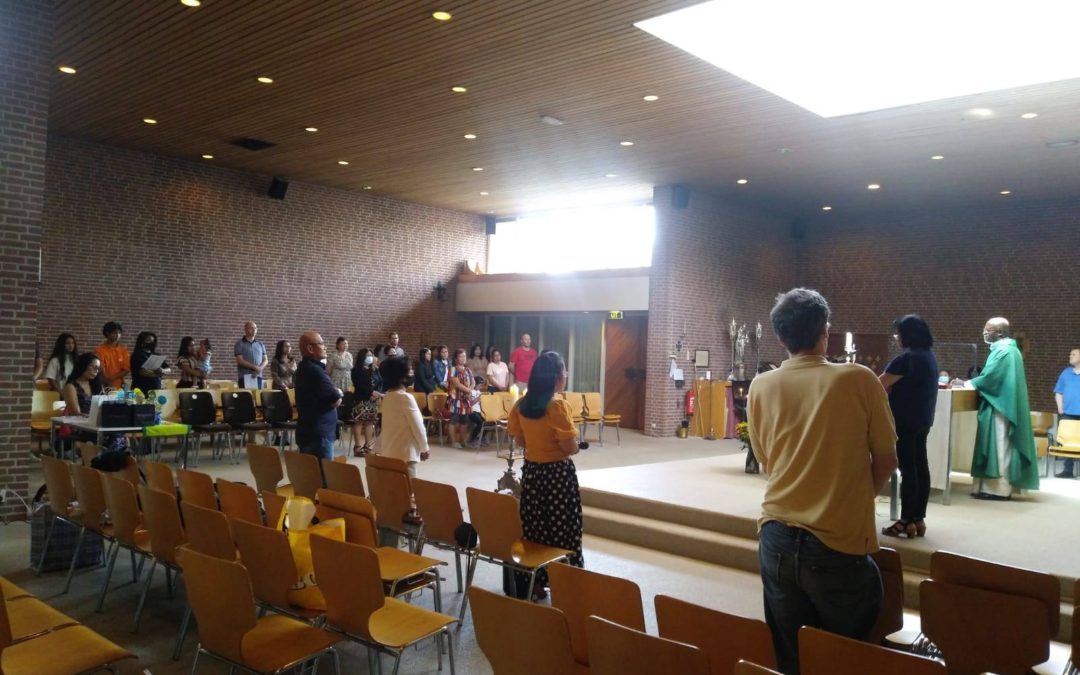
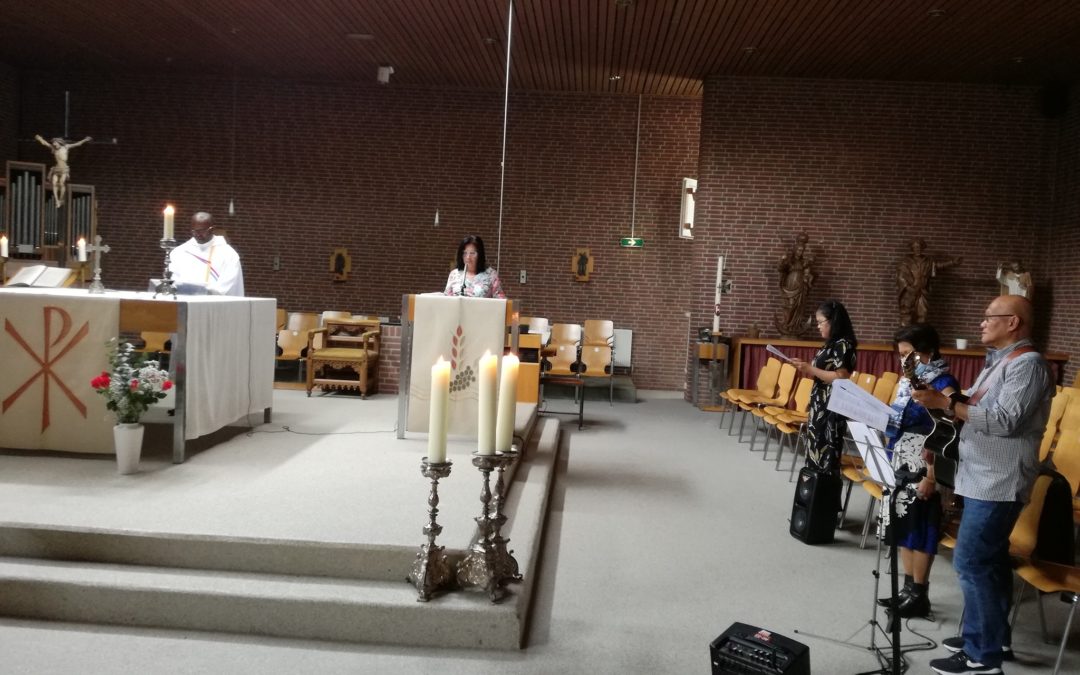
The regular 4th Sunday mass celebrated by the Filipino Catholic Community of Gouda & Surroundings is back! On July 26, 2020, the community happily celebrated the mass at OLV Hemelvaartkerk after months of COVID-19 lockdown. Every year, FCC-Gouda celebrates Family Fun Day, a social gathering of all members of the community and their families for merriment, fellowship, and communal dining. But due to COVID-19-related restrictions, this year’s Family Fun Day celebration is cut into an hour gathering with few games, just drinks, and the annual raffle draw fundraising event.
FCC-Gouda needed to raise funds and push through with the planned raffle draw despite the foreseen difficulty of selling tickets and possibility of a cancelled event. By God’s grace, the 4th Sunday mass at the church and the Family Fun Day gathering and fundraising went through successfully. Winners of the raffle draw are as follows:
GRAND PRIZE WINNERS
1st Prize (€75): Ticket # 101— Fr. Marcel Uzoigwe
2nd Prize (€50): Ticket # 384 — Eva Donaire Kroeze
3rd Prize ( €25): Ticket # 602 — Elma May Lich-Asumbrado
CONSOLATION PRIZES
- Gift Certificate (€20) Donated by Aziatisch Kleding Reparatie: Ticket # 317 — Joy Bouma
2. Gift Certificate (€15) Donated by Aziatisch Kleding Reparatie: Ticket # 842 — Norma Reyes
3. Gift Certificate (€15) Donated by Aziatisch Kleding Reparatie: Ticket # 824 — Dulce Permanes
4. Jewelry Accessories: Ticket # 850 — Christy de Jong
5. Grocery Items: Ticket # 310 — Joy Bouma
6. Grocery Items: Ticket # 103 — Fr. Marcel Uzoigwe
7. Set of Wine Glass: Ticket # 305 — Joy Bouma
8. Set and saucer: Ticket # 230 — Tess van As
SPECIAL PRIZE
Best Raffle Ticket Sellers: Marivic Adema & Susan Horn-Perez
YOU ARE ALL WINNERS! To all who supported us for this cause, from producing the raffle tickets to giving your donations for the prizes, selling the raffle tickets, buying the tickets with a cheerful heart, consolidating all sold tickets, drawing the winners, and making a financial report, THANK YOU VERY MUCH! Together, we’ve raised a total of €465!
WORDS OF THANKS FROM THE FCC-GOUDA BOARD
Dear Brothers & Sisters in Christ,
Thank you so much for your continuous support to our once-a-year celebration of Family Fun Day of the Filipino Catholic Community of Gouda and Surroundings. We are very happy to have you. Your donations have been able to help our activities & diaconal work. Your continuous support helps us build a strong foundation that fosters growth and enriches the worship life of the Christian community. You make the difference, especially in this time of crisis. Your help sustains our mission, and we are sincerely grateful for all your help and support.
Our special thanks to our volunteers and donors:
- Marivic Adema
- Myra Colis
- Elpi de Clercq
- Elpi Aziatisch Kleding Reparatie
- Susan Horn-Perez
- Mar Jane Streefland
- Amor van Os
If you have any questions regarding our work and how the proceeds will be put to use, please do not hesitate to contact us.
With much appreciation and thanks,
The FCCG Board
RECORDING ALSO AVAILABLE
July 26, 2020 4th Sunday Mass Online
Jul 12, 2020 | News & Updates
Jun 29, 2020 | Homily
By Fr. Marcel Uzoigwe, CSSp
(2 Kings 4:8-11, 14-16a; Romans 6:3-4, 8-11; Matthew 10:37-42)
Dear friends in Christ,
We often presume that others are the beneficiaries of whatever we are generous with, whereas we are actually the ones who reap from our acts of generosity. It is interesting to know that our acts of generosity serve to supply what we lack, and everyone lacks something in life, either materially or spiritually. The facts that “it is in giving that we receive” (St. Francis) and “it is more blessed to give than to receive.” (Acts. 20:35) are clearly highlighted in the readings of today. They also portray love as the driving force of generosity.
The first reading presents the wealthy but childless Shunammite couple. What makes this couple exceptional is the ability to feel the sufferings of others, shown in the initiative they took to alleviate the suffering of Elisha. They provided bed and board for Elisha each time he came across. The process was set in motion by the woman, and her husband must be a good and generous man to be open to her suggestion to furnish a little room for Elisha in their house so that he could always have a place to rest during his journey. Their generosity was matched and surpassed by God who granted them a son according to the words of Elisha: “This time next year you will be fondling a baby son” (2 Kings 4:16).
Hospitality is a form of generosity, and it is one of the greatest virtues in the Bible. The ancients believed that each person should be welcomed as though one were welcoming God himself. The virtue of hospitality is encountering the presence of God in others, usually in those whom we least expect. This reminds us of a similar story found in the eighteenth chapter of the book of Genesis, where the old man Abraham and his aged wife Sarah welcomed and entertained three strangers. But they never knew that the travelers were actually God’s messengers. And in a year, Abraham and Sarah had a baby boy whom they named Isaac. Many a time we miss to welcome God who visits us in a way we never expected Him to.
For those who know how to listen, like the Shunammite couple, they hear the voice of God inviting them to take action. Despite the attendant dangers in doing good for others—peoples incomprehension—they trust that God sees their hearts and good intentions. Such people get surprised by God. The Shunammite couple couldn’t buy a child, in spite of their wealth; but they received a gift of a son, through the prayers of the prophet. Note that when God called Elisha, he cooked his farm animals and fed his workers with the meat—his whole wealth and source of livelihood disappeared in a single day (1 Kings 19:19-21). He too was generous with his material possession, but even more in dedicating his life to God’s service with the attendant material poverty and dependency that go with it.
The gospel deals with excessive attachments which restrict our generosity and freedom to do God’s work accordingly; something that St. Ignatius of Loyola would call ‘inordinate affection’. To demonstrate to us that charity or generosity with our gifts to others is not easy, three classes of excuses we usually give for refusing to be generous are presented to us: responsibilities to our parents, children and preservation of our wealth. Against these excuses, Jesus warns that “whoever loves father or mother more than me is not worthy of me, and whoever loves son or daughter more than me is not worthy of me; and whoever does not take up his cross and follow after me is not worthy of me” (Matthew 10:37-38). By demanding that we prioritize his call to serve above every other human consideration or family ties, Jesus affirms the very principle of love as the driving force for generosity which looks beyond the individual to see God in human persons. Thus, when we are generous to a person, it is actually to God that we are generous. We see this also in the statement of Jesus concerning the last judgement, “Truly I tell you, whatever you did for one of the least of these brothers and sisters of mine, you did for me.” ( Mathew 25:40).
What goes on in our minds when we see people in difficulty or suffering? Do we simply get angry and place the blame on institutions and governments for wrong policies or do we think their situation calls us to take action? Bad policies do lead to people suffering, but it is not just the anger against institutions and governments that matter; rather, our ability to be generous towards them.
Generosity does not require a great deal of wealth, for anyone to feel dispensed from it; a cup of water to a thirsty person suffices as generosity: “And whoever gives only a cup of cold water to one of these little ones to drink because he is a disciple – amen, I say to you, he will surely not lose his reward” (Matthew 10:42). Everyone is rich enough to share something, no matter how little, with others. It is sin – especially greed and lack of faith – that prevents us from sharing with others. The solution to this sin, given in the second reading, reminds us that our sinful nature died with Christ in baptism. We must therefore consider ourselves dead to sin and alive with God in Jesus Christ (Romans 6:11). If we are still stingy and unfeeling towards people who suffer, our claim to Christianity is questionable. We must be supportive to anyone who needs what we can offer.
Generosity goes beyond material giving. The very source and origin of generosity is God himself. He made us freely in his own image and likeness and generously gave us the entire creation to manage (Gen. 2:26). After the fall of Adam and Eve that brought us death, God’s generosity gave us salvation. Thus generosity is an expression of the person of God which is love itself (1 John 4:8). In John 3:16 we read, “For God so loved the world that he gave his only Son, that whoever believes in him shall not perish but have eternal life”. It is God’s gift of His Son that enables us to be generous like Him. We can then offer our time, attention, services, resources cheerfully without grudging. It also enables us to see something good in everyone, feel their pains and seek to help them in ways we can. The greatest form of generosity is to lead the sinner and those going astray to salvation, and to be part of the salvation ministry which is the very reason Jesus emphasized on generosity given to prophets, apostles, disciples and ‘the little ones’.
Let us realize that whatever we posses in terms of time, talent and treasure as well as spiritual gifts, are freely bestowed on us by God for the purpose of serving our good and that of our neighbour, knowing that whatever good we do to others, we are ultimately doing it to God.