Jun 15, 2020 | Homily
By Fr. Marcel Uzoigwe, CSSp. (Deut. 8:2-3,14-16, Ps.147:12-20, 1Cor. 10:16-17 & Jn.6:51-58)
Dear friends in Christ,
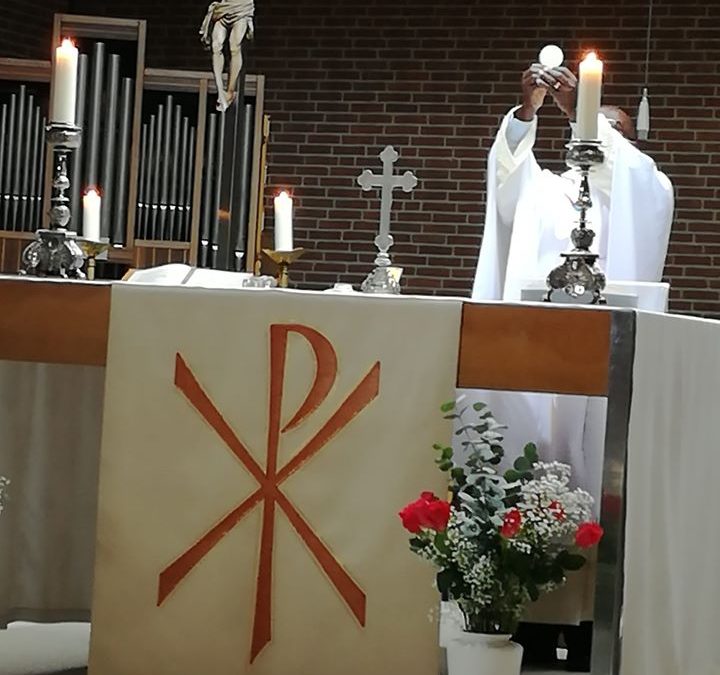
Today the Church celebrates the Solemnity of the Corpus Christi (Body and Blood of Christ) which is at the very center of Catholic spirituality. Ever since the institution of the Eucharist in the Upper Room by Jesus with the mandate “Do this in memory of me”, (Luke 22:19, 1Cor.11:24,25), the Church has in obedience gathered regularly in the name of Jesus to do and say what the Lord Jesus did and commanded at that last supper. By this establishment, Jesus really wants us to keep celebrating and living out his life and message as Eucharistic people and also to draw life from his Body and Blood which sustains us in our pilgrimage to eternal life.
The three readings of today deal with the subject of Jesus as the Bread of Life from different perspectives. In the first reading, Moses calls on the Israelites to remain faithful to God who led them through the desert for forty year, feeding them with manna, the bread of heaven. He described this bread as something uncommon and unknown to their fathers; something that God alone bestows on his people out of love, to strengthen them on their difficult journey through the desert. Moses pointed out that the event of feeding the Israelites with the manna coupled with the circumstances of their painful journey obliges them to realize that there is more to life than bread and butter. They are called to live by every word that comes from the mouth of God. In other words, they are called to obedience of faith – living by God’s commandments and standard so as to remain the people of God, pleasing to Him. Their unity as a people derives not only from their common ancestry but also from their faithfulness to God who has claimed them as His own and saddled Moses with the task of leading them out of slavery to the freedom that befits the children of God.
Paul takes up this theme with the early Corinthian Christians who were besieged with various pastoral problems. He cautioned them on the dangers of neither according the Body and Blood of Christ the dignity it commands nor living according to its demands. Sharing the one body required them to be united in love for one another, working for the good of all rather than seeking individual interests in ways that harm the community of believers. Being a Jew did not blind St. Paul from realizing Jesus as the new source of unity among the believers rather than ancestral descent. If anyone is in Christ, he is a new creation: The old has gone, the new is here (2 Cor. 5:17). He or she is a member of the new community of the people of God.
Partaking of the body of Christ implies being one with Jesus. The consequence of this event is enumerated in the earlier verses (verses 1-15) of the 1Corinthians 10 out of which today’s reading consists of only versus 16 and 17. St. Paul connects there the dangers of unworthy participation in the Eucharist with the Israelites at the time of Moses who ate the manna in an unworthy manner, and consequently died in the desert. They were, so to say, the rotten part of the body, and therefore unworthy to remain united with the rest. Paul warns us that sin makes us unworthy and has an unpleasant effect when we approach the Eucharist. We need to be prepared because we are dealing with God who is holy and almighty.
The question of true presence of Jesus in the Eucharist is the subject of the Gospel reading. In spite of Jesus’ declaration that the bread and wine are his true body and blood, this discussion has continued until this day. Down through the ages many heretics doubt and deny the real presence of Jesus in the Eucharist. For some it is impossible to be true while for others, Jesus’ real presence is limited within the time of the Eucharistic celebration but not after the celebration.
The importance of this teaching of Jesus led Pope Urban IV to establish Corpus Christi as a Feast for the universal Church in 1264 and Pope Clement V made it an obligatory feast for the universal Church at the Council of Vienna in 1311. The Church takes this teaching serious because it was Jesus who made this statement “I am the bread of life”. He didn’t stop there, he went on to say that, this bread is my flesh. So the bread you see is God whole and entire, body and blood, soul and divinity. The bread is not a pointer, but Jesus himself who continues to offer himself to us. Again, during the Last Supper, “while they were eating, Jesus took bread, and when he had given thanks, he broke it and gave it to his disciples, saying, “Take and eat; this is my body.” Then he took a cup, and when he had given thanks, he gave it to them, saying, “Drink from it, all of you. This is my blood of the covenant, which is poured out for many for the forgiveness of sins”(Matthew 26: 26-28). Searching for the very words of Jesus in the scriptures (ipsissima verba), scholars found that these were the actual words of Jesus himself. He said, “this is my body, this is my blood” and not “this represents my body, this represent my blood”. Corpus Christi Feast was, therefore, established in order to re-assure the Christian Faithful of Christ’s ever abiding real presence in the Eucharist as opposed to the heretical doubt and denial of the real presence of Jesus in the Eucharist.
In the light of our great celebration today, the big question that confronts us is, to what extent do we really believe in the Eucharistic Jesus and His ever abiding real presence, and how has the celebration of the Eucharist positively transformed us as individuals and united us as a community of faith where the life of Jesus is replicated in our dealings with one another? The early Church gives us an example of living as a community of faith. Acts 4:32 says, “all the believers were one in heart and mind.” And when problems started arising, the apostles chose men full of the Holy Spirit and wisdom to handle the situation and maintain unity among the brethren (Acts 6:1-3).
The feast of the Body and Blood of Jesus (Corpus Christi) reminds us of who we are: the people of God on a journey to our eternal home in heaven. While here on earth, we are united with God, protected and strengthened by the body and blood of Christ we celebrate. It is our responsibility to remain united with Him, helping one another with the realization that we are members of the one body, and the journey could sometimes be more difficult for one or more of our members. In this regard, let us heed to the admonition of St. Paul in Romans 15: 1-3, “we who are strong ought to bear with the failings of the weak and not to please ourselves. Each of us should please our neighbors for their good, to build them up. For even Christ did not please himself but, as it is written: ‘The insults of those who insult you have fallen on me’”.
May 25, 2020 | Homily
By Fr. Marcel Uzoigwe, CSSp. (Acts: 1, 1-11; Eph. 1, 17-23; Mt 28, 16-20 )
Dear friends in Christ,
Today we celebrate the Ascension of our Lord Jesus into heaven. The first reading details the account of the Ascension while the gospel deals more with the account of the commission of mission to the nations. The second reading places us before God to be filled with the Spirit of wisdom and knowledge without which we cannot bear true witness to Jesus.
The Ascension is an event that opens a very important dimension to the Christian faith. When Jesus rose from the death, he gave us the assurance that all who believe in him will have life beyond the physical death. By the fact of his resurrection Jesus gave a new dimension to his teaching in the house of Mary and Martha before the event of rising Lazarus from the death when he said to Martha, “I am the resurrection and the life; he who believes in Me will live even if he dies, and everyone who lives and believes in Me will never die” (John 11:25-26). From this very moment in the Gospel narrative of John, Jesus furthered his teaching on the resurrection, using every opportunity to teach his disciples that the Son of Man will suffer and be put to death, but on the third day he will rise again. The resurrection was something more than a physical event in a space-time limit as in the case of Lazarus. What resurrection really meant was not clear to the disciples at this time.
As the disciples continued to wonder about the mystery of the resurrection, Jesus introduced in John 14 the concept of his ascension into heaven saying that he would go to the Father. He wasn’t going to be in heaven alone, but he would go to prepare a place for his disciples and all who will come to believe in him so that they could be together again. This is true to the prayer of Jesus in John 17:20-21 that all those who will come to believe through the words and messages of his disciples may all be one in Him even as He is one with the Father. The ascension is an assurance of life with Jesus in heaven when the battle of life is won by being his true disciple through living according to his commandments and witnessing to him here on earth. It is the glory that God has prepared for us, to be with us forever. That is the aspiration of every believer – to be with God forever in His glory.
In today’s first reading from the acts of the Apostles, which is a somewhat continuation of Luke’s gospel narrative, we see the sequence of events up to the ascension of Jesus into heaven. While still in the presence of his disciples moments before ascending into heaven, Jesus gave them specific instructions not to go away from Jerusalem until they have received the promise of the Father, The Holy Spirit. The Holy Spirit will empower them to be his witnesses in Jerusalem, throughout Judea and Samaria, and to the ends of the Earth. The gospel account of his resurrection we read today describes the same event with greater emphasis on the commissioning of the disciples to go make disciples of all nations, ‘baptizing them in the name of the Father, and of the Son and of the Holy Spirit’ knowing that Jesus is with them till the end of the age (Matthew28: 19-20). The commissioning to witness comes from Jesus to all the baptized who in turn are empowered by the Holy Spirit, the gift of the Father.
The second reading leads us through a beautiful prayer and a sincere wish that God gives each and everyone who believes in Him (you and I) the Spirit of wisdom and revelation resulting in knowledge of Him. True knowledge of God offers us the right predisposition to grasp our position in His plan of salvation, but also to understand how richly blessed we are in Christ. It enables us to place the death, resurrection and ascension of Jesus in the right perspective so that we can understand the call His Spirit makes on us to be his witnesses in the present time. The author of the letter to the Ephesians touches on the rich position of the Christian who enjoys the backing of Jesus because Jesus wields power over all the principalities and powers. Thus, we Christians need to be bold in the face of present apathy and challenges towards witnessing to Jesus in our secular society.
Christians sometimes feel shy to speak of Jesus in public or around circle of friends, partly because they feel their lives are not completely measuring up to the Christian values. But that should not be a hindrance. While working to live the call to perfection, lets not forget what Paul said in 2 Corinthians 4: 7, “we have this treasure in jars of clay to show that this all-surpassing power is from God and not from us.” In today’s gospel, some of the disciples doubted Jesus, even in his presence (Matthew 28:17). But their doubt did not stop Jesus from commissioning them because He knows that by witnessing to something, one begins to align his or her thoughts and lifestyle towards it. The failure to witness weakens the commitment to act in line with what one witnesses to, and vice versa. In his speech to declare churches and places of worship as essential places that need to be opened, Donald Trump said something that one rarely hears from politicians, “In America, we need more prayers, not less.” Whatever one may think of this, it is a bold speech to publicly recognize the place of God. In the fight against the Covid-19 pandemic or other global challenges, there has been some tendency to think that humanity is capable of handling the situation outside of God. There is the arrogance to arrogate successes to ourselves as if we could achieve it if God was not on our side. This secular tendency often results in statements that show how far the modern man has failed to recognize the presence of God in his daily activities. When the New York governor was warning against reopening places of worship, he was bold to say, ‘the number is down because we brought the number down. God did not do that’. While unbeliever are bold to air their faithlessness, modern Christians, and even religious leaders, have become naive to speak openly about God. That is unfortunate.
The situation in which Jesus commissioned his disciples to ‘go make disciples of the nations’ was more hostile tot he gospel than that of today. It was the society that crucified their master; a society that perceived ‘the Way’, as the new teaching was called, as something very dangerous, such that it was met with heavy persecution (Acts 8:1). Yet they traveled all through the known world of their time proclaiming the gospel. We too are being commission by Jesus today, on his ascension event, to go make disciples of all the nations using the communication media available to us in the present age. That is why we celebrate the world communication day today.
Communication is not a complex word. It simply means the imparting or exchanging of information by speaking, writing, or using some other medium. Communication is vital to humans as social beings. We engage in it every now and then. Various electronic communication media in use has bridged the geographical distance between people. The present Covid-19 pandemic has shown how the electronic media, has become part of our lives. This Eucharistic celebration is possible thanks to this communication channel that makes it possible for us to be united in worship. The challenge today is to employ these communication media for purposes that promote the kingdom of God on earth. There is so much going on with the social networks, YouTube, blogs, internet channels, and even on the older media as the television and radio. How much of them promote the glory of God and the dignity of the human person? The Church calls on us to evaluate our use of them and find ways to employ them in the spreading of the gospel and promotion of the good purpose for which we are created.
Let us pray that we may be true disciples of Jesus who employ every means available to us to fulfill the mission of witnessing to him in the present life so as to ascend with him to heaven when our time here on earth is over. May God bless you and fill you with his love… Amen.
Apr 26, 2020 | Homily
By Fr. Marcel Uzoigwe
(Acts 2:14,22-33, 1Pet.1:17-21 & Lk24:13-35)
This Sunday’s Gospel deals with the encounter between Jesus and his disciples on the road to Emmaus. The disciples had embraced Jesus as the Messiah but all their hopes were dashed when he died like a common criminal on the cross. They were furthermore afraid for their own lives because the whole project for which they dared both the Jewish and Roman authorities has failed. In frustration, two of them were walking away from the city to the margins, from Jerusalem to Emmaus.
The two disciples (Cleopas and his friend) were discussing their shattered hopes because of Jesus’ death while journeying away from Jerusalem to Emmaus. Behold, all of a sudden Jesus joined to walk with them but they didn’t recognize him. Seeing their obvious despair, he asks what they are talking about. He wants to hear their version of what happened. First, they referred to him as a “prophet” in their narration as though after his tragic death, they could not see in him the Messiah they had earlier acknowledged. Then, they saw his death as the failure of his mission. They dejectedly lamented about their unmet expectations; how they had hoped that he would be the one to set Israel free. For them, freedom meant political liberation from foreign domination, not just freedom from the tyranny of sin and death.
Still unrecognized, Jesus explained to them how all of the Scripture points to him as the Messiah and how, far from being a tragedy, his suffering and death were destined unto his glory. As they reached their destination, in a gesture of hospitality, they invited the stranger in since it is nearly evening. As they sat down to the meal, Jesus the visitor, curiously started acting as the host. He took the bread, said the blessing over it, broke it and gave it to them. And in that very act their eyes opened and they recognised him.
In the experience of these two disciples, we find some elements of the Christian life. First is the tendency of believers to run away from where Christ is to be found. The present situation has given rise to so much pain that people are confused on the way out. Like these two disciples, some people are already on the road to Emmaus, questioning the existence and power of God. The road to Emmaus represents the path of people who have met with disappointments and frustrations in life; people whose world had collapsed and their hopes and dreams are shattered. There are many like that in our world today. In frustration, we usually tend to walk in the wrong direction.
Second is meeting Jesus in the unexpected place, person or situation. The Corona virus pandemic has shown us that God can be found and worshiped, not just in the churches, but also in our homes, in the streets and even on the internet. How often does this happen and we do not recognize God in the people and events around us, or worse still mistreat him? Yet, imagine how lost the two disciples would have remained had they not welcomed this stranger.
There is something interesting about the two disciples. They were ready to share, not only their pain, but also their lodging and their bread with the stranger. On the part of Jesus, he was willing to listen, without interruption, to the sorrows of those young men. The ability to listen is a great quality. It gives the sense of worth, being loved and hope to the one in distress. We have seen a number of video clips of people who committed suicide these past few weeks as a consequence of the corona virus loses. Should there have been good and caring listeners around them, and were they willing to share their stories with these listeners, maybe they would still be living. Unfortunately, people often refuse to share their sorrows for fear of betrayal, or for lack of empathic listeners.
Further on the meeting with these disciples on the way to Emmaus, Jesus first spoke his healing words to them before the breaking of the bread. By this Jesus gave two gifts to these disciples; the gift of understanding the significance of the Word of God and the gift of the Holy Eucharist. The disciples did not recognize the Risen Lord until he had broken the bread with them.
How often do we fail to pay attention to the Lord when he speaks to our hearts and opens his mind to us in the Scriptures? The Risen Lord is ever ready to speak his Word to us and to give us understanding especially in our moments of crisis and confusion. We need to listen attentively to his Word and allow it to change and transform us. Let us make time to allow him speak to our troubled hearts especially at this period of providential quarantine, by engaging in daily Scripture reading.
Do we also recognize the Risen Lord at our Eucharistic celebration? It is the same Lord who speaks to us through the Scriptures that gives us himself in the Eucharist. The two disciples did confess that their hearts were on fire when Jesus explains the Scriptures to them on the way, but they recognized him in the breaking of the bread. This informs the pattern of the Church’s Eucharistic celebration. Firstly, allowing the Lord to speak to our hearts through the Scripture readings which then prepares us to recognize and meet Him in the Holy Eucharist. In other words, listening to his Word first helps to set our hearts on fire and prepares us to receive the Eucharist which is the fullness of Jesus divinity.
It is important to note that as soon as the two disciples recognized the Risen Jesus at the breaking of Bread, they immediately set out to return to Jerusalem, seven miles away (not minding that it was getting dark already as they had earlier expressed, Lk.24:29). It didn’t seem for them so dark and full of danger any longer. What a wonderful sense of urgency! They couldn’t wait till the safety of daylight the next day. The journey back to Jerusalem to share their experience with others had to be done immediately. This is what the power of experiencing the Risen Lord can do in the life of a fervent Christian.
As we also hear the Scriptures explained to us and receive the Holy Eucharist daily, Let us act with the same sense of urgency to convey and share the Good News to others who are in dare need of knowing and recognizing the Risen Lord in their lives. May the Lord who journeys with us daily to revive our broken hearts and drooping faith with his Word and the Eucharist also make us his fervent witnesses. On our own part, may we give Him the first place in our lives and allow his principles and values to determine our daily decisions and life choices. Amen.

Apr 12, 2020 | Homily
Easter Sunday Homily by Fr. Marcel Uzoigwe
(Acts 10:34,37-43, Col.3:1-4 & Jn 20:1-9)
Today we joyfully celebrate the resurrection of Our Lord Jesus Christ. It was all dark for the disciples of Jesus on Good Friday when they watched their master being put to death and buried. Their experience got no better as the day dawned on Saturday with Jesus still in the tomb. But “on the first day of the week” something different happened. Their darkness was turned to light and their sorrows melted away. Fear disappeared as courage took the stage. Sin and death were conquered by righteousness and life.
As today’s gospel reading relates, very early in the morning of the first day of the week, Mary Magdalen went to the tomb to perform the burial rituals that could not be properly done earlier because of the Sabbath preparations. Certainly, Mary Magdalen wasn’t going to the tomb to see the Risen Lord but to anoint the body of Jesus whom she so much loved for changing her life for good. There is something about Mary’s action that is touching. Her encounter with Jesus that transformed her life has resulted to such a great love for Jesus that she remained united with him even in death. It is common for people to abandon their friends in difficulty. But Mary Magdalen’s first thought in the morning was Jesus in the tomb. By so doing, she became the first to encounter the risen Lord Jesus. While her first encounter with Jesus brought a transformation from being a dejected sinner to being a beloved follower of Jesus, the second encounter with the risen Lord made her the first witness to the power of the resurrection.
The story of the resurrection is, therefore, a story of encounter – the concept of being born-again. To be touched by Christ, like Mary Magdalen was, is to be resurrected. The ability to say, I used to be this kind of sinner/person or the other, but not any more, is the story of the resurrection. Not just observing the empty tomb, but walking away from it as a Christian is the issue at stake. Even the disciples of Jesus needed conversion to the reality of the resurrection. Easter is therefore a great event because, in Christ, and because of his death and resurrection, a new dawn of grace has arrived. Christ’s resurrection ushers in the divine power that dispels the darkness of sin and death, and gives way to the light of Christ, the Rising Sun of God bringing happiness and forgiveness to our lives. The power of the resurrection opens the door for a new evangelization. It is an evangelization by the testimony of repentant and forgiven sinners to the power of love, the forgiveness of sins in Jesus Christ. With the resurrection of Christ, every sinner has a hope of a share in the resurrection of Jesus Christ. Yes, the hope of a life beyond the grave finds its concretization in the resurrection of Jesus Christ.
Mary Magdalene prepares the way for our first reading today, she convinces us that the power of the resurrection is present in every encounter with Jesus. Anyone who encounters Jesus in His word and embraces the teaching is destined for the resurrection/immortality: “Very truly I tell you, whoever hears my word and believes him who sent me has eternal life and will not be judged but has crossed over from death to life” (John 5:24). These two-fold encounters (what Jesus did while physically present, and what he does today through the power in His word) are evident in the speach of Peter in the house of Cornelius.
In his speech (our first reading), Peter takes his listeners down memory lane, in order to prove the power in the encounter people had with Jesus: “You know what has happened all over Judea, beginning in Galilee after the baptism that John preached, how God anointed Jesus of Nazareth with the Holy Spirit and power. He went about doing good and healing all those oppressed by the devil for God was with him” (Acts 10:37-38). It was important for Peter to link the person of Jesus with the effect of his encounter with the people during his time on earth for Cornelius to understand the experience that made him send for Peter. That served as a step for Cornelius and his household to understand the mystery of Jesus’s death and resurrection that Peter was going to explain. As humans, we meet with several people every now and then. But only experiences of special encounters linger on in our memories. These experinces enable us to know something about the person beyond what is readily observeable. Being touched by the word of God enables us to seek to know more of Jesus and the power of His resurrection, like Paul desired in Phil. 3:10.
Our second reading provides us with an index to measure whether we have resurrected: “If then you have been raised with Christ, seek the things that are above, where Christ is, seated at the right hand of God. Set your minds on things that are above, not on things that are on earth” (Colossians 3:1-2). There is one fundamental reason for this new lifestyle because “For you have died, and your life is hidden with Christ in God”. That implies that mundane concerns should give way to Christlike attitudes. By living the love of Jesus and making it felt by those around us, we proclaim Him alive. Each time we let go of our selfish interests to be of service to others, we become the embodiment of the risen Lord in their midst. Helping others in difficulty, especially during this Corona pandemic period is replicating Jesus’s life in the world of today. The unfortunate situation of the Corona virus has forced us to realize how unimportant some of the things that consume our time and efforts are. We now realize the most important things in life which are life and love. And these are the very things that Jesus offers us in His resurrection: the power to live and to love.
As a people who have encountered the love and mercy of God in the risen Lord, this is our chance to bear testimony to that love. Being freed from the power of sin and death, we have been granted life, justification and grace. Above all, we are now entrusted with the mission of bearing witness to the good news of salvation to others. You and I who celebrate the Risen Lord have been made missionaries and preachers of God’s offer of forgiveness, love and life. That is the Easter gift to us. May His resurrection open new channels of love and service in His name, and may we enjoy the fullness of Life in His presence (John 10:10). Amen.
(Featured photo credit: Jonathan Petersson)
Mar 13, 2020 | News & Updates
Dear Brothers and Sisters,
The Board of the Filipino Catholic Community of Gouda & Surroundings decided to cancel the mass this coming March 22. We continue to monitor the changing conditions related to COVID-19. Of any changes we will keep you informed and updated regarding our church services and activities.
We encourage members to pray and reflect this Lenten season, to continuously care and help one another, and to keep protecting yourself and others from any harm. We are all God’s sons and daughters. Rest assured that the love of Jesus is with us during this challenging and difficult times. Meanwhile, let Psalm 91 comfort and bring you peace amidst the ongoing pandemic we are in at the moment.
PSALM 91
1 Whoever dwells in the shelter of the Most High
will rest in the shadow of the Almighty.
2 I will say of the Lord, “He is my refuge and my fortress,
my God, in whom I trust.”
3 Surely he will save you
from the fowler’s snare
and from the deadly pestilence.
4 He will cover you with his feathers,
and under his wings you will find refuge;
his faithfulness will be your shield and rampart.
5 You will not fear the terror of night,
nor the arrow that flies by day,
6 nor the pestilence that stalks in the darkness,
nor the plague that destroys at midday.
7 A thousand may fall at your side,
ten thousand at your right hand,
but it will not come near you.
8 You will only observe with your eyes
and see the punishment of the wicked.
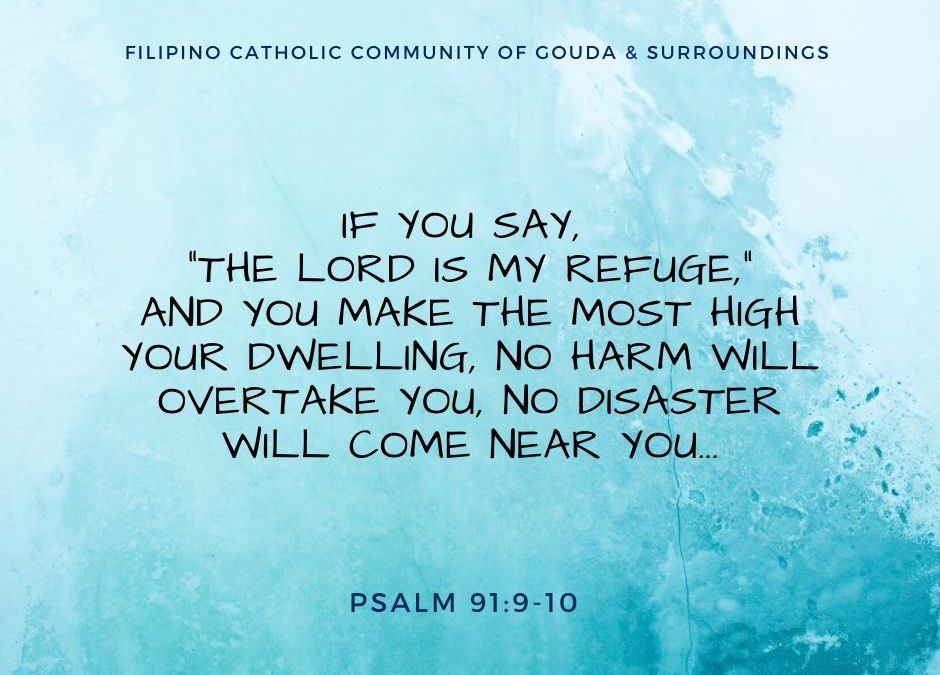
9 If you say, “The Lord is my refuge,”
and you make the Most High your dwelling,
10 no harm will overtake you,
no disaster will come near your tent.
11 For he will command his angels concerning you
to guard you in all your ways;
12 they will lift you up in their hands,
so that you will not strike your foot against a stone.
13 You will tread on the lion and the cobra;
you will trample the great lion and the serpent.
14 “Because he loves me,” says the Lord, “I will rescue him;
I will protect him, for he acknowledges my name.
15 He will call on me, and I will answer him;
I will be with him in trouble,
I will deliver him and honor him.
16 With long life I will satisfy him
and show him my salvation.”
Please be guided accordingly and stay informed by monitoring recent updates and developments via the website of the Dutch National Institute for Public Health and the Environment (RIVM): Updates on novel corona virus (COVID-19).
Sincerely yours,
The FCC-Gouda Board