Responsible in presiding meetings and ensure smooth and harmonious relationship among church members.
Coordinates with other FCC Chapters in Rotterdam, Dordrecht and Tilburg for any related church activities/information.
Overall coordinator for church activities and communications with the Dutch Catholic Community at OLV Hemelvaartkerk, Gouda.
Represents FCCGouda in all dealings outside the church.
Safe keeper of the church key and church building during Sunday service.
Vice Chairman/Vice President
Assists the president in planning, implementing church activities and initiatives.
Assumes all responsibilities of the Chairman/President in his/her absence.
Secretary
Facilitates communications among officers and church members.
Keep minutes of meetings and general record keeping, including reports from the treasurer.
Maintain an up-to-date records of church members, officers and contact list.
Send out event invitations to church members.
Treasurer
Records all financial transactions.
Writes monthly/quarterly/annual reports.
Oversees collection of donations, church offertory and contributions for monthly coffee/tea.
Gives financial status report during regular Board Meetings.
Auditor
Examines and analyses accounting nrecords to detect any duplicated effort, non-Compliance with relevant policies, deficiency or fraud.
Assists the treasurer in handling financial matters and counterchecks the report of the treasurer.
Liturgical Coordinator
Responsible for preparing and printing of liturgical materials every month.
Ensures that someone is assigned for liturgical readings.
Assigns people for church collection.
Coordinates with the priest and assigned readers to ensure proper orientation.
Event/Program Coordinator
Overall responsible in the organization of events of the church including the preparation and maintenance of things at the event venue and acoustic/music provisions.
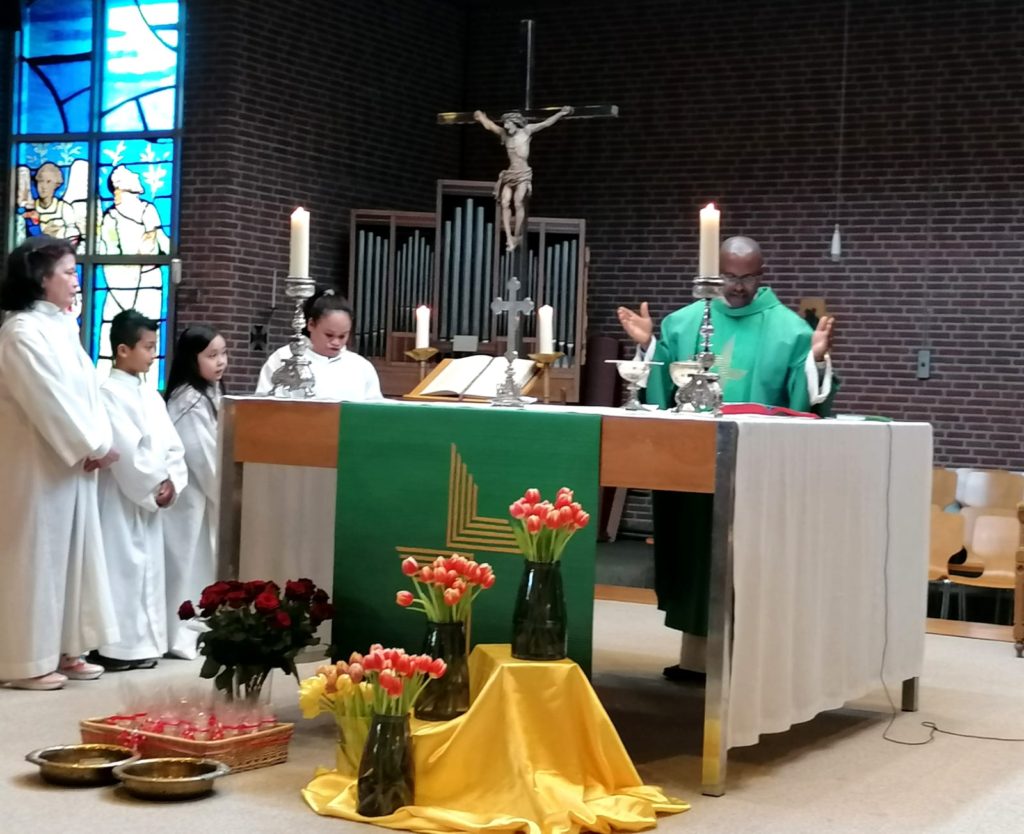
This month’s theme during the 4th Sunday mass of FCC-Gouda is all about love, a four-letter word that also means four different kinds of love. Ancient philosophy categorizes these kinds of love into four: the romantic or intimate love (eros), the brotherly/sisterly or friendly love (philia), the unconditional or Godly love (agape), and the affectionate or familial love (storge). Interestingly, these classic four were revered to and celebrated by members of the Filipino Catholic Community of Gouda & Surroundings who came for today’s service despite the bad weather.
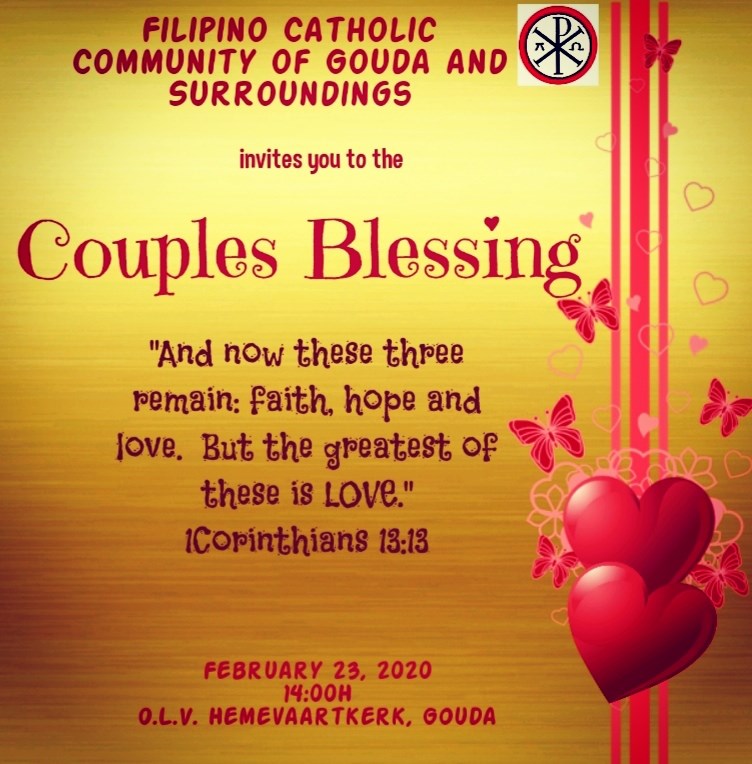
Couple’s Blessings
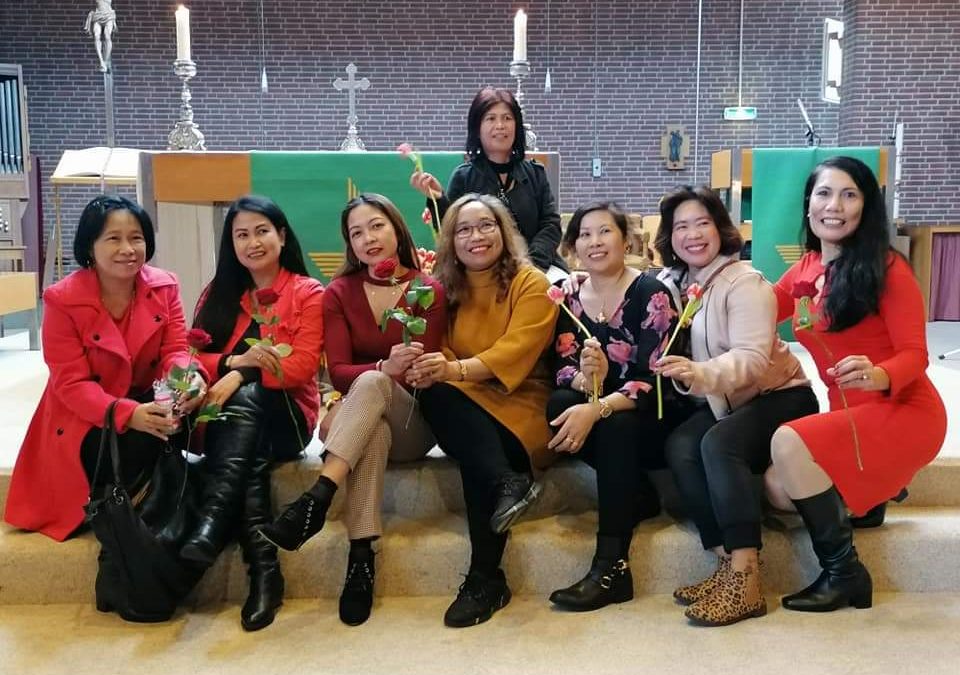
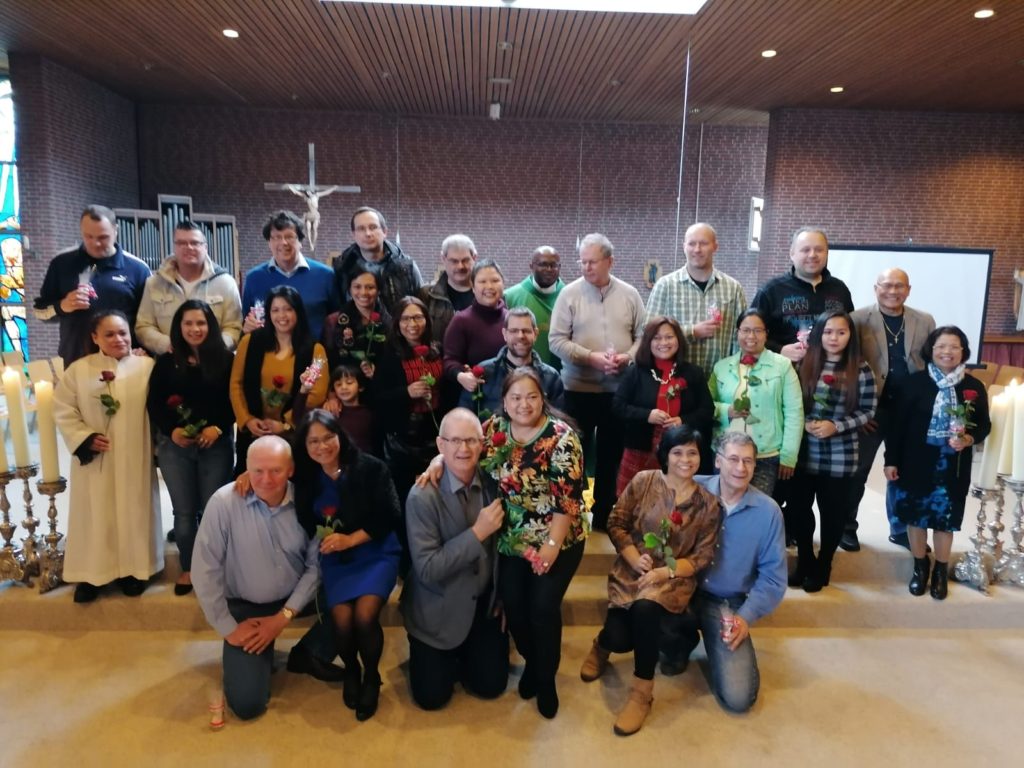
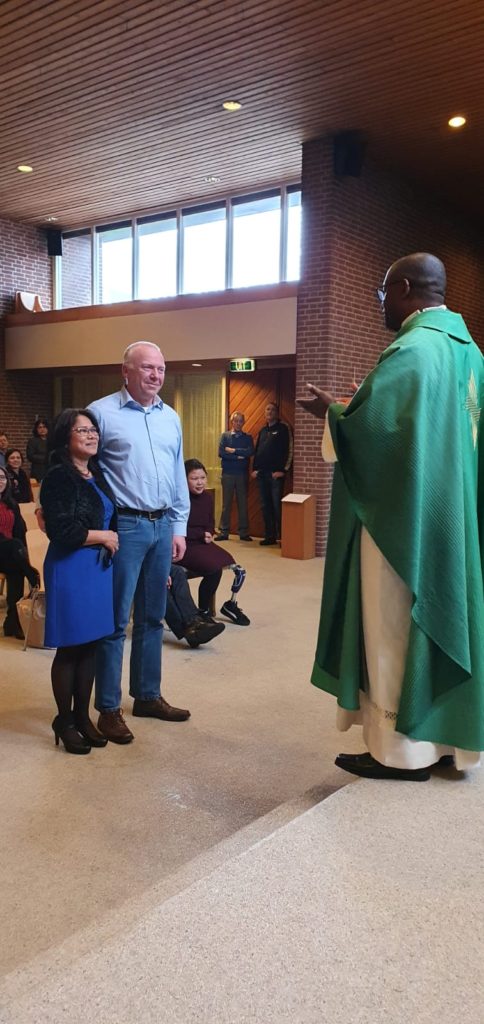
It was just a week past when many lovers and couples celebrated Valentine’s Day. The sweetness and warmth of this February 14 lingered on as Fr. Marcel called for all couples to come forward for prayers of blessings and years of happy and harmonious marriages with the Lord God as center of the couple’s relationships. The leaders of the church prepared roses for the women and nicely crafted jars (made by Jenny Luna) for the men.
Specially mentioned of all the couples were Henk and Marietta Boswinkel whose years of togetherness as husband and wife have just turned 32 this month of February! Seeing a couple reaching this far with their pledged love still shining bright from within has certainly brought inspiration not only to the couples present but to all who were there to witness the couple’s blessing ceremony (and picture taking).
Children’s Bible Corner
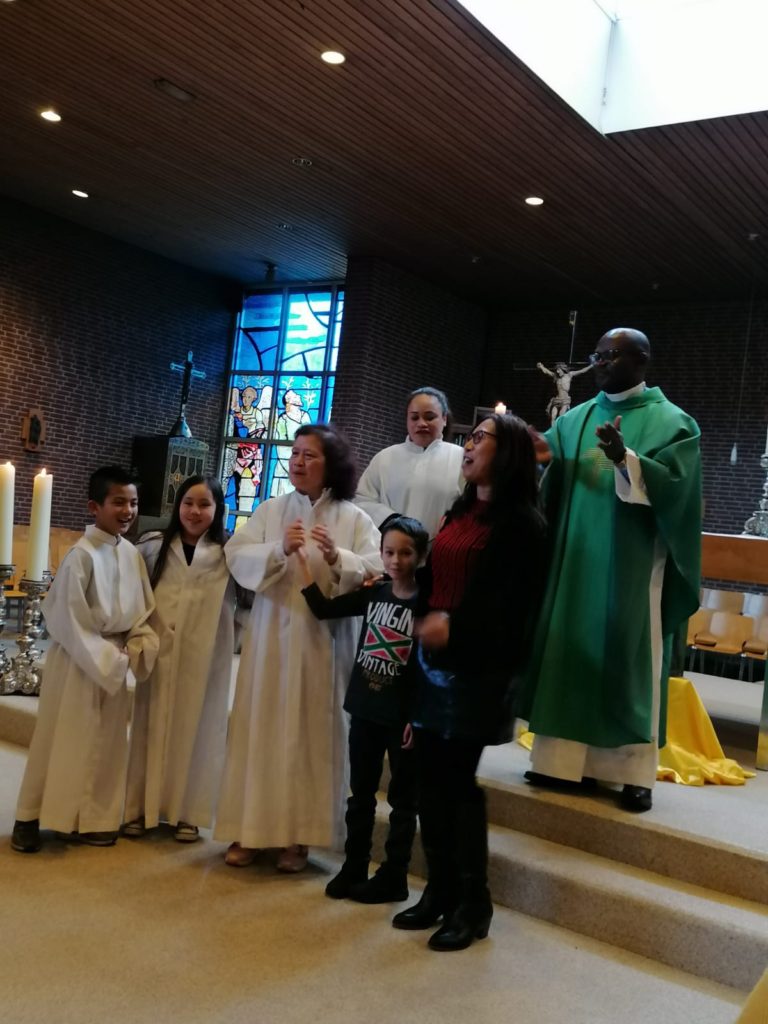
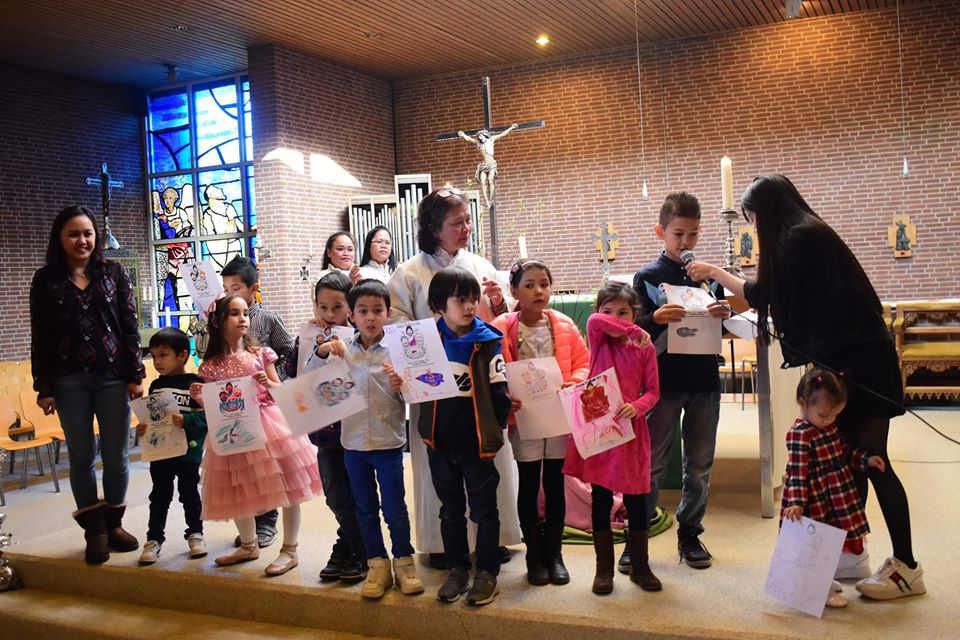
The theme of love continued from the service in the main hall to the children’s corner in the other room. When asked what love is, the children responded with words like “being nice to others”, “being friendly at school”, “giving a hug”, and “caring”. And they are absolutely right. They have just described philia, that friendly, brotherly or sisterly kind of love. Interestingly, when asked whom do they love, their answers covered all the four kinds of love as each one answered with the words “mother”, “father”, “oma and opa”, “girlfriend”, “my best friend”, and “God the Father, Jesus, and the Holy Spirit”. But when asked whether or not to also love that bully at school or that someone who is not treating someone nicely, the children unanimously shouted “NO”. And this is where John 13:34 was taught to the kids as Jesus told his disciples His new commandment, “Love one another. As I have loved you, so you may love one another.” The children understood that loving one another also means loving even those who are not nice to us by simply praying for them to become better persons.
Preaching of God’s Word
If the children got the simplified version of speaking about God’s love, then the adults at the main hall received a more in-depth preaching about what love is. In Fr. Marcel’s homily, he spoke of the nature of our Loving Father, who spoke of us as His children. What then does it mean to be children of the Most High? God’s love is unconditional, and if we are God’s children, could we also love unconditionally like our Loving Father does? Are we indeed able to love our enemies or the mean people around us? Did you also know that you are the temple of God, and that the Spirit of God dwells in you? These questions were answered during the preaching of God’s Word and you can also find the full transcript of the homily by clicking here.
“Our homily today may sound idealistic, impossible and fantastic. But it is not. Take the example of a normal human behavior. When a person is interested in doing something or in achieving a goal, he/she can spend a lot of time and energy on it, without any external coercion or obligation. Think of football fans. They could stay in the cold winter rain to cheer their club during a football match. At such time, they would be so focused on the game that one may wonder if it is really cold outside. When we want to become like God our Father, our minds would be only focused on how to achieve our objective. In like manner, we abandon sin and do not remember to commit sin because all our energy is dedicated to becoming like God. Here is where we experience and feel the power of love. When we love, there is no obligation, we find an inner motivation to crave for what we love.” ~an excerpt from Fr. Marcel Uzoigwe’s homily
Family Fellowship
As usual, the church service is always followed by a family fellowship where all attendees of the day’s service could stay for a cup of coffee or tea coupled with some snacks (typically home-made Filipino snacks or dish) that were lovingly prepared and brought by some generous members of the church to share with the community. This tradition of sharing meals or simply spending extra hour to sit down and catch up with everyone has all the more enhanced this time of fellowship as children of God and, therefore, as one big family. Part of this fellowship time is also the communal celebration of the birthday celebrants of the month. For those celebrating their birthdays in February, those who were present to receive blessings and prayers were Elpi, Irene and Dirk!
By Fr. Marcel Uzoigwe. Leviticus 19:1-2, 17-18; 1 Corinthians 3:16-23; Matthew 5:38-48
Children always have something of their parents. They are actually part of their parents in many ways, though they can develop differently due to nurture. Nature and nurture play vital role in the development of every individual. By nature we acquire the attributes of a certain generic identity such as the fact of being human and not animals like dogs or chicken. And by nurture we acquire characters and habits that define the kind of human being we become. The readings of today points out our true identity and how we can develop and become true to that identity.
It is amazing that it was written in Psalm 82:6 that we are Gods. The gospel of John 10:34 also talks about it, and today, in our second reading, St. Paul confirms it—“You are Gods, all of you, children of the Most High” (Psalm 82:6). If you think that Jesus is demanding the impossible by commanding us to offer no resistance to those who hurt us, but instead to love our enemies and pray for those that persecute us, you are very much mistaken. You are only looking at it from a purely human perspective without regard to your real identity. From a purely human perspective, it might seem as if being a Christian is the same as being a weakling, victim, timid, coward, etc. But reflecting deeper on it, you could find out that it is about mastery and power which takes a lot of time and character to build. It is very easy to mess things up, very easy to hurt or wound people. Where the difficulty lies is in building up, healing and restoring what is destroyed. Our power as Christians lies in what we can build, heal, develop, construct, restore, improve, reconcile, salvage, nurture, unite, and not what we can destroy or mess up. That is the difference between love and hate. Since God our Father is Love, we His children cannot be children of hate but of love. Thus, the command is based on Jesus’ understanding of who you and I are: we are Gods. As such, we should behave like God, not just like human beings—simple mortals. Our nature and status has been elevated, our citizenship transformed from earthly to heavenly. Philippians 3:20 notes that we are citizens of heaven. But do we realize it?
Fr. Anthony de Mello told a story about a hunter, who went into the forest to hunt. He came upon an eagle’s nest with eggs in it. The hunter picked the eggs and brought them home. He gave the eggs to his wife, who mixed them up with the eggs of an incubating hen. The unsuspecting hen hatched, what she thought were all her eggs, unknowing that she had both chicks and eaglets. One day, the brooding free-range hen was pasturing her chicks around the compound, when one of her chicks that was actually an eaglet, noticing some creatures like itself flying in the sky, said to the hen: “mom, look up, who are these guys flying up there?” The hen said to the supposed chick, “you belong down here, they belong up there, you just follow me!” The poor eaglet lived its life believing it was a hen, even though it was an eagle, for lack of knowledge. What a pity!
Yes, each and everyone of us need to think seriously about this. Reclaim your identity and dignity. You are more that just your body and mind – an earthly creature. If you don’t believe it, listen to our first reading: “Speak to the whole Israelite community and tell them: Be holy, for I, the Lord, your God, am holy” (Leviticus 19:1). God compares you and I to himself, no more no less! Are you still in doubt? Listen to Paul, in our second reading: “Do you not know that you are the temple of God, and that the Spirit of God dwells in you? If anyone destroys God’s temple, God will destroy that person; for the temple of God, which you are, is holy” (I Corinthians 3:16-17). What other proof do you need to know that your identity derives from that of our Father who is called God? Otherwise He would would not require us to be like Him, for that would be demanding the impossible.
You know what? Holiness is what you and I are called to, not just the avoidance of sin. Don’t get me wrong, you need to avoid sin, certainly, but you will find yourself committing sin, if your plan is only to avoid sin. On the contrary, seek “holiness”! What is the difference? “Holiness” is becoming who you are, claiming your identity as a child of God. Thus, for Jesus, we must not only avoid returning evil for evil, but we must seek the good of those who wish us ill. That is the nature of our Father who makes his sun rise on the bad and the good and causes his rain to fall on the just and the unjust. Since our Father loves without boundary, we are expected to do the same. Listen to the gospel say the same thing: “be children of your heavenly Father . . . be perfect, just as your heavenly Father is perfect” (Matthew 5:48). So, the imitation of God is what holiness means, and that is the meaning of “you are Gods”.
Our homily today may sound idealistic, impossible and fantastic. But it is not. Take the example of a normal human behaviour. When a person is interested in doing something or in archieving a goal, he/she can spend a lot of time and energy on it, without any external coercion or obligation. Think of football fans. They could stay in the cold winter rain to cheer their club during a football match. At such time, they would be so focused on the game that one may wonder if it is really cold outside. When we want to become like God our Father, our minds would be only focused on how to achieve our objective. In like manner, we abandon sin and do not remember to commit sin because all our energy is dedicated to becoming like God. Here is where we experience and feel the power of love. When we love, there is no obligation, we find an inner motivation to crave for what we love.
Dear friends, becoming like God makes us realize that there is only one commandment—Love: “You shall love your neighbor as yourself. I am the Lord” (Leviticus 19:18), says our first reading. Through love, then, we realize that our neighbor is our brother/sister and fellow citizen. The thoughts of harming others disappear. The old law, “You have heard that it was said, You shall love your neighbor and hate your enemy” disappears because the urge for revenge which is strictly human will no longer have absolute control over us. Then we can wish them well and hope they become better: we pray for them.
Our gospel reading gives us simple rules through which we know our citizenship—heavenly or earthly: “love your enemies and pray for those who persecute you . . . For if you love those who love you, what recompense will you have? Do not the tax collectors do the same? And if you greet your brothers only, what is unusual about that?” If you’re still struggling with the forgiveness and love of your enemies, if you cannot pray for your enemies, when your love is partial, then your citizenship of heaven and identity as “god” is still very much in question.
This Sunday provides us with the knowledge that will help us to fly like the eagles that we are, not subdued and cowed down like the chickens we are told that we are—powerless sinners. Our world keeps telling us the bad story of what we do wrong, how it is “human to err,” without the encouragement that all is possible with God. Yet, the power of knowledge is the change it brings, the audacity it inspires and the challenge kindles in people. The choice is ours to make, either to listen to the untruth that celebrates our sins and human weakness or the determination to maximize the divine that is already in us. It is for everyone to make this choice individually. Indeed, “You are gods”. Reclaim your identity as a child of your loving father, and live in the boundless love that is meant for you.
(Isaiah 8: 23-9:3; 1Corinthians 1:10-13, 17; Matthew 4:12-23)
The readings of today remind us that we are children of the Light. In the light of this theme, I wish to highlight three important points that form the liturgy of this third Sunday in the ordinary time.
The first point is that Pope Francis has declared the third Sunday in Ordinary Time a special day for the Word of God. This is simply to emphasize the importance of focusing on the Word of God as a guide for Christian life. The Psalmist says “Your word is a lamp for my feet and a light on my path” (Psalm 119:105). Part of the Pope’s declaration reads, “Consequently, I hereby declare that the Third Sunday in Ordinary Time is to be devoted to the celebration, study and dissemination of the word of God”. He noted that the word of God brings us close tot he Jewish people and calls for unity and world peace.
The reading of the Scripture used to be a regular event in families. Children were taught to lead in prayers and reflections at home. So it was in my family. We had to read the assigned portion and give reflection. In that way we grew in the appreciation of the Word of God. Today, the center of preoccupation is the smartphone and television. Children and adults spend time navigating channels, apps and social media. There is even little time to communicate among partners and with children. Two people sitting in the same room, each busy with someone far away on the social media and nothing happening among them. If we don’t have time for one another, how can we have time for the word of God? Thus, the Pope wishes to draw our attention back to the very Word that is Life and Light.
The second point is the very fact that we are called to be the Light wherever we are. In the first reading of this Sunday, the prophet Isaiah recalls an historical event recorded in 2Kings 15:27-27, where in the past, the Lord afflicted the land of Zebulun and Naphtali, the Northern Kingdom of Israel around 732 BC owing to the people’s gross disobedience and worship of foreign gods. The Lord allowed their enemies, the Assyrians to destroy everything and carried the inhabitants into exile and the pagan nations then settled in the conquered territories. That was a moment of darkness for them.
In today’s Gospel reading, therefore, St Matthew the evangelist makes a link tot his event, seeing in it the fulfillment of God’s plan to liberate his people through the coming of Jesus. After after his baptism and his forty days in the desert, Jesus began is ministry. Seeing that John the Baptist, his forerunner, was arrested and put into prison, He went and settled in Capernaum, a lakeside town bordering Zebulun and Naphtali. The gospel refers to this action as the fulfillment of the prophecy of Isaiah: ‘Land of Zebulun! Land of Naphtali! Way of the sea on the far side of Jordan, Galilee of the nations! The people that lived in darkness has seen a great light; on those who dwell in the land and shadow of death a light has dawned.’ Indeed, Jesus’ mission is to bring a total liberation to all who live in the of darkness of error and sin.
Both readings (the first reading and the gospel) of today talk about those who walked in darkness seeing a great light. Darkness brings fear, uncertainty, confusion, failure, doubts, worry, etc. Darkness is related to shadow and valley. Shadow and valley are related to depression, despair, death, chains, bondage, pit, forsaken, gloom, decay, etc. When light comes, these negative forces are driven away. Light brings celebration, joy, energy, life, optimism, certainty, enthusiasm, growth, progress and confidence.
During the baptism of Collin, we gave a lighted candle to the Godparents as a symbol of the light of Jesus that must be guarded for him. Parents and Godparents were told to ensure that he grows up in a positive environment with love and respect for people around him. He has to grow in this light and be a light to his generation. In the same way we are called to be the light of Christ to our generation – people around us. We are invited to bring something positive and liberate to those undergoing difficult situations, friends in the dark moments or situations of their lives. Our presence should offer solutions and show a way out, at least to some extend; and not complicate their situation.
As we grow in faith we develop stronger inner light, the light that is the presence of Christ in us, in such a way that it becomes the source of our inner strength and the compass that directs our thoughts, words and actions.. This light determines almost everything about us; it determines our level of joy and happiness, our ability to survive crises, disappointment, losses, heart breaks, sickness, bad news, anxieties, etc. We all need this inner light, inner power, positive energy, tough optimism.
The third point can be found in the second part of the gospel reading where Jesus calls the disciples. It is the call to collaborative ministry. The very first thing that Jesus did before beginning his ministry was to call those who were to be with him (John 1: 35-40). We often think that we know it all and can do it alone. Jesus did not do the work alone. He got collaborators. And those called left everything to follow him: commitment. Peter and Andrew, James and John were all called and they dropped everything and followed Jesus. They weren’t extra-ordinary class of people but rather, common everyday people, fishermen. Nevertheless, they were prettily extra-ordinary in their attitude and their willingness to leave everything to follow Jesus.
A true follower of Jesus, would always willingly set aside his/her plans and respond to God’s plan for him/her. We might not necessarily leave fishing boats, torn nets and even parents as the apostles did in their days, but we are called to leave behind those part of ourselves which hinder us from answering the call that God makes to us; those things that keep us away from making our gifts and talents available to serve our community. Reflect today, and ask yourself what you have to drop in your life in order to follow the Lord more lovingly and faithfully. Give God the first place in your life and allow his principles to determine your decisions and life choices.