Since February 2025, Monsignor Jan Thomas Limchua of Cebu has been the charge d’affaires at the Apostolic Nunciature on Carnegielaan 5 in Den Haag. The Apostolic Nunciature serves as the Vatican’s Embassy in the Netherlands. In recent months, Monsignor Limchua has been getting acquainted with the Catholic communities in the Randstad by saying Mass for the FCC Rotterdam and FCC Dordrecht.
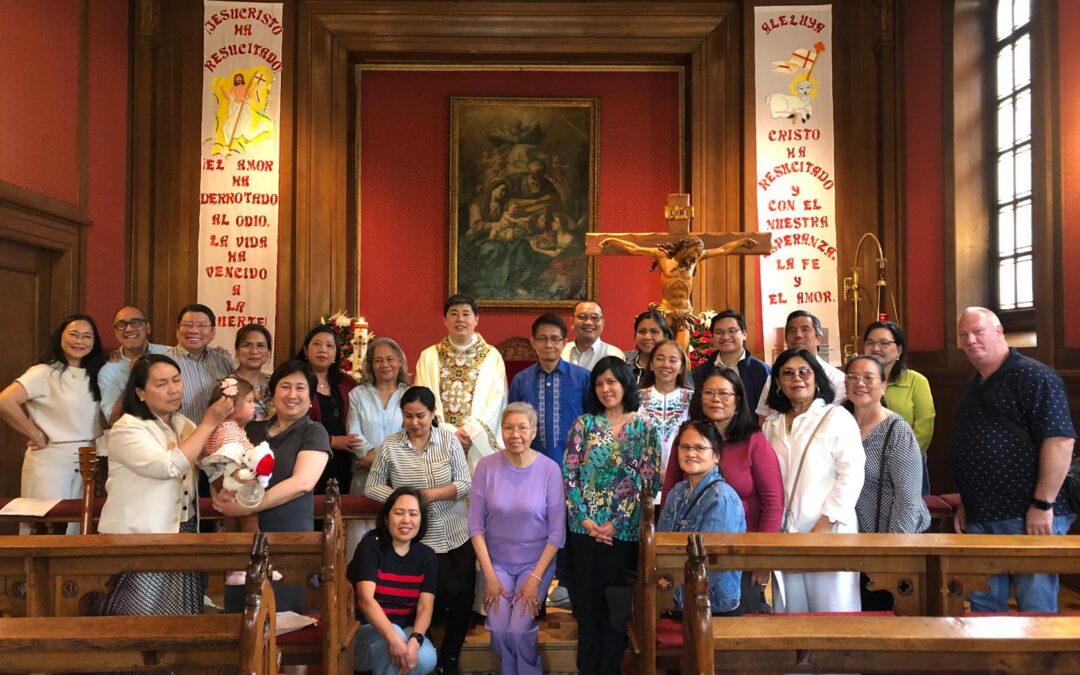
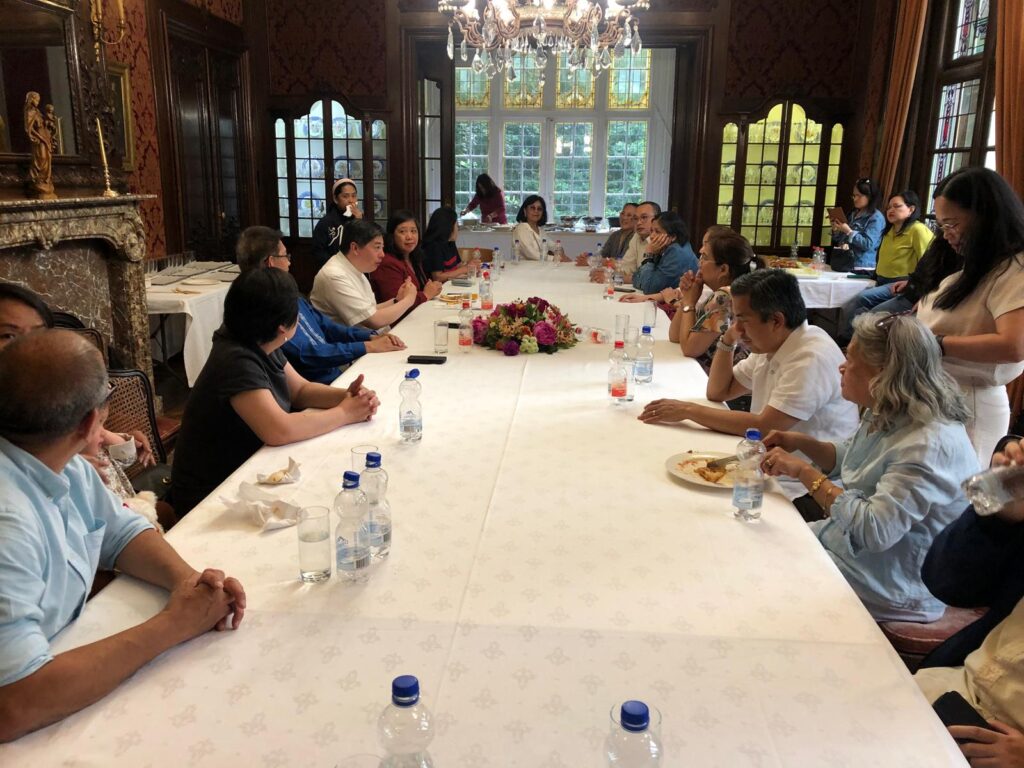
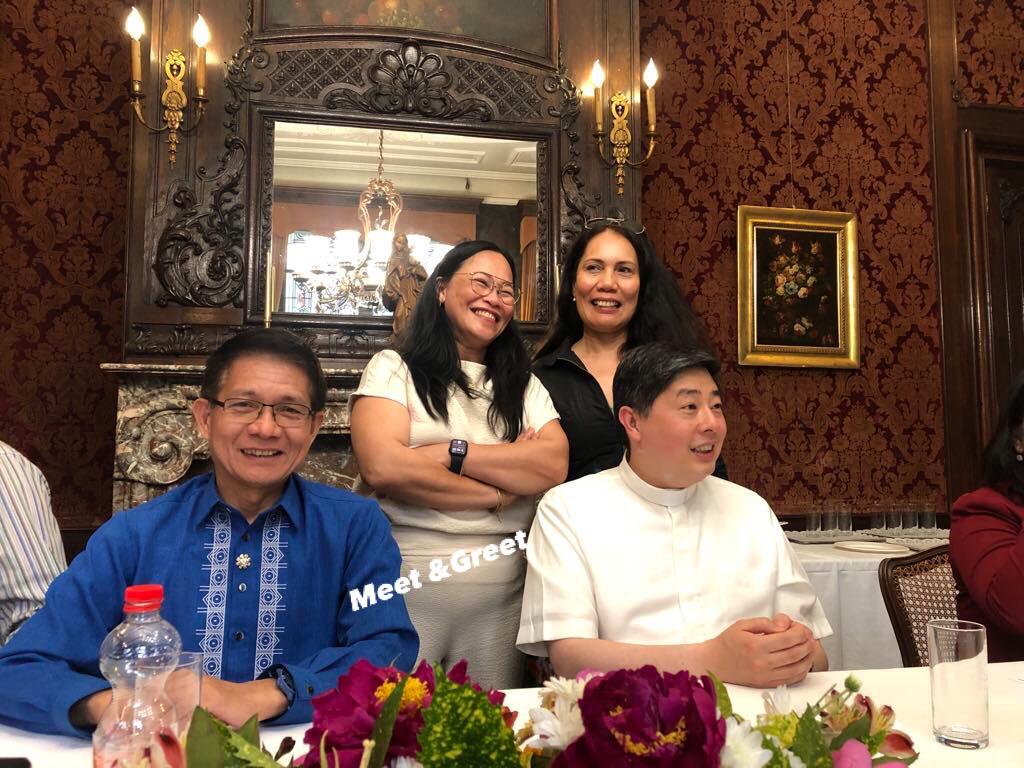
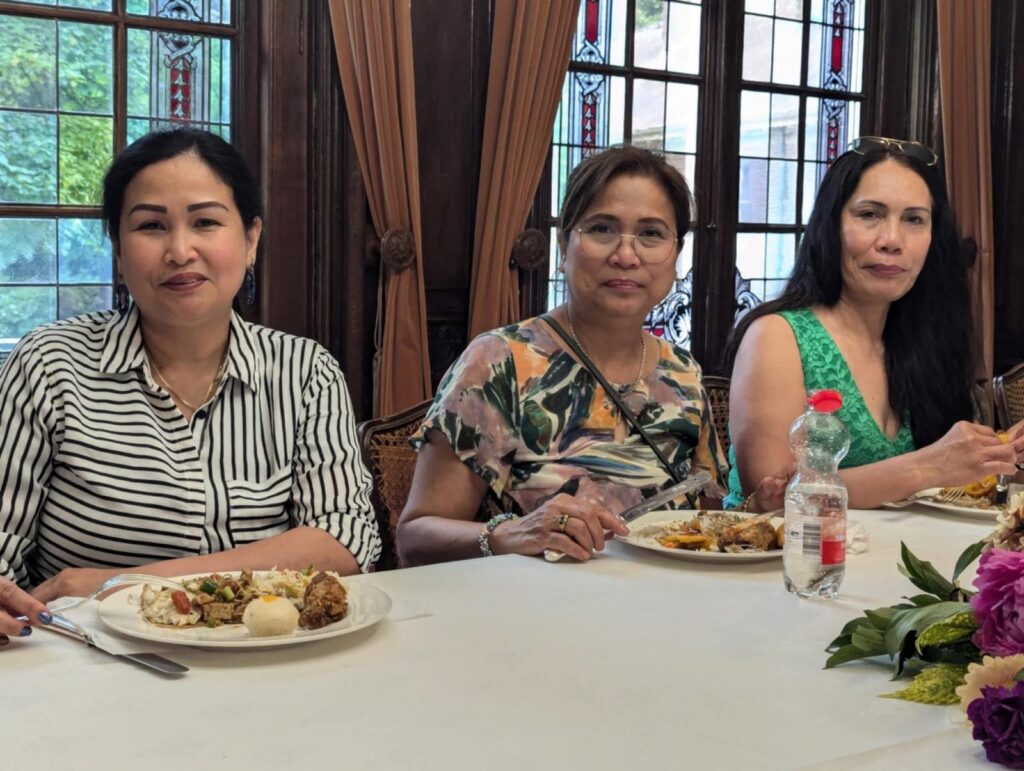
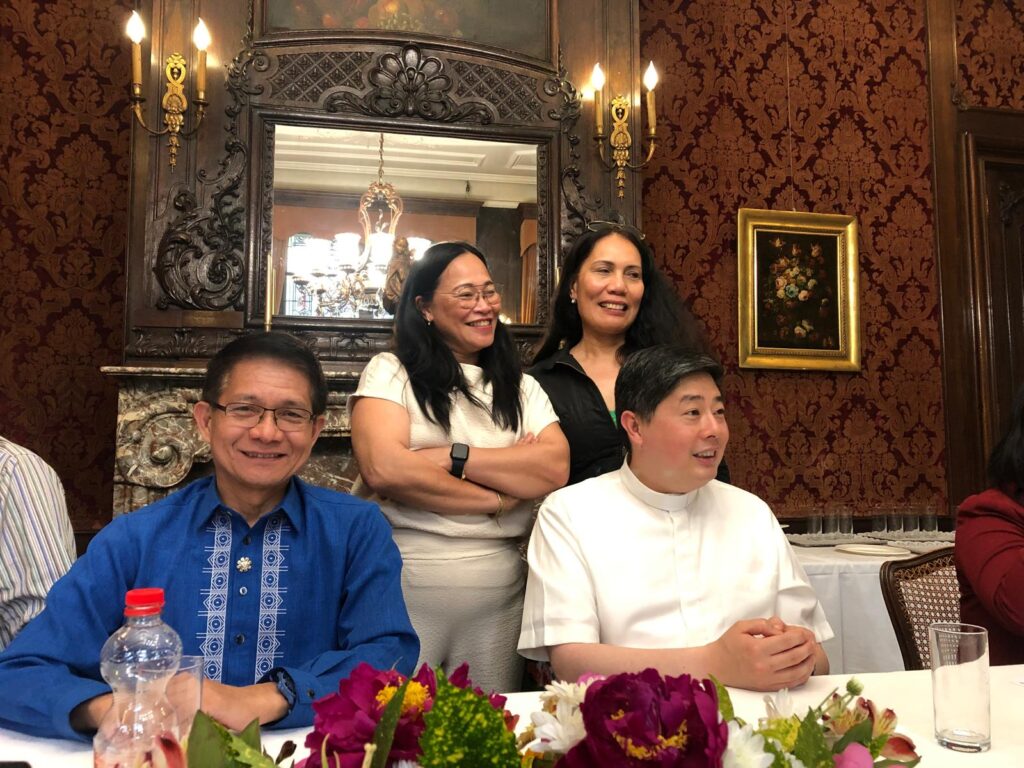
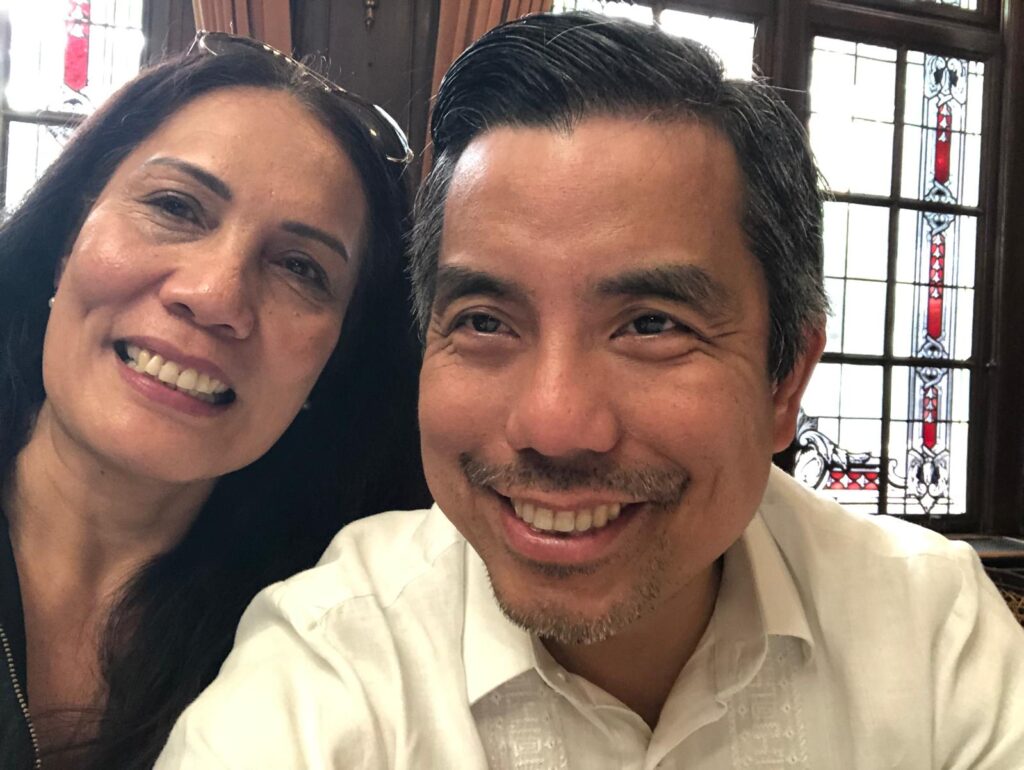
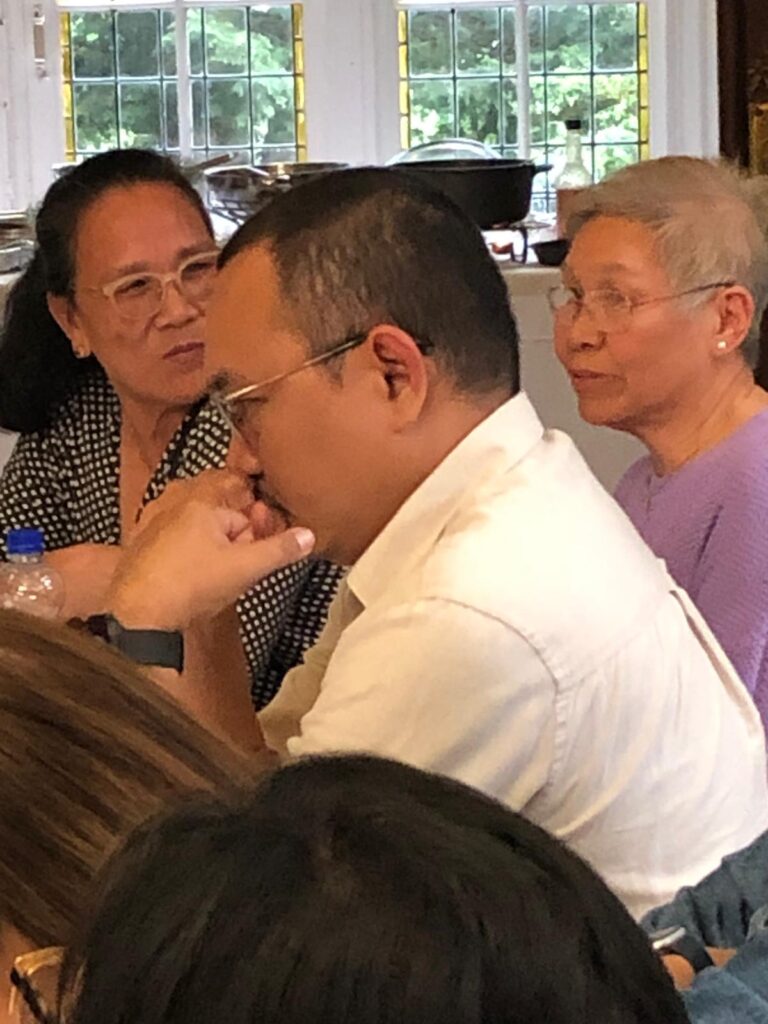
On 31 May 2025 he invited representatives of the various Filipino Catholic Communities (FCCs) to a Meet and Greet. FCC Gouda e.o. was represented by Amor van Os, Mary Jane Streefland, Jenny Luna, and Mary Lynn van Dijk.
A beautiful 19th-century building houses the Apostolic Nunciature, which in Monsignor Limchua’s words is where the Holy Father will stay when he is in the Netherlands. There is a wide and long graveled driveway on the right (from the street) leading to a smaller building where a chapel is located on the first floor. A curved pathway connects the main building with the chapel building. The entrance to the beautiful main building is on the side (not facing the Carnegielaan), and both the main building and chapel building are surrounded by well-maintained lawns.
The FCC Gouda contingent arrived on time, and met the FCC Dordrecht representatives, Marissa van der Graaf and Glenda Huisveld. Agnes van der Beek of the FCC Den Haag, who contacted the various FCCs, also arrived at the same time.
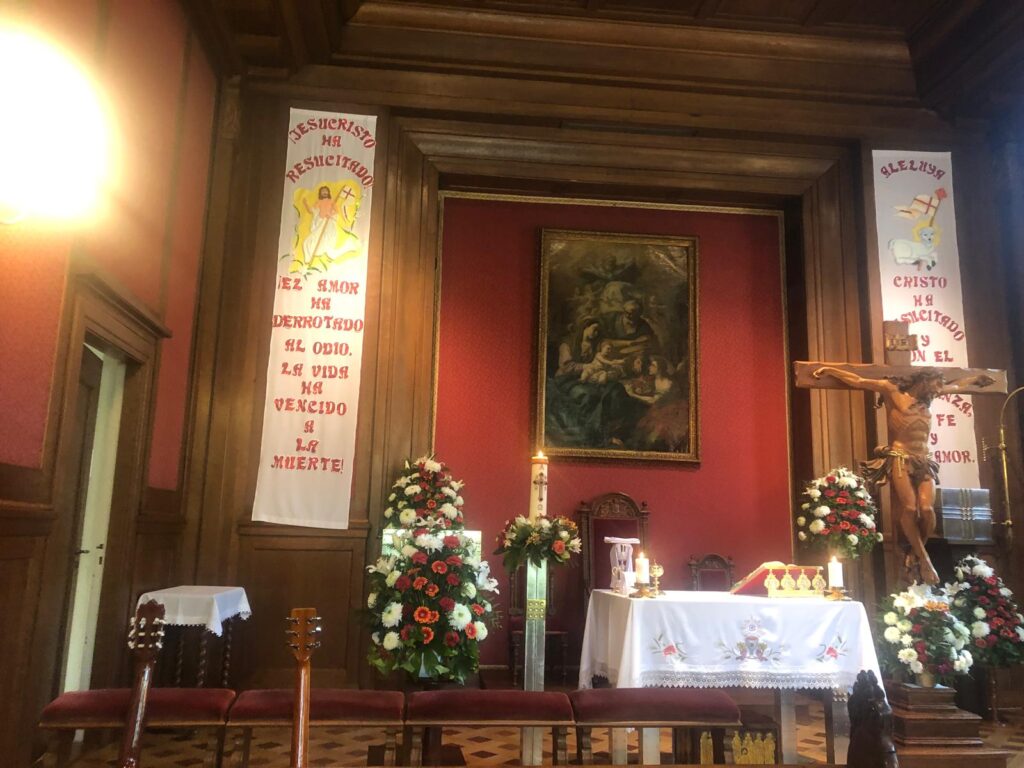
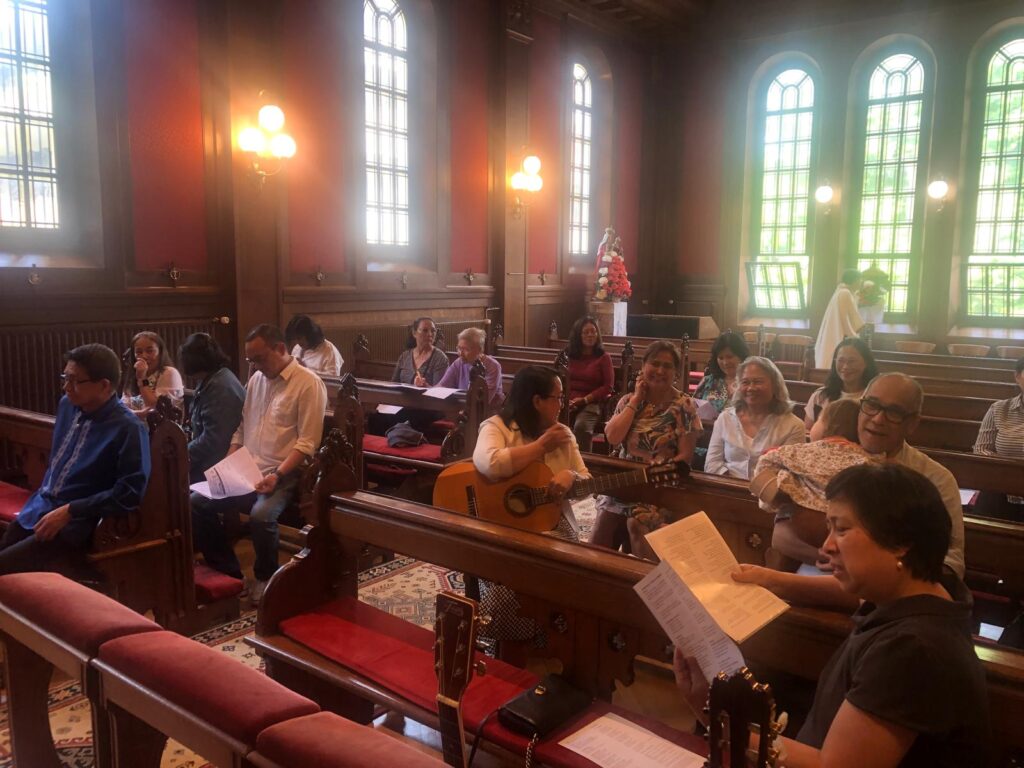
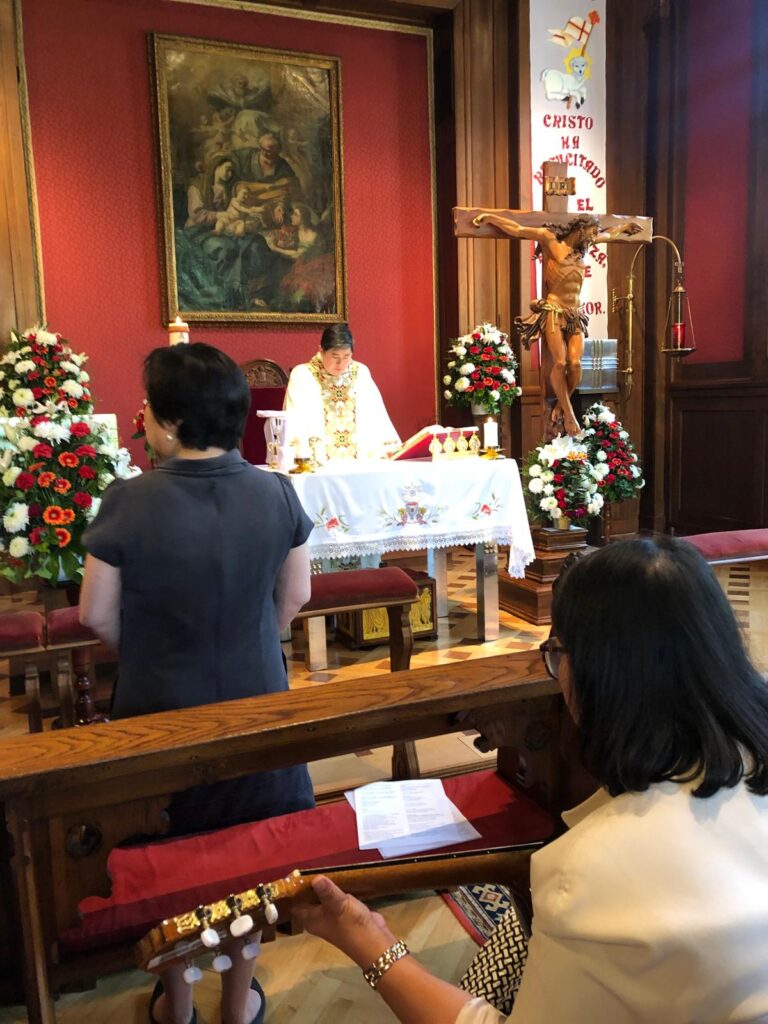
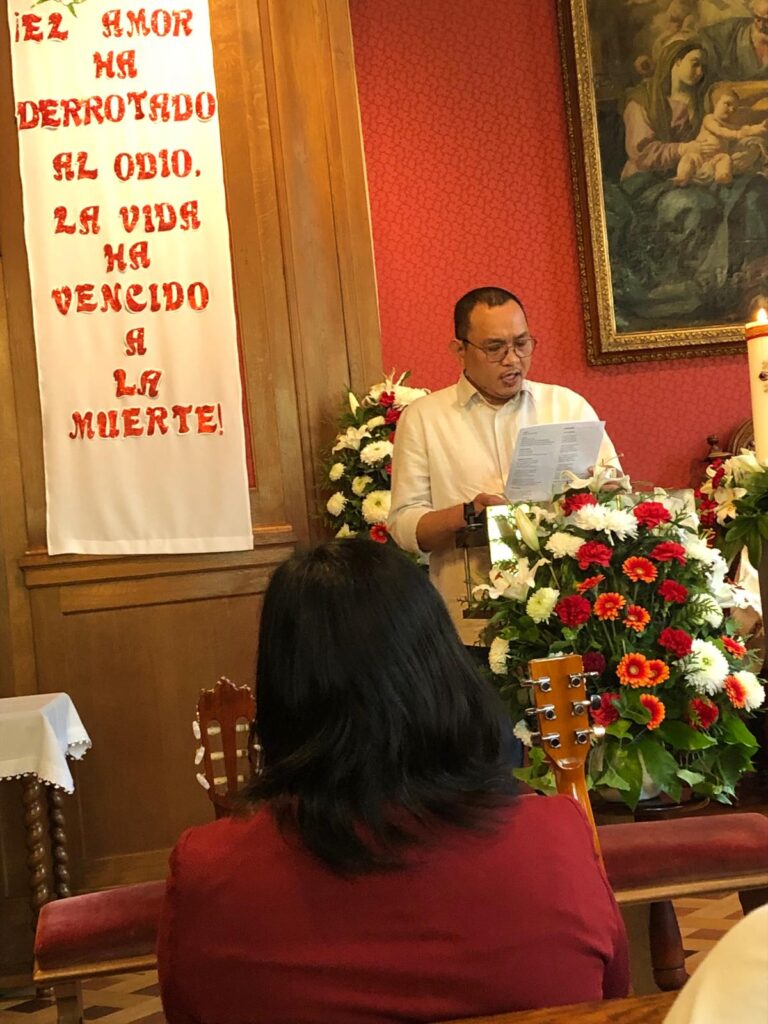
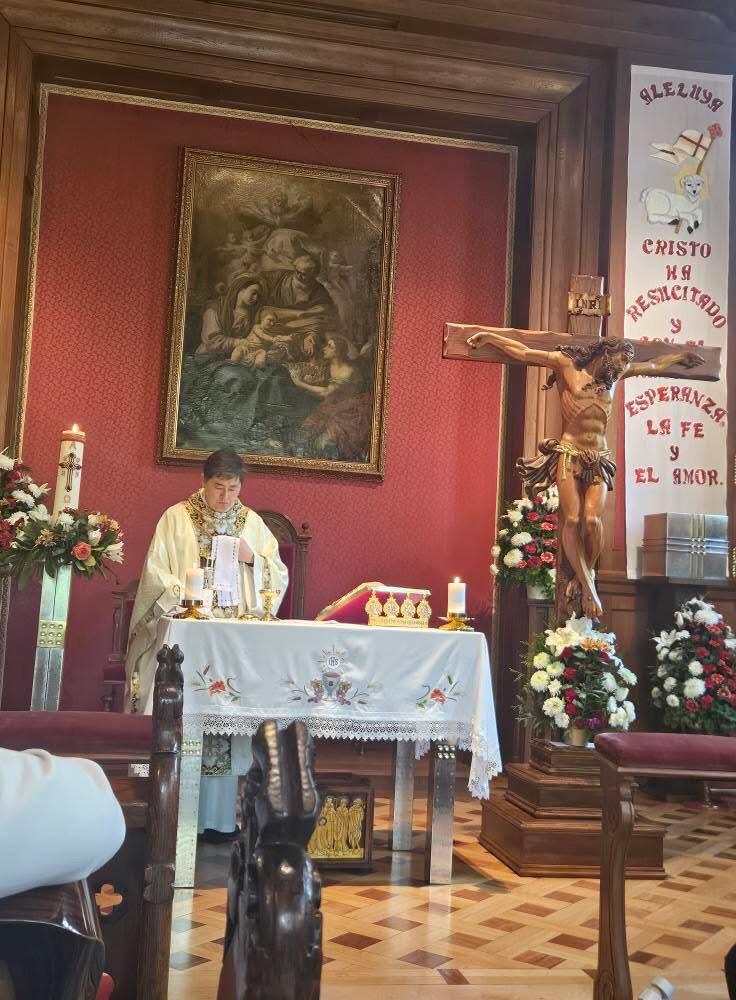
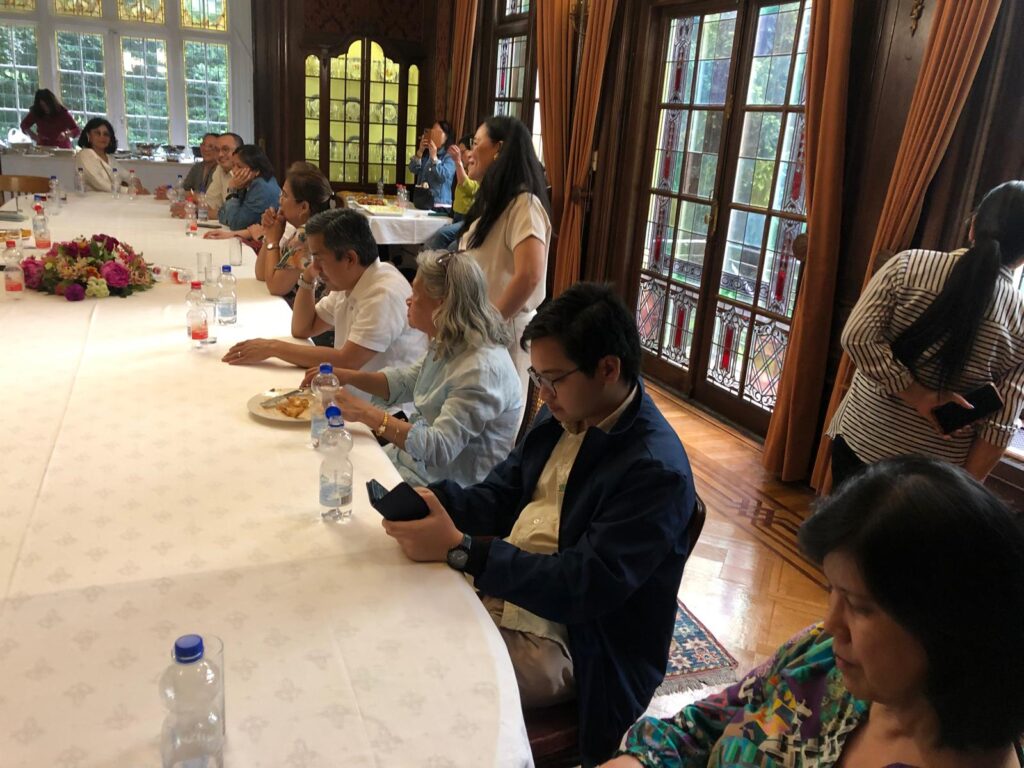
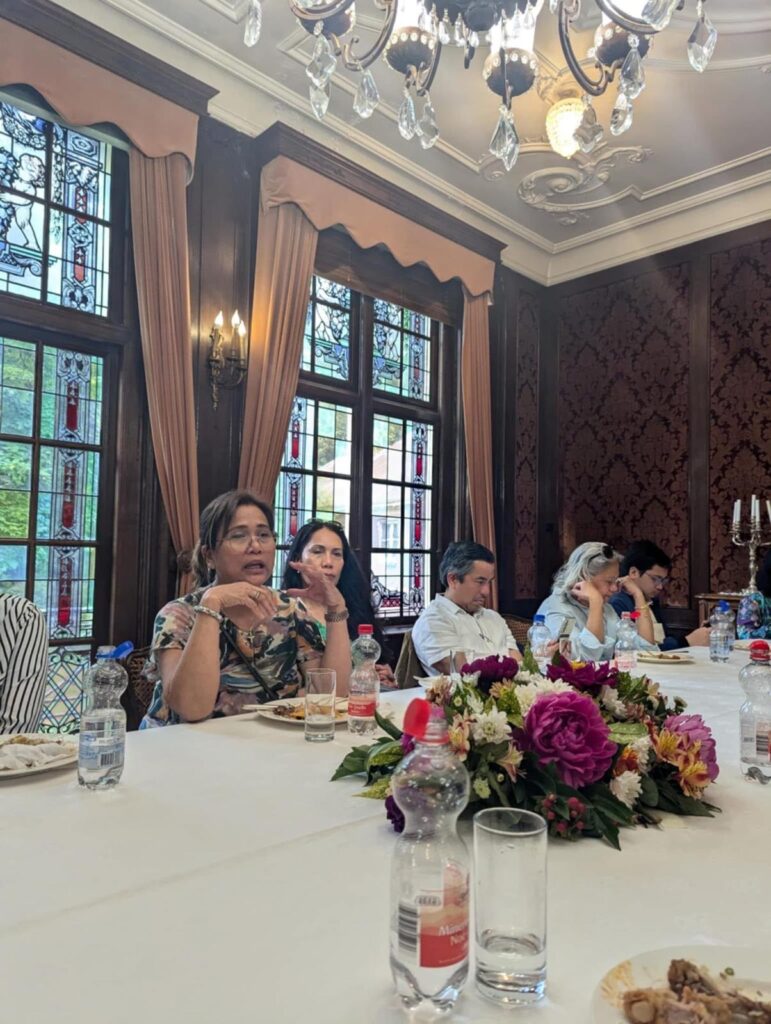
Marissa pressed on the doorbell of the main building, and it was the Monsignor himself who opened the door for us. We could not help but be impressed by the stately interior. He led us to a formal dining room on the right where a long table with a pristine white tablecloth had already been laid, not by himself, he said, but by the nuns. At one end of the dining room was a corridor where a shorter table with a white tablecloth had been prepared for the food we brought with us. After arranging the food, and lighting the tea lights to start warming up the food, we went into the dining room. On one smaller table were bottles of water and soft drinks, and on another, close to the corridor, cutlery and dishes. Then we were led to the beautiful chapel which had dark wood paneling, a beautiful painting of the Holy Family behind the altar, a beautiful painting of St Pope John Paul II on the left wall and windows on the right. To one side of the altar was an almost-life sized statue of the crucified Jesus.
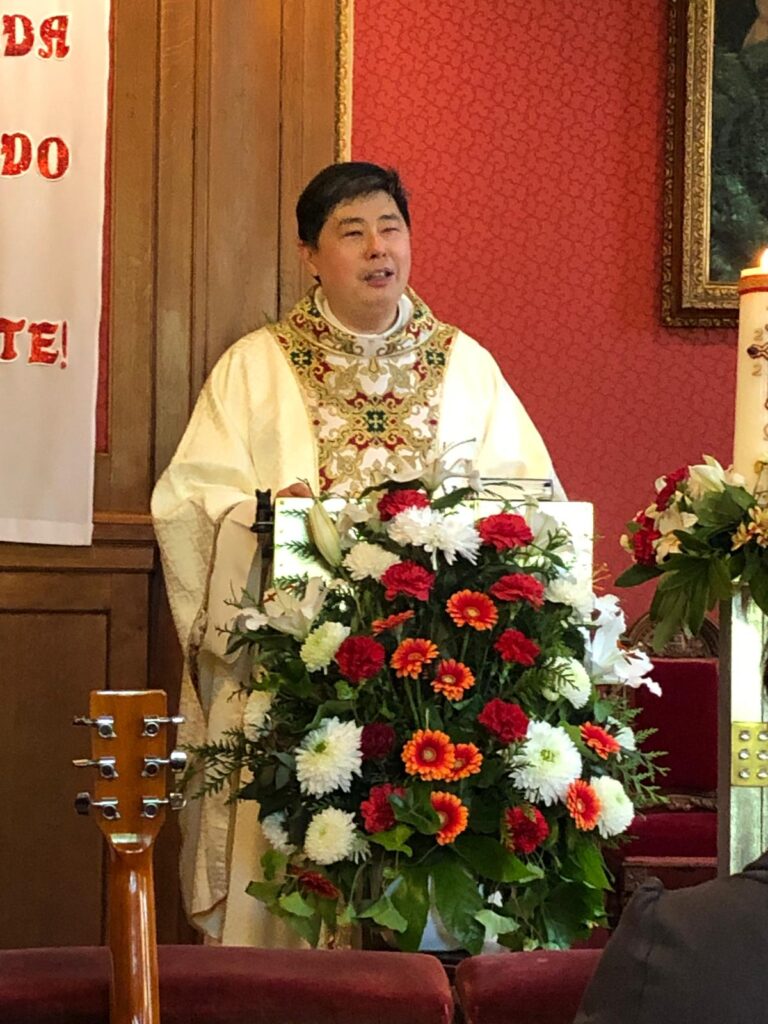
There was to be a Mass at 17:00 and dinner would follow afterwards. As the Mass was an anticipated Mass, the readings were for the following Sunday, Ascension Sunday. After he read the Ascension Sunday Gospel of Jesus taking leave of the Apostles and ascending to heaven, for his homily Monsignor Jan talked about leaving, the pain of leaving, and in Jesus’ case, that He had to leave as He was preparing rooms for His disciples in God’s home in heaven, and so that the Paraclete, the Holy Spirit, could descend on the Apostles and guide and strengthen them on their task of evangelization. This task is a task we all Catholics have, to share our faith, to live like Jesus did. Monsignor Jan also said that we Filipinos have very good traits, but we also have some bad ones. We need to make sure that we let our good side rise above our not-so-good habits or practices.
This was the third time Jane and I had heard a homily from Monsignor Jan, and we felt that it was not too short nor too long, but it was to the point, and inspiring, too. We found ourselves agreeing with what he said.
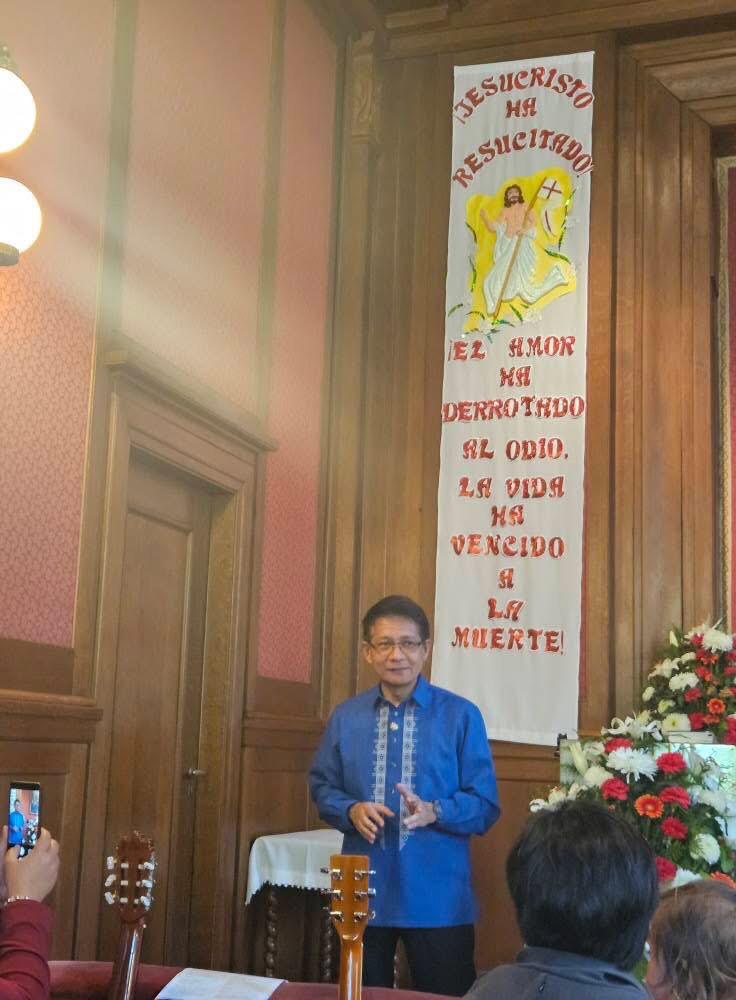
Since Ambassador Malaya was also present, the Monsignor asked him to say something.
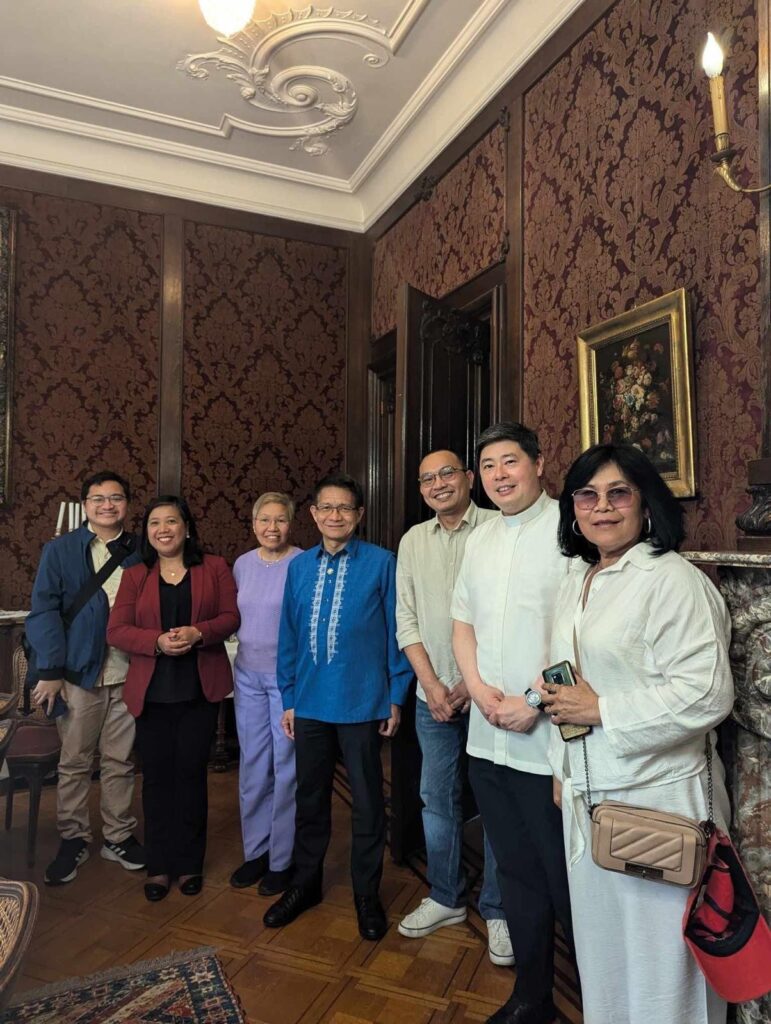
After the Mass, the Ambassador suggested that we have our photograph taken in front of the altar. We eagerly took our places. The Ambassador then suggested that a second photograph be taken on the front steps of the main building. We moved out of the church, into the curved walkway connecting the chapel with the main building. On the front steps, we took our places, and had our smiles preserved for posterity. Both photographs can be seen on the FB page of the Philippine Embassy in the Netherlands.
Then we queued up for dinner in the formal dining room. On a table by the windows were delicious empanadas and tacos which the nuns had made especially for us.
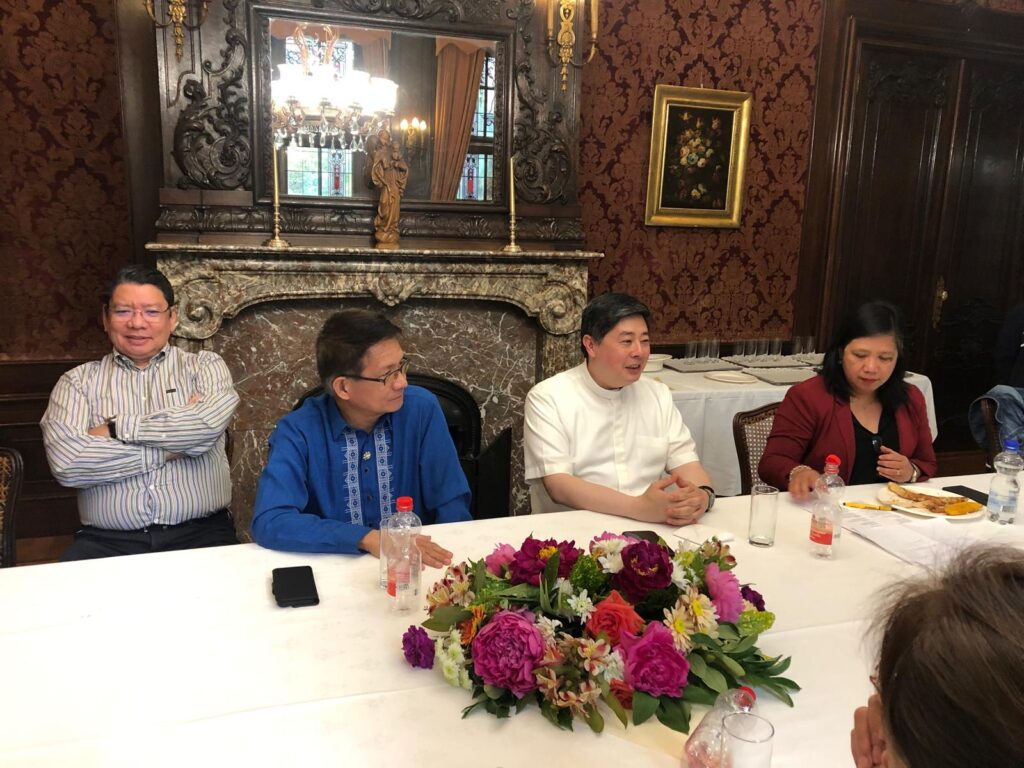
While people ate, people talked with each other. After dinner, Monsignor explained just what it was his reason for inviting the Filipino Catholic Communities (FCC) to the Apostolic Nunciature. As with his homily, he wanted us to live the faith, and do what Jesus commanded His disciples to do when he said goodbye to them. We were to work together. We would not just make sure that there were Masses for Filipinos in the Netherlands to attend but also make sure that we take care of each other spiritually.
He would request the Dutch Bishops’ Conference for a full-time Filipino priest to be hired to provide us with pastoral care. Take for example the Italians, he added, who have three communities in the Netherlands and get together and have a Mass said in Italian regularly. Perhaps the Filipino communities could set up a joint Santacruzan, or Simbang Gabi.
(Note: This year, the organizer invited FCC Gouda to join the Santacruzan in Hoofddorp, but since the fourth Sunday of May coincided with Fr Marcel’s birthday, we had our very own modest Santacruzan. After the Mass, we helped Fr Marcel celebrate his birthday with Filipino food, songs and dances. In the past two years, the various FCCs arranged for each FCC to organize one of the Simbang Gabi masses. FCC Gouda took care of the Simbang Gabi mass on 18 December 2024. This year, too, a number of FCC Gouda e.o. members went to Haarlem to participate in the Divine Mercy mass the Sunday after Easter.)
Later on, he asked each of us to introduce ourselves and to mention when the community we belonged to, held Mass. It turns out that most Masses were held on the fourth Sunday, and as it is the Sunday when we have our Mass in Gouda, we will not be able to attend Mass at other FCCs. But FCC Rotterdam schedules their Masses on the second Sunday while FCC Dordrecht holds theirs on the third Sunday. FCC Den Haag has Masses on the second and fourth Sundays of the month. So it is possible for some of us to attend Masses on the other Sundays, either in Rotterdam, Dordrecht or Den Haag.
Amor explained that at FCC Gouda we facilitated baptisms, we had preparation sessions for First Communion, we also gave assistance to bereaved members for when their (usually Dutch) partners passed away, and also provided assistance to families back home, when parents, children, or siblings died, or were victims of fires or natural disasters. We also held Recollections, and community-wide events such as the Family Fun Day in June.
Marvin Martin of FCC Rotterdam talked about the community holding a Retreat, and activities like the Family Sports Day, in addition to the monthly second Sunday Mass. FCC Rotterdam also had programs to assist seamen, and au pairs having difficulties with their employers or guest families, as well as the Filipino elderly (and those from other nationalities) in Rotterdam who needed food and other assistance.
(Note: In April, there was a very sick seaman who needed spiritual guidance and care. The group was able to avail of Fr Gilbert Razon, SVD, to go to Rotterdam and minister to this ailing seaman. For that reason Fr Gilbert was not available to say the Mass in Dordrecht but Fr Nico who had lived in the Philippines for many years and who speaks very good Bisaya was able to concelebrate that Mass with Monsignor Limchua.)
Ambassador Malaya took the opportunity to reply to these concerns of our fellow FCC-ers in Rotterdam. Regarding the seamen who stay in Rotterdam for a very short time (usually they disembark in Rotterdam from their latest assignment, stay a day or two before boarding another ship for their newest assignment) the Embassy had considered requesting that a full-time Labor Attaché be assigned in the Netherlands. But it was determined that the Attaché would be needed only half the time, so they decided that any problems with the seamen can be referred to the Labor Attaché in Berlin, Germany, or to the embassy in Den Haag. On the problems some au pairs are having, the Ambassador said that the embassy was aware of the problem and the government is considering whether to end the au-pair program. He assured us that in case of problems of seamen and au pairs these can be referred to the embassy which has resources to provide assistance.
At Monsignor’s statement that he would be asking the Bishops in the Netherlands for a full-time Filipino priest to serve the Filipino Catholic Communities, Marvin said that for now, hopefully Fr Gilbert can remain as de facto Filipino pastor. Fr Gilbert says the Masses in Dordrecht, and when there are other Sunday Masses, like on a fifth Sunday, he also officiates the Mass in Rotterdam. He also serves as Retreat Master.
Marvin added that FCC Rotterdam members (and in the past, FCC Gouda members, too) have also attended workshops, the first of which is “How to Be a Church Volunteer”. This workshop had always been offered by the Bisdom (Diocese) of Rotterdam, albeit in Dutch. Our late Fr Dan Ceballos, msc, gave these workshops in English, although he used the printed Dutch-language material the Bisdom provided. Marvin said that these days it seemed that the Rotterdam Diocese was going to hold these workshops in English.
There were two Filipino couples who were the people behind the Couples for Christ organizations in Amsterdam and Den Haag; they, too, also organize masses. In June because we celebrate Philippine Independence Day, their monthly mass would be held on a Saturday. Also present at the Meet and Greet were representatives from the FCCs in Tilburg and Nijmegen.
Now Agnes had asked everyone who attended to provide the FCC where he/she belonged to, and their mobile phone number and e-mail address on a form that was passed around. Ambassador Malaya said that this list could become a database, the beginning of inter-FCC activities and mutual cooperation. He asked if Agnes, who had contacted the various FCCs to the Meet and Greet, would act as coordinator. She would.
Ambassador Malaya also mentioned that during his assignment in Malaysia he organized activities and one of the FCC representatives would be the chair and assisted that year by a representative of another FCC who would be co-chair. The next year, the co-chair of the previous year would become the chair, and a member of another FCC would be co-chair, who would be chair the following year, with a co-chair from yet another FCC. This way, the program could be continued with the co-chair gaining valuable experience the previous year to use as chair the following year.
Monsignor Limchua repeated that he would like to see the FCCs get together and plan joint activities, with the aim of following Jesus’ footsteps. There are Masses in the chapel on Mondays and Tuesdays in English at 07:30, on Wednesdays at 08:00, and from Thursday to Saturday the Masses would be said in Spanish. On Sunday the Spanish-language Mass will be at 10:00. Everyone was invited. At that, our Meet and Greet ended, and we went to put away our dishes and rechauds. There was plenty of leftovers some of which were taken home and some left for the nuns to enjoy. We said our goodbyes and thanked the nuns, too. By the way, Ambassador Malaya’s assistants cleared our plates for us.
By Marcel Uzoigwe, C.S.Sp. (Acts 5: 12-16; Revelation 1: 1-11; John 20: 19-31)
Dear friends in Christ,
On this second Sunday of Easter, we celebrate the Divine Mercy. The Church designated this second Sunday of Easter as the Feast of Divine Mercy following the various messages of Jesus to Sr. Maria Faustina Kowalska detailing his desire to bring the message of his mercy to mankind. It is a great opportunity to reflect on God’s loving mercy for us, and how we should respond to it. The readings give us insight on how God handles our failures to understand, and lack of faith in what he does in our lives.
The resurrection of Jesus is essentially linked to his great mercy and desire to give us new life, which is the fruit of his Passion. That is why, in his appearances after his resurrection, Jesus showed his hands pierced by the nails, and his side torn open by the soldier’s lance from which flowed out blood and water. That was enough to convince those of his disciples, especially Thomas, who were yet to recover from the shock of his Passion and death, and therefore, doubted the joyful news of his resurrection. While it might be easier for us to believe in the resurrection on account of the Gospels, it remains an obstacle to those who apply human reasoning to divine mysteries, given that the resurrection of Jesus does not lend itself to material order or human consideration. It is clear that some of the people who left the Church or have difficulties believing in God do so on account of the difficulty in understanding the existence of God in the context of the human experience, such as human suffering, which their concept of God could not explain. The experience of Thomas is a reminder that God’s ways are not ours.
In today’s Gospel, we see the first disciples discouraged and terrified after Jesus’ death. They are locked in a room. Suddenly, Jesus stands among them and says to them, “Peace be with you,” and breathes the Holy Spirit on them. They are sent out in the power of the Spirit to offer others the gift of forgiveness. “If you forgive the sins of any, they are forgiven…” Notice that Jesus did not reprimand them for deserting him during his passion, nor reminded them of their weaknesses. Rather, he focused on empowering them to bring His forgiveness to mankind because forgiveness in itself is empowering, and creates new opportunities. That is a great lesson to our human societies that often label people, getting them stuck in the mistakes that once made. We often hear the saying, “Once a thief always a thief”. But God sees potentiality for goodness even in the thief and gives him the opportunity, through forgiveness, to bring out that goodness to the world.
What Jesus gave to his disciples is both a gift of forgiveness and a mission. That gift and mission are also given to all of us who have been baptized into the risen Jesus. Reconciled to the Lord, we are all sent out as servants of reconciliation. The Sacrament of Reconciliation is of course a privileged moment of reconciliation, in which we once again receive the Lord’s forgiveness and pass that forgiveness on to those who have hurt us. But there are other moments of reconciliation: the daily forgiveness of our brothers and sisters; the courage to say “I’m sorry” and the gracious acceptance of another’s offer of apology. In these moments, Jesus is among us to help us get out of situations that can be debilitating for all involved.
The Gospel tells us that Thomas was not with the other disciples when the Risen Lord appeared to them. He might have been devastated by the events of Jesus’ Passion and death and had withdrawn to deal with the pain. Thomas’ absence from the community of the disciples when Jesus came depicts the withdrawal approach taken by some people when they felt hurt. The second appearance of Jesus to the disciple during which Thomas was present teaches us the importance of community even amid crisis. When we cut ourselves off from the community of believers, we lose a great deal. Despite all its faults and shortcomings, the Church is the place where we encounter the Risen Lord. It also teaches us compassion towards one another. Jesus had to come again for the sake of Thomas. Let’s not forget that when Jesus wanted to go raise Lazarus from the dead, and his disciples were afraid that the Jews would kill Jesus, it was Thomas who encouraged his colleagues, saying, “Let us also go, that we may die with Him” (John 11: 16). One good turn, they say, deserves another. In whatever we do, let a day of sorrow not becloud the years of sunshine we have shared with whoever it might be.
Further on Thomas, the other disciples reached out to him. They shared with him their discovery – their experience of the Resurrected Jesus. “We have seen the Lord”, they said, seeking to convince him. The action of the disciples reminds us of our call to continue to look out in faith for all those who, for whatever reason, have drifted away from the community of believers and no longer meet with us. We may indeed receive the same sort of negative reaction that the disciples received from Thomas. But even if our efforts fail, we know that it remains the will of the Father that no one gets lost. In the parable of the shepherd that left the ninety-nine sheep in search of the one lost sheep (Matthew 18:12-14) Jesus showed us the love and mercy of God for all his creatures. When Jesus brought Thomas to faith, we have one of the greatest expressions of faith in all the Gospels come out of the mouth of the skeptic: “My Lord and my God.”
Thomas Merton wrote in his book Asian Journal, “Faith is not the suppression of doubt. It is the overcoming of doubt, and you overcome doubt by going through it. The believer who has never experienced doubt is not a believer.” Unlike some Christians who profess Jesus in the church but deny him in public places, Thomas was very honest. He did not pretend to believe when he did not. He needed certainty to make his fundamental option for Jesus. Once he got it, he gave it everything. The Gospel suggests that such honesty is never far removed from authentic faith.
Let us recognize today that just as the risen Lord addressed Thomas’ discontent, he is always ready to address our discontent and that of every human being. We are simply people who have been wounded by injustice and marked by various life experiences, both good and bad. But as baptized followers of the crucified and risen Lord, let’s be marked above all by the forgiving peace of Christ. He is our living Lord and our God, who was crucified, died and rose for us so that we can truly learn to live and forgive in his name. That is why he also says to us today: “Peace be with you!”
***
Livestream recording of the mass can also be viewed HERE.
Many a time, we see people glory in the misfortune that befall their enemies. It is very easy to believe that people who do certain things that we consider unwholesome, or people who are different and live differently, are doing something very wrong. Worse still, when people suffer as a result of their fault, for something they did, we say that it serves them right. There are many such examples today. That was precisely what those who came to Jesus in the gospel believed about the Galileans whom Pilate slaughtered and mingled their blood with their sacrifice. This human attitude and sense of justice work better when it has to do with someone else. But if one of our own is involved, the attitude quickly changes.
It was clear that those who had this judgment about the Galileans had a holier-than-thou attitude. For them, the Galileans were sinners while they were the holy ones. By making such a judgment, they distanced themselves from those Galileans. When you judge someone, condemn him or her, and distance yourself from the person, there is no way you can understand the situation of the person and be of help to him or her. As Mother Theresa rightly pointed out, “If you judge people, you have no time to love them.”
Last week, I read a piece titled, “The first time I wept in Church” written by a young Nigerian man named James Terna on his Facebook page. In that piece, he narrated how he always sat in the same seat at church to avoid distractions. For months, a quiet and almost invisible woman occupied the seat beside him, always alone and often tearful during Mass. At first, he paid little attention, but one Sunday, he noticed she was trembling and appeared unwell. He often considered speaking to her but never did. One Sunday, he resolved to talk to her after Mass but got distracted. When he finally turned around, she was gone. The next week, he planned to reach out to her, but she was absent for the first time. Week after week, her seat remained empty. Then, the parish announced her passing. She had died alone, with no family, and the church had to arrange her burial. The realization struck James deeply. He had been physically present in church but had failed to truly see the suffering soul beside him. He wept, just as the lady had wept many times before without being noticed. At her burial, James brought flowers, but it felt meaningless. He reflected on how often people neglect the suffering around them, only to show up when it’s too late—traveling miles for a funeral but failing to check in and care when it truly matters.
The readings we have today call us to repentance and go further to point out what is required of us to show that we truly repent. First, Jesus used the parable of the fig tree that failed to bear fruit to remind us of the saying, “By their fruits, you shall know them”. So, being repentant is shown by the fruit we bear. John the Baptist made it his theme when the people came to him for baptism. He told them, “Bear fruits that befit repentance” (Matthew 3:8). Repentance is not something we claim, but something that claims us – something that changes everything about us: our perspective about life and death, about our relationship with God and people around us, about our attitude to material things, our strivings in life, and so on. It is felt by those we relate to because the Godliness in a repented soul is readily felt, and leaves footprints wherever we go. The Christian life is not private. There must be synchronism between our private life and life in public. We cannot confess Jesus in the Church and deny him once we get out there in the public. That is why Jesus said in Matthew 10:32-33, “Everyone therefore who acknowledges me before others, I also will acknowledge before my Father in heaven; but whoever denies me before others, I also will deny before my Father in heaven.”.
Jesus went further to assure us that God is patient with the sinner just as the owner of the vineyard was patient with the unfruitful fig tree. But such patience has a time limit. For the fig tree, it was three years. For human beings, we do not know how long because no one knows when his or her life will end. The story of James Terna shows that God provides us with the opportunity to bear fruit by being God’s loving presence to someone in need. However, our ability to recognize such an opportunity depends on our understanding of what it means to live the life of God. It happens that we are so concentrated on ourselves, our salvation, our interests, and our well-being that we do not recognize the person next to us. Yet, when Jesus was discussing the criteria for attaining eternal life in heaven, he said, “Truly I tell you, whatever you did for one of the least of these brothers and sisters of mine, you did for me.” (Matthew 25: 40). And that brings us to the first reading where we see Moses being sent to Egypt to liberate the Israelites in slavery.
Before the mission to Egypt, Moses had tried severally to fight for his people, having seen their pitiable situation. On one such occasion, he killed an Egyptian who was fighting an Israelite. But when the same Israelite betrayed him, he feared for his life and fled to Midian (Exodus 2:14). He started a new life with Jethro, the priest of Midian whose daughter he married. It was at this period that he was busy building up his family that God came to send him back to the same Egypt he was fleeing to liberate the people who betrayed him. The mission of Moses was not for his well being, but that of others. The text of the reading made it clear that the call of Moses was significant, filled with the strange phenomenon of a burning bush. He was not to find it easy. But when God revealed his name “I AM WHO I AM”, it became clear to Moses that what his human effort could not achieve is possible with God. What was required of him was to make himself available and let God do the rest.
When you realize that your life has a purpose that goes beyond your interest, you will begin to understand that you have a mission to accomplish. And that mission is given to you by God who is only waiting for you to say yes. Jesus came to accomplish a mission. He recognized it as something required of him by his Father. Moses was called to accomplish a mission. He could see the hand of God in that call. We are all called to accomplish one mission or the other. But without repentance from our self-centeredness, egoism, hatred, sin, and everything that blinds us and keeps us away from God, we would never recognize such a mission. Like Moses before his call, we would never understand the real purpose of our life on earth. We would live like any other animal: eat, drink, do one selfish thing or another, and die.
As we advance in our Lenten observances, let us recognize that Lent is a grace period to reflect on our lives and seek to understand the aspects of our lives that God is calling each of us to pay closer attention to become holy and ready for every mission He wishes to entrust into our hands. So, instead of wasting our limited time standing in judgment over those whom misfortune has befallen, let’s heed the warning of Paul in the second reading: learn from their misfortune so as not to experience such. More importantly, get ourselves ready to respond to the invitation to humble repentance and good works before our time on earth runs out.
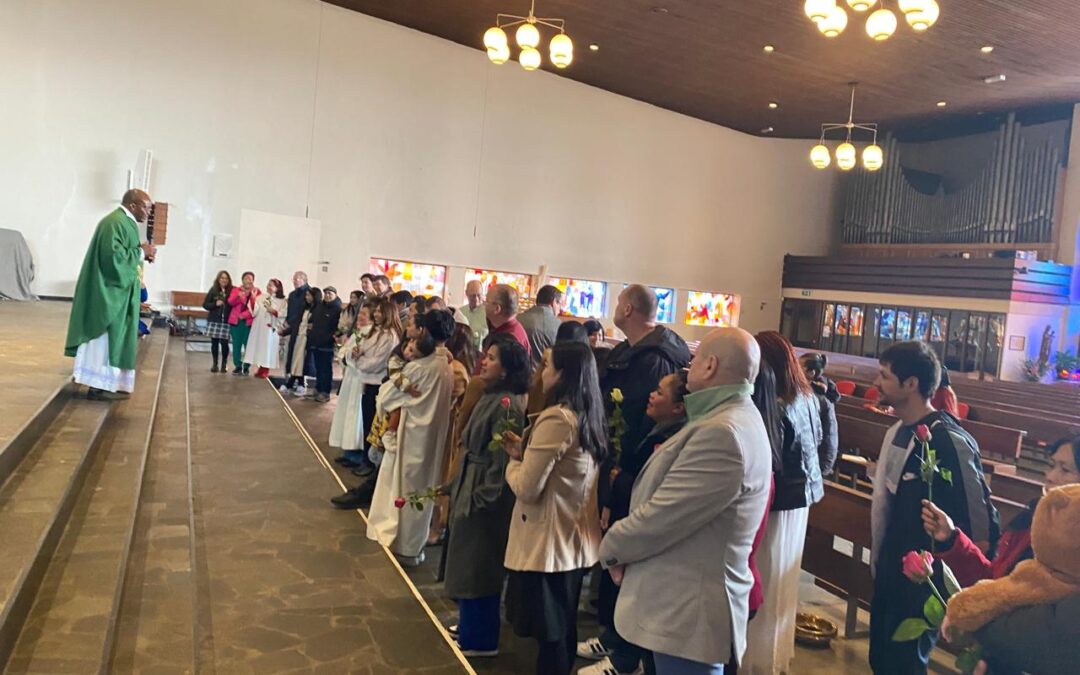
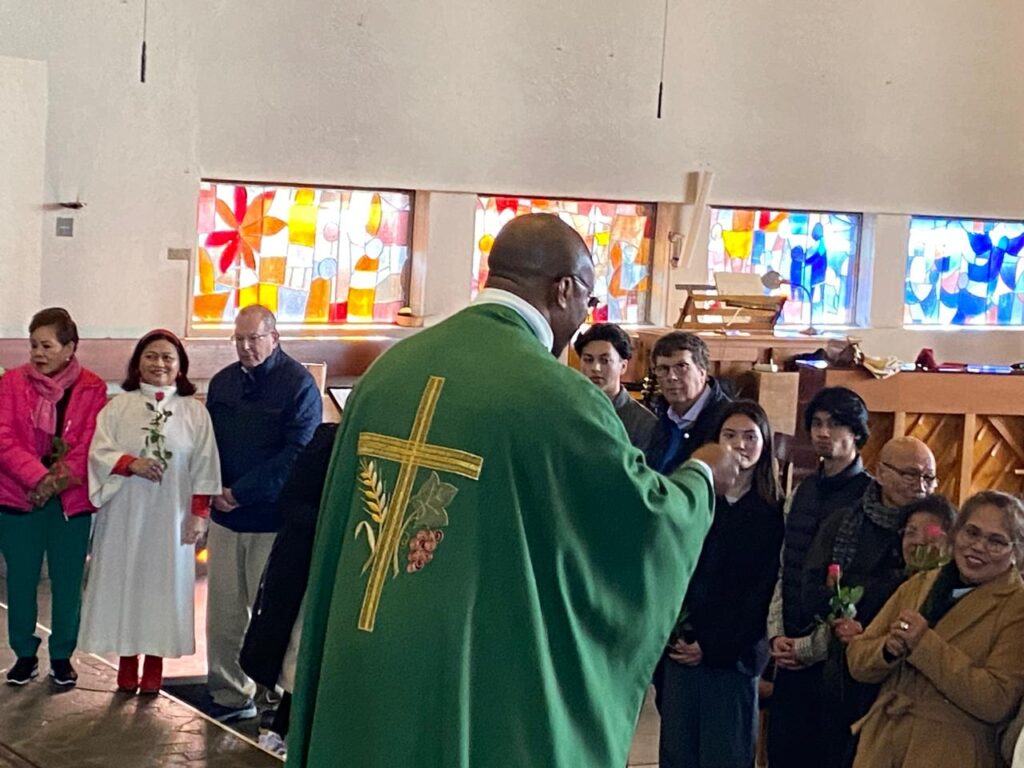
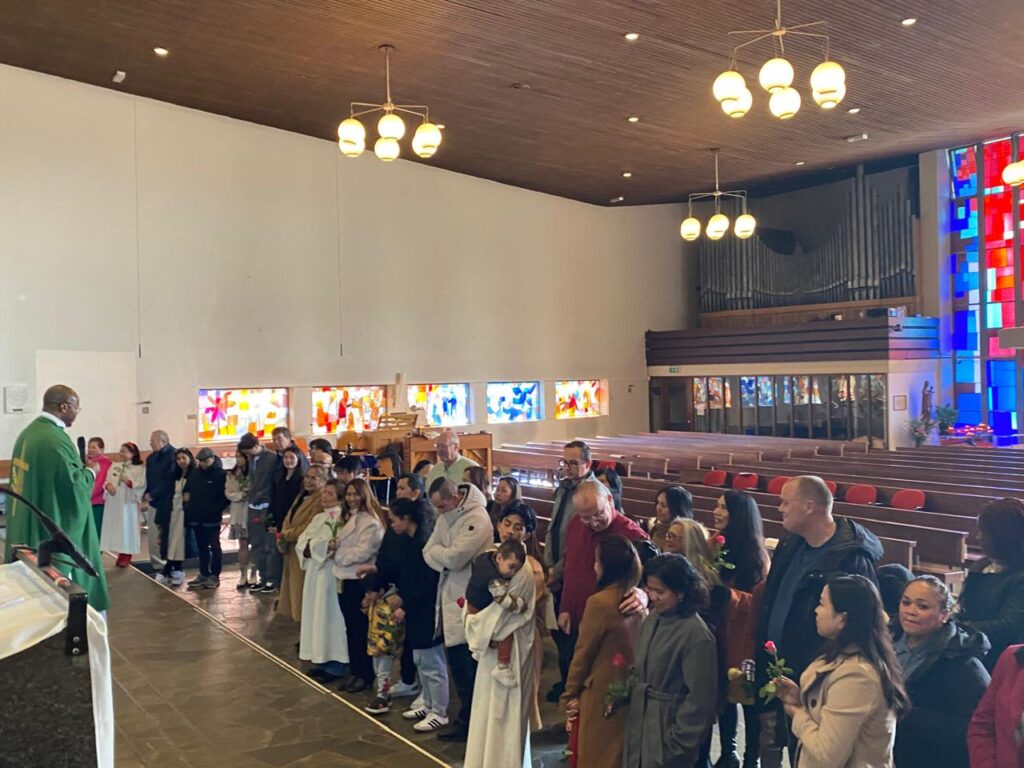
February is a month of love, unity, and connection for Filipino Catholic Community in Gouda and its surrounding (FCCG) that gathered to celebrate not only the bond between couples but also the love that unites us all. A special Mass was held to mark the occasion, offering a beautiful blend of spiritual reflection and heartfelt blessing.
The highlight of the Mass was the couples’ blessing, where couples as well as other attendees gathered to receive a special blessing from Father Cyril. This beautiful tradition honors the couples’ commitment to one another and their shared journey of faith and love. As the couples stood together, hands clasped and hearts open, they received prayers for strength, health, and continued growth in their relationships. It was a moving moment that reminded all of the power of partnership and mutual support.
Flowers for All: A Symbol of Appreciation
As a gesture of gratitude and love for every attendee, the church also provided flowers to each person present. These flowers were more than just a decoration; they symbolized appreciation for the love and presence of each individual in the community. For the couples, it was a token of their shared bond, while for singles and families, it was a reminder of the beauty and significance of all relationships.
The gesture was simple yet meaningful, and the vibrant colors of the flowers brought an extra sense of joy and warmth to the celebration. The act of giving flowers reflected the church’s message that love, in all its forms, should be celebrated and cherished.
The Filipino Catholic Communities in the Netherlands celebrated the joyous season of Advent and Christmas with a series of meaningful events that brought together members of the community in Gouda and Hoofddorp. These events not only fostered the spirit of togetherness but also deepened the faith and traditions of the Filipino Catholics living abroad.
Simbang Gabi at Josephkerk, Gouda (December 18, 2024)
The festive celebrations began with the much-loved Simbang Gabi (Night Mass), held at Josephkerk in Gouda on December 18, 2024. Simbang Gabi, a tradition deeply cherished by Filipino Catholics, is a series of nine early morning or evening masses in anticipation of Christmas. For the FCCG, this event marked the beginning of their Christmas celebration, bringing together families and friends to pray and prepare spiritually for the birth of Christ.
This special mass was facilitated by Fr. Alan de Guzman, who led the congregation through a spiritually enriching service. His homily resonated deeply with the attendees, as he shared messages of hope, faith, and the importance of family during this holy season. The FCCG organized this event as a way to keep the Filipino Christmas traditions alive, even while living far from home.
Simbang Gabi at Joannes de Doper Kerk, Hoofddorp (December 19, 2024)
The Simbang Gabi continued the following evening at Joannes de Doper Kerk in Hoofddorp, where the Filipino Catholic Community members gathered to celebrate the anticipation of Christ’s birth. Like the previous night in Gouda, this mass was facilitated by Fr. Alan de Guzman, and was equally filled with prayer and reflection.
Both Simbang Gabi celebrations were sponsored by the Filipino Catholic Community Gouda and its Surrounding (FCCG), a vibrant and welcoming community that offers support to Filipino Catholics in the region. These events allowed participants to reconnect with their roots and celebrate their shared faith and cultural traditions.
Christmas Mass and FCCG Christmas Party at Josephkerk, Gouda (December 22, 2024)
The festive atmosphere continued on December 22, 2024, with a special Christmas Mass at Josephkerk in Gouda and was facilitated by Fr. Marcel. This mass marked the culmination of the Christmas celebrations for the FCCG. The church was filled with joy and reverence as the community came together to commemorate the birth of Jesus Christ.
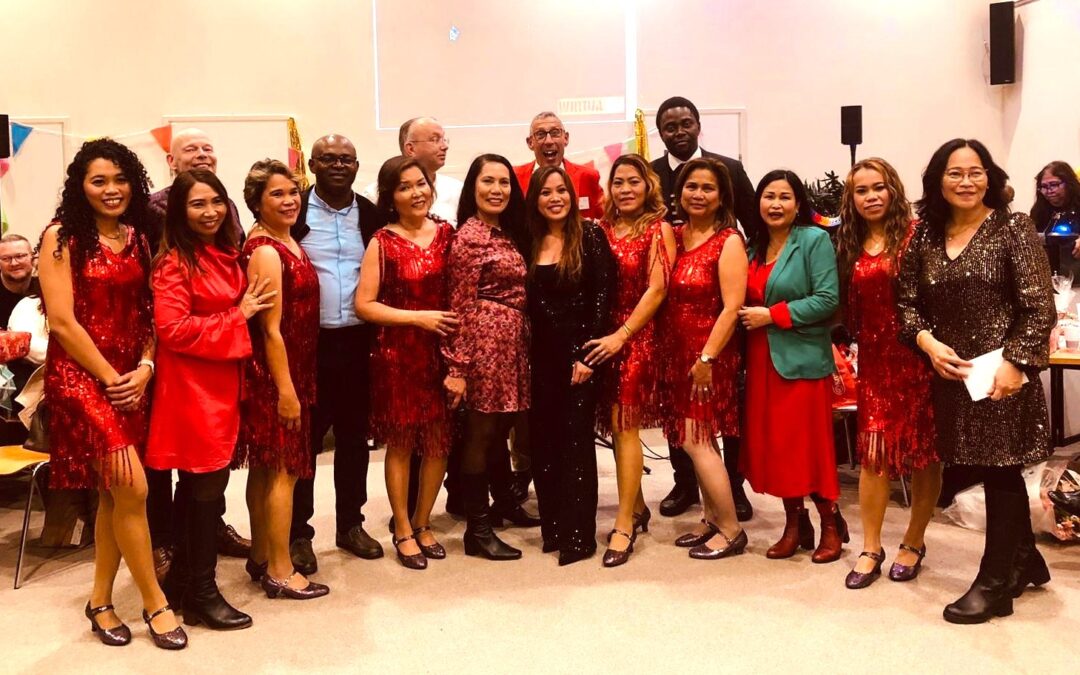
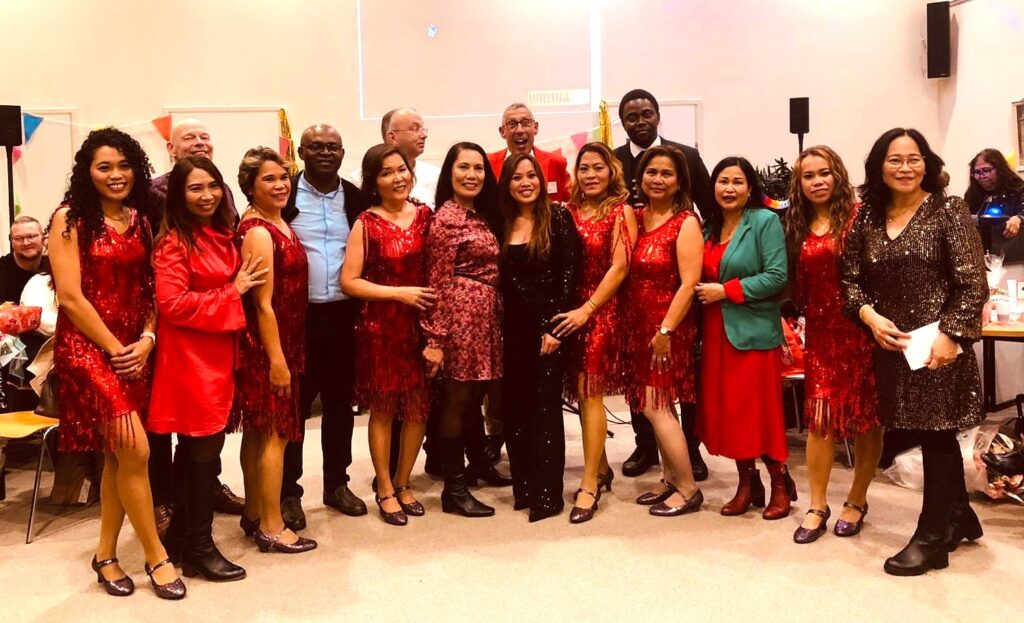
Following the mass, the FCCG Christmas Party took place, creating a lively and festive atmosphere. DJ Norie provided the music, ensuring that the event was filled with energy and excitement. The highlight of the evening was a special performance by Merlinda Dano, whose voice resonated with warmth and love, perfectly capturing the spirit of the holiday season.
In addition to the music, the evening was filled with Christmas caroling by the FCCG choir, which performed beloved Filipino Christmas carols. The choir’s beautiful renditions of traditional Christmas songs brought the crowd into a spirit of celebration and unity.
A Season of Joy, Faith, and Fellowship
The FCCG’s celebration of Simbang Gabi, the Christmas Mass, and the Christmas Party was a testament to the strength of faith, family, and Filipino traditions. It was a heartwarming way for members of the community to share joy, build lasting memories, and reflect on the significance of Christmas, even as they were far from home.