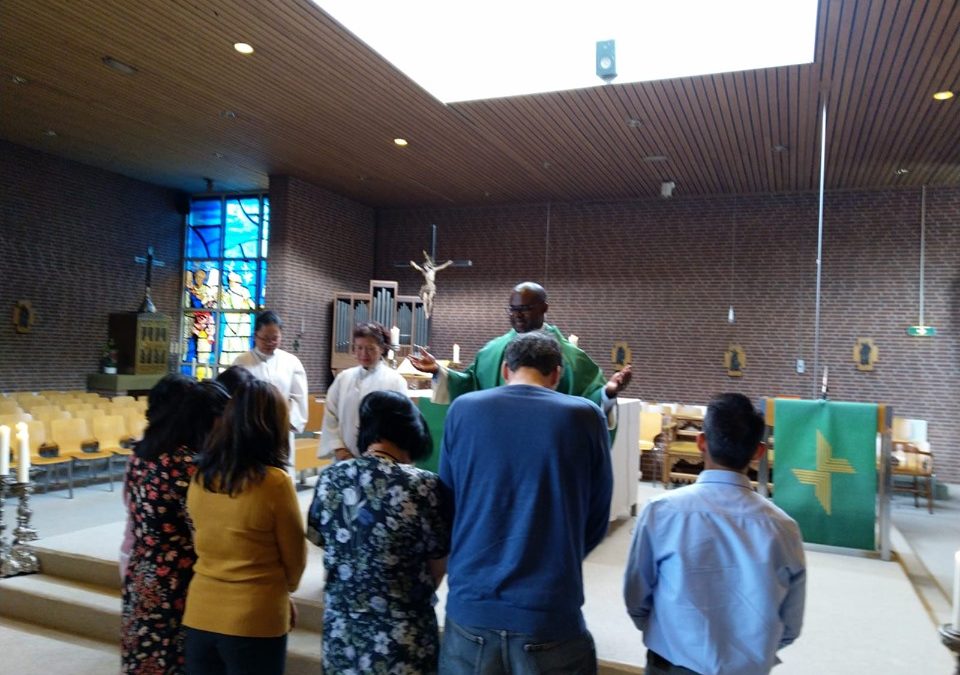
The readings of today, especially the first reading and the gospel, deal with the issue of acquisition of wealth and its uses. Prophet Amos is known for his crusade for social justice. He stood against the oppression of the poor by the rich during his days. That oppression marks the relationship between persons, groups and even nations of unequal powers is evident even in our days. Take any century of your choice and analyze social relations in any given society in it or among the nations. You will see clear traces of the weak being subjected to the strong.
Prophet Amos’ struggle against the oppression of the poor in his days foreshadows the opening sermon of Jesus on the mountain called the Beatitudes (Mtt. 5:3-12). Jesus made a counter-cultural statement about the value system of his time: ‘blessed are the poor in Spirit, to them belongs the kingdom of God’. Further in his preaching, Jesus would regularly remind his audience of the uselessness of trusting in wealth. In the parable of the rich fool (Lk. 12: 13-21) Jesus ended by saying “This is how it will be with whoever stores up things for themselves but is not rich toward God.”
Money and what money can buy seems to top the criteria in determining human success in most societies. Your talents, career, ideas and whatever you have are often judged with regard to their financial values. That is why you see parents making all the efforts to ensure that their children get every opportunity to develop those talents that are financially rewarding in the hope that something clicks someday. Almost every child now is engaged in sport or music, even on Sundays; something that was not the case a few years ago.
Wealth, in itself, is not bad. There is fundamental difference between wealth/money and love of wealth/money. Genuinely acquired wealth is a gift from the Lord, and its proper use for the good of humanity is a sign of blessedness. The love of wealth/money is often evident in the manner of its acquisition and dispensation. With love of wealth/money, people can do anything to acquire wealth and to guard it for themselves alone. 1 Timothy 6:10 “For the love of money is the root of all kinds of evil. And some people, craving money, have wandered from the true faith and pierced themselves with many sorrows”. Like the prophet Amos emphasized, any acquisition of wealth at the expenses of someone else is an atrocity before God. It is a dehumanization of the image of God in which men and women are created. Think of the various things people do to make money and how that affects the society: human trafficking, crimes, forced labor, illegal trades in weapons and raw materials that lead to wars and impoverishing of developing nations, etc. Ecclesiastes 5:10 “ If you love money, you will never be satisfied; if you long to be rich, you will never get all you want. It is useless”. When Amos berates the people for trampling upon the needy and bringing the poor of the land to an end, he is speaking of a reality that still faces us today.
The gospel presents another dimension on the question of wealth in the parable of the astute steward. He was wasteful of his master’s wealth. Yet all through the time the steward was in the service of his master, it never crossed his mind that the wealth he was handling could be taken away from him at any point, at least not so soon. He made no reservations or savings for such eventuality. When he was eventually asked to prepare a handover note, he went for a quick fix that will earn him a future. That was a last minute effort. There is something about last-minute fixtures. You risk losing more than you gain. In the case of the astute steward, he never minded because the goods he was giving away were actually not his own. All he cared for was to ensure that he didn’t end up on the streets.
The steward is both dishonest and smart. In the parable, the master praised the astuteness of the steward but not his dishonesty. There is something interesting that Jesus uses this parable to teach. Note that the steward could have decided to steal his master’s goods instead of making a deal with his debtors. That he could make such a deal indicates that his master does not know the quantity of goods that he has. He rather chose the second option because he wanted to secure what he considered lasting relationship rather than quick money. And Jesus added, “I tell you, use worldly wealth to gain friends for yourselves, so that when it is gone, you will be welcomed into eternal dwellings” (Lk. 16:9).
Everything we have could be considered as the wealth we possess: our talents, time and treasure. They are wonderful to behold and to enjoy, but they will certainly fail some day. However, the use we make of them could be an investment for the future or a wasteful use that has no reward. It is quite encouraging to note that a good number of us devote time and energy to visit the Detention Camp and are involved in various humanitarian works. Others support various community projects, including those of this community. Nevertheless, the gospel challenges each and everyone of us to re-examine our commitment to use worldly wealth to gain eternal friendship with God for ourselves.
In Matthew 25: 31-46 Jesus gives a picture of what the last judgement will look like. Those admitted to the Father’s joy are those to whom the Kind would say, “I was hungry and you gave me food, I was thirsty and you gave me drink, I was a stranger and you welcomed me, I was naked and you clothed me, I was sick and you visited me, I was in prison and you came to me’ (Mt. 25: 35-36), and “Truly, I say to you, as you did it to one of the least of these my brothers, you did it to me”(Mt. 25: 46). We don’t need to wait for a last minute quick fix like the steward in the parable. We can make hay while the sun shines.
While the world occupies itself with wealth creation and craze for riches, it is important to pay attention to the process of wealth acquisition and its use. God who made us in his image prize our being higher that any other material riches. We are beings in transit with an eternal destination. Lets not forget the words of our creator in Genesis 1:26 “And God said, Let us make man in our image, after our likeness: and let them have dominion over the fish of the sea, and over the fowl of the air, and over the cattle, and over all the earth, and over every creeping thing that creeps upon the earth.” We are meant to rule over created things, to care for the earth and not to be dominated and controlled by created things. Ours is to use the wealth in our possession to serve God in creation and thus win for ourselves an eternal friendship with God.
By Jean-Pierre Niati, R.C. chaplain, Detention Center Rotterdam
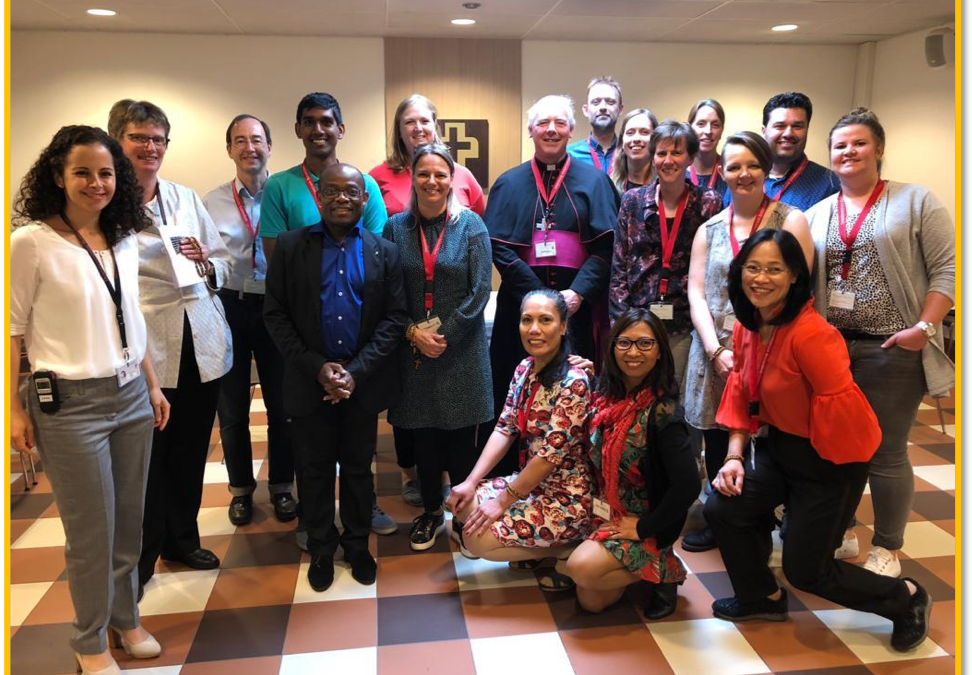
On Sunday July 7th 2019, the bishop Everard de Jong (diocese of Roermond) has visited the detention center of Rotterdam. Monsignor Dr. Everard de Jong, auxiliary bishop of the diocese of Roermond, was appointed by the Dutch bishops to be in charge of pastoral care in the prisons, youth ministry and care institutions.
Upon his arrival in the morning, he was welcomed by Mrs. Jeanin Bou Rached, one of the five members of the general management. She is also the one who holds the portfolio of the Pastoral Service at the detention center.
During her meeting the Deputy Director, Jeanin Bou Rached, has briefed her guest about the situation in the course of the last period. She also informed her visitor about the transformations that will take place in the Center.
As holder of the pastoral care portfolio, the Deputy Director emphasized the importance of the pastoral care for those who are locked up in the center as well as for the entire institution entrusted to her. At the end of the meeting, the Deputy Director accompanied the prelate to the church where he celebrated the Sunday Mass before the ardent congregation.
It is worth to note the role of the Filipino parish at Gouda.
The worshipers, the choir, the chaplain of the detention center and the volunteers Irene, Jane and Amor from the Filipino Catholic Community of Gouda warmly welcomed the prelate. Here it is worth noting that Irene, Jane and Amor are actively involved in the roman catholic chaplaincy of the detention center Rotterdam.
The faith in
God as the source of our
strength
The perceptible meditation of this Eucharistic celebration was candied by songs in English, French, Dutch and Tagalog (one of the languages of the Philippines). The believers sang with fervor that came from their hearts.
Bishop De Jong urged the believers to consider the faith in God as the source of our strength. Particularly, he addressed those who are locked up in the center because of lacking a permit of stay in the Netherlands.
Afterwards he encouraged them to pray incessantly and recite the rosary. Referring to the role of prayer in the life of a believer, the bishop affirmed the strength of praying.
He advised them to keep their eyes, minds and hearts focused on Jesus, for only He who can give us the strength to go through the storm and He who grants inner peace.
In concluding his preaching, the celebrant reminded us to always ask for help from Jesus and the Blessed Virgin Mary. They will never abandon us. The Filipino wisdom teaches us that “Kung walang tiyaga, walang nilaga.” (Without perseverance, there is no reward). Msgr. De Jong offered a rosary of Nazareth to all participants.
How good it is for sisters and brothers to dwell together in unity
Just before leaving the church, one of the undocumented exclaimed: “It’s a unfortunate that we are going back to our cells. “It was good to be here together” (Psalm 133).
For sure, it was good for the bishop, the choir, the warders, the deputy director, the undocumented and the volunteers to have shared this moment together in the house of God.
Each of us
is an angel with only one wing
Luciano de Crescenzo rightly says that each of us is an angel with only one wing. This is a known reality in the Philippines, “Malakas ang isang walis dahil ang mga tangkay nito ay maayos na nakakabit” (the broom we use can only be strong if its rods are properly attached). We can only fly by supporting one another.
(Pictures from Deputy director Mrs. Jeanin Bou Rached)
Communication is something that barely any human person can do without. Whenever we pick up our phones, we expect to see a message from someone. Besides official messages, it is a fact that the closer people are to each other, the more often they communicate with one another. While communication involves transmission of information, communion goes further to include union of minds or spirits. Contents of communication (i.e messages) differ in relation to depth of relationships. There can be no relationship without communication or communion such that one can rightly say that a relationship is dead without communication, or how healthy a relationship is can be deduced from the modes, contents or intensity of communication among the partners. Partners in a relationship is here defined in the broader sense to include anyone with whom you are in transaction at the point in time. It could be your boss or colleague, parents or children, and of course your married partner or any other form of relationship, the highest being our relationship with God.
Communication takes many forms. It could be negotiating, arguing, urging, acknowledging, motivating, appreciating, etc. The manner of communicating is not only influenced by the circumstance and the relationship with the other, and vice versa, but can as well largely determines the direction any relationship goes.
In the first reading, we see Abraham negotiating with the Lord who was on his way to destroy the city of Sodom and Gomorrah. Relationship between Abraham and the Lord attained a new level with the good manner in which Abraham received him and the other co-visitors, prompting the Lordm to consider telling Abraham his intention to destroy the city of Sodom and Gomorrah. As the discussion developed, Abraham gained confidence because the partner in the discussion seemed open and tolerant to his requests. Abraham was not asking anything for himself, but knowing that his brother, Lot, was residing in Sodom at the time, he sought to spare the land and his brother’s family. Here we see intercessory prayer in action. The action of praying for others, but also to work for the benefit of other people always find favour in the sight of God. The bible is filled with accounts of great intercessors who pleaded on behalf of the people before God. Moses played this role when the anger of God broke out against his people in the wilderness. In Exodus 32: 11 and Deuteronomy 9: 13-14 Moses stood against God’s anger towards the rebellious Israelites in the wilderness and thereby averted their being destroyed. Ezekiel 22:20 echoes the need for intercession in the words attributed to God desiring that there was an intercessor to avert destruction of the people, “I looked for someone among them who would build up the wall and stand before me in the gap on behalf of the land so I would not have to destroy it, but I found no one”.
In the Gospel Jesus taught his disciples how to pray. In the format of the prayer, The Lord’s prayer, we see the elements of good communication between a child an his loving father. The first part which concentrates on the interest of the father – acknowledgement of his fatherhood, adoration, wishing his will to be done – reflects the purpose of the incarnation of Jesus Christ. He came to reveal our heavenly father to us and teach us his will. Jesus himself opinioned that his food is to do the will of the father who sent him and to finish his work (John 4: 34).
Doing the will of the father is something that is often confusing. How do we know the will of God in any circumstance? The simple human question that naturally arise from this is, “how do we know the will of those around us – our boss, colleagues, friends, children, loved ones, partners, etc? Simple! We may not always know what they want or desire but the closer we are to them the easier it is to decode what they would likely want in a situation. It is a matter of how close a relationship is and the intensity of good and open communication existing in it. Jesus maintained close communion with the father by constantly going aside to pray. Major decisions like choosing his apostles (Lk. 6: 12-13) and facing his crucifixion (Matt. 26:36-42) were preceded by prayer with the father. Communication with the father was a vital aspect of the life and mission of Jesus. When we intensify our communication with God our loving father through prayer and reflection/meditation, our relationship with him will deepen, and his Spirit will reveal things to us (cf.1 Corinthians 2:10).
The second part deals with the interest of the one praying. Like Abraham in the first reading, we negotiate our interest with our heavenly father – seeking our sustenance, reconciliation with him and with others. Forgiveness is so important that it is premised on the condition that we too forgive others. Lack of forgiveness blocks any meaningful communication and severely harms relationships. There is nothing so destructive as unforgiveness. We need God’s forgiveness and those of the people we have offended to enable us enjoy peaceful and blessed life, and we equally need to intend this goodness to others by forgiving them for the harm they caused us. Offering or receiving forgiveness is like repairing a bridge that connects two communities, without which physical contact between those communities would be impossible.
In the Lord’s prayer, Jesus draws our attention to the pattern our prayers or communication with God should take. So often we begin with our interest (give us this day) rather than acknowledging the goodness of God and seeking for his will to be done in our lives. Similar things happen in human relationships. People who only come to take from us without ever appreciating our goodness or giving back in any way are often not in our good book. Even Abraham knew that good reception of his guests could open a way to better relationship.
Jesus went further to tell a story to encourage perseverance. Life is tough and only the tough keeps winning. Giving up in the face of adversity or shutting off when we feel we are not making a headway is often not the best decision. Giving one more trial could do the needed magic. Jesus urges us to pray without ceasing (Lk. 18:1). We need to have confidence in our heavenly father. A confidence that springs from the fact that, through baptism, we have been made God’s children by the death and resurrection of Jesus, an event that cancelled the consequences of our sins (cf. 2nd reading – Colossians 2:12-14).
Jesus assures us that God our loving father will give us what we asks with confidence if we persevere, and St. Paul’s statement in Rom. 8:32 strengthens this assurance: “He who did not spare his own Son but gave him up for us all, how will he not also with him graciously give us all things?” It is with this confidence that we have to strengthen the bond of our relationship with God and intensify our communion/communication with him in the various forms of prayer (liturgy, worship, private prayers, meditation/reflection, etc.).
Every 4th Sunday of the month, FCC Gouda and Surroundings holds a Children’s Bible Corner. Its aim is to teach children the liturgy for that particular Sunday in words and activities they can understand. On this 17th Sunday in Ordinary Time, the reflection is about Jesus teaching us how to pray and why praying is important .
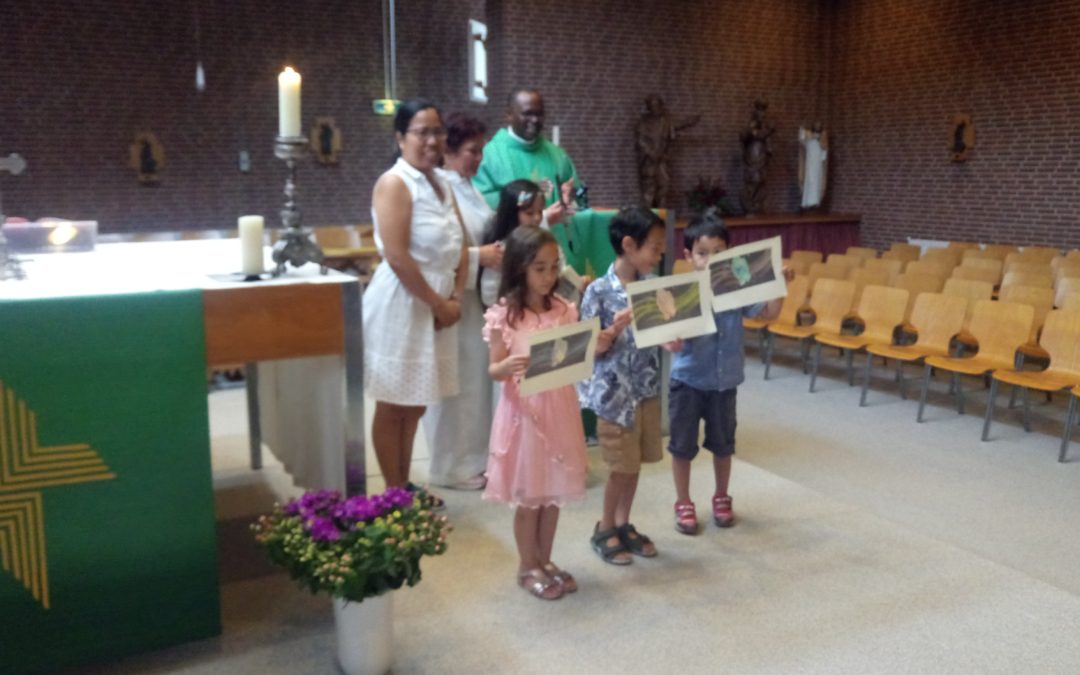
Last Sunday, there were only four children present in the church, ( Lucas, Derek, Zeanna and Lorraine), nevertheless, the interaction among them was enthusiastically light and interesting.
This photo below of both hands together was shown to them and immediately the children recognised that it is a photo of someone praying.
The children were asked if they pray and all answered in the affirmative. Derek said that he prays that no one in his family will become sick while Lucas prays for a new toy. Do they pray with both hands together? Everyone answered “Yes!” Zeanna mentioned that she even closes her eyes when she prays. When do they pray? One said before sleeping and the other, before eating and another in the car before going somewhere. When asked if they can tell God everything, they responded that they can. They learned that God loves and wants us to talk to Him.
Indeed, prayer can be done with both hands together or both hands open, swaying their hands praising God , kneeling or bowing their heads. The children must learn to pray and talk to God as their Father just like how Jesus taught us how to pray, short or long, anytime and anywhere.
With that said, the children presented the photo above( which they colored) in the church. Zeanna led the prayer for the group, reminding everyone that Prayer is conversation with God; He loves us and He wants us to talk to him.
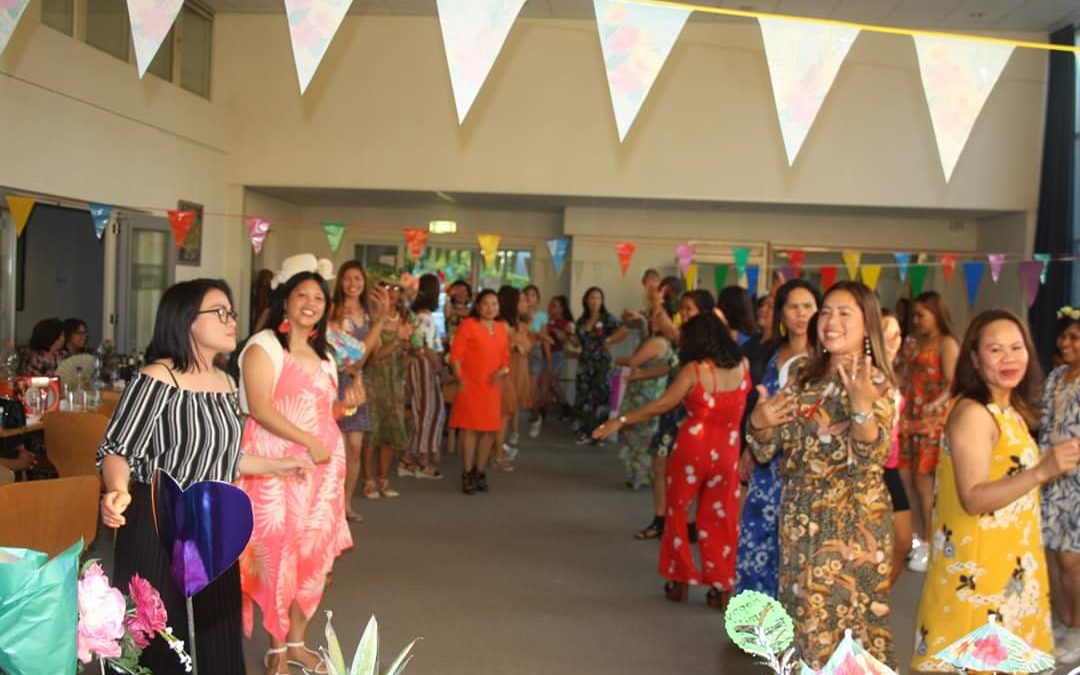
The Filipino Catholic Community of Gouda and Surroundings held its annual Family Fun Day last June 29, 2019 at the Antonius Hall in Gouda. Its goal is to raise funds to support FCC Gouda activities. To captivate the beauty of summer, this year party theme is Havana look. The hall was decorated with colorful and summer-like articles. Despite a very warm (32°C) day, people, attired in colorful clothes, started to fill the hall at around 5pm with smiles and joyous greetings.
Rightly so, the program started with an opening prayer of praise and gratitude led by Fr. Marcel Uzoigwe. Dinner was served afterwards while Stephany Alison renders a sweet song. The party went on with surprise dance and song numbers and games for young and old.
The highlight of the night is the appreciation of all volunteers who gave time and resources and worked hard for the maintenance and betterment of the FCC Gouda. The volunteers were each given a ribbon of recognition for their contributions (diaconal work, choir, altar servers, making and printing of mass handouts, creative works and the Children Bible Corner (CBC) guides). Appreciations were extended to the members of FCC Dordrecht and FCC Rotterdam for their support in the FCC Gouda activities. Special acknowledgements were also given to persons who generously donated things/items/articles and funds to FCC Gouda.
Towards the end of the party, the best havana costume was selected by a panel of judges. Ma Luz vd Starre and Gina Lea van Rijn were chosen to be the best havana dressed girls of the night.
It was indeed a fun filled family day, just as how the people came in, everyone left not only with smiles on their lips but joy in their hearts.