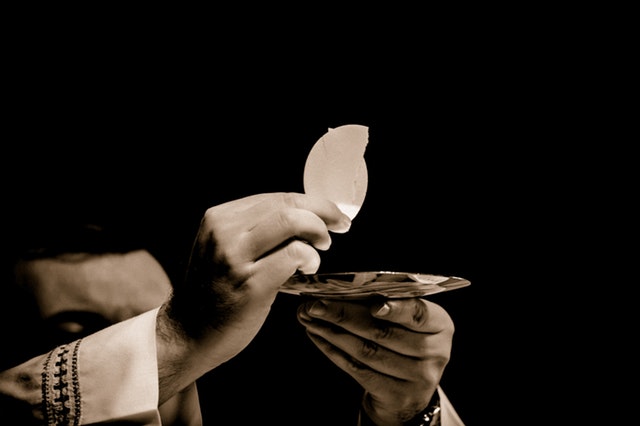
Today, the universal church celebrates the Solemnity of the Body and Blood of Jesus Christ. This feast was established and extended to the Universal Church by Pope Urban IV in 1264 to celebrate the Real Presence of the Body and Blood, Soul and Divinity of Jesus Christ in the elements of the Eucharist. During the Last Supper, while at table with his disciples, Jesus took bread, said the prayers, broke it and gave it to his disciples saying: take this all of you and eat of it, for THIS IS MY BODY. The same he did with the wine saying: “THIS IS MY BLOOD”. He then commanded them to “do this in memory of me.” These same words are repeated by the priest during consecration because the Eucharist is NOT a symbol of the Body and Blood of Jesus Christ but the REAL presence of Jesus Christ.
Jesus makes the most perfect gift of himself to us in the Eucharist out of his love and desire to be intimately united with us at all times. Love manifests itself in giving, and the greatest gift is that of oneself. The readings of today deal with the subject of giving or offering of something. The first reading related the encounter of Abram with Melchizedek on his return from a victorious battle. Abram offered a tenth of all his spoils to the priest of the Most High God, Melchizedek, who blessed him. Melchizedek in turn offered bread and wine in thanksgiving to God on behalf of Abram. The offering of bread and wine foreshadowed the event of the Eucharist which Jesus, the perfect high priest of the new order, offered for the salvation of mankind.
The Gospel reading touched on the same theme of giving without counting the cost, a symbol of boundless love. Having taught the people for several days, Jesus felt their physical hunger and lack of bread. Rather than sending them away to go and fend for themselves, he decided to do something instead, to find a way to feed them. Jesus had no bread himself. John’s account of this event (John 6: 9) has it that there was a young boy with five loaves and two fish, and was willing to offer them up for the good of everyone rather than focus on his own personal need for them. Jesus took the bread and fish, said the prayers and set them before the people. What could not be enough for a few persons was sufficient to feed over five thousand men and twelf baskets of leftover were gathered afterwards. The extent to which true charity can go is unfathomable. That is why it is more blessed to give than to receive (Acts. 20:35).
Aware of the constant human weaknesses and spiritual poverty, Jesus freely offers himself to us in the Eucharist, in such an unconditional love that the human mind can hardly grasp. He invites us to eat of him who is the true bread that comes down from heaven and gives life to the world (John 6:51). Vatican II in Lumen Gentium 11 declared that the ‘The Eucharist is “the source and summit of the Christian life.”’ The Catechist of the Catholic Church (CCC 136) reaffirms this and added that “The other sacraments, and indeed all ecclesiastical ministries and works of the apostolate, are bound up with the Eucharist and are oriented toward it. For in the blessed Eucharist is contained the whole spiritual good of the Church, namely Christ himself, our Pasch … It is the culmination both of God’s action sanctifying the world in Christ and of the worship men offer to Christ and through him to the Father in the Holy Spirit” (CCC 137-138). In his first letter to the Corinthians, which forms the second reading, St. Paul recounts the event of the Eucharistic celebration as a tradition which he himself received and transmits. The Eucharists became the center of Christian communities that began with the apostles of Jesus Christ and has continued down to our time. It is the command of Jesus himself that we do it in his memory.
The famous Dutch priest, Henri Nouwen, in his teaching on becoming the beloved (https://www.youtube.com/watch?v=3-bGS8sysjY) sought to illustrate how the actions of Jesus in instituting the Eucharist summarise the life of Jesus and that of us all as the beloved of the father. In doing that he virtually used the words of St. Paul in the second reading to illustrate the sequence: Jesus took the bread, said the blessing, broke it and gave it to his disciples. The four words: Taken, Blessed, Broken and Given, according to him, summarize the life we are called to live in the footsteps of Jesus. Jesus, the beloved, unique and anointed son of the father allows his blessed life to be taken, broken to the utmost, and given for the life of the world.
As we celebrate the solemnity of the Body and Blood of Jesus Christ today, let us call to mind the immeasurable gift of himself that Jesus makes to us. A gift that led him to a great suffering and pain, and continues to hurt whenever we abuse his body and blood in the Eucharist. Let us also call to mind that we all, as members of his mystical body – the Church – are called to offer ourselves daily for the good of others. Difficult and painful as this may sometimes be, the Eucharist offers us the spiritual strength to walk in the footsteps of Jesus Christ and make of our lives an offering to God for our brothers and sisters.
(Homily delivered by Fr. Marcel Uzoigwe on 23 June, 2019)
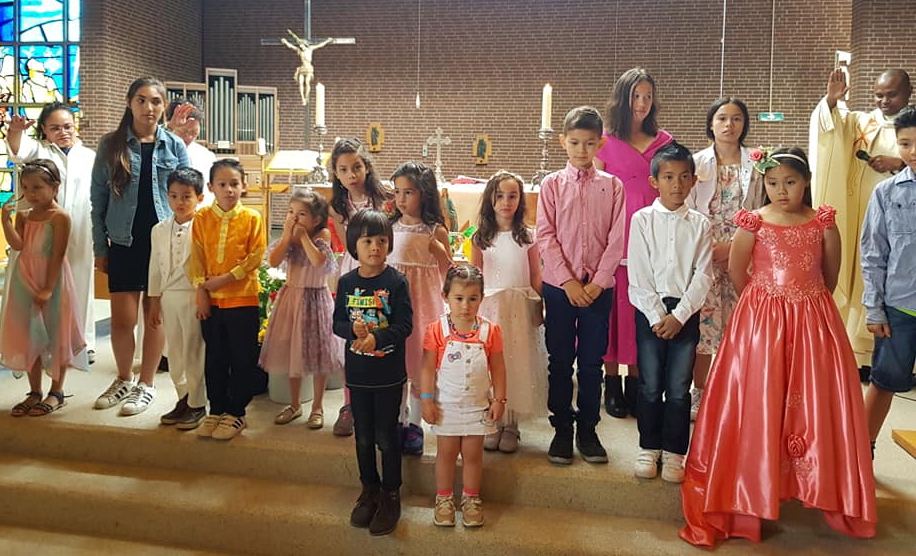
Sunday, May 26, 2019, the Filipino Catholic Community of Gouda and Surroundings held the first ever Flores de Mayo, Santacruzan and the Children’s Mass at the OLV Hemelvaartkerk in Gouda.
Flores de Mayo (flowers of May) and Santacruzan ( holy cross) are devotional native festivities of Filipinos to the Blessed Virgin Mary in the month of May. Flores de Mayo involves offering flowers to the image of the Virgin Mary. It is being done for the entire month of May. Santacruzan, which commemorates the alleged finding of the true cross by Helena of Constantinople, is done on the last day of the Flores de Mayo. It is a procession of people, mostly women, representing biblical characters and Marian titles. At the end of the procession is the Reyna Elena (in honor of Helena) carrying a cross.
The activity started at 1 o’clock in the afternoon with the Flores de Mayo, participated by the adult members of the church, each carrying a flower and offering at the altar bearing the image of Mama Mary.
It was immediately followed by the Santacruzan. Young members of the church took part in the procession, each carrying symbols from the bible and Mary titles. Three children each carried a figure of a cross, an anchor and a red heart, representing the three theological virtues of faith, hope and charity, respectively. Other participants were carrying symbols such as a star (Mary Queen of the Stars), flower boquet (Mary Queen of Flowers), dove (Mary Queen of Peace) and the cross in honor of Reyna Elena (Queen Helena who allegedly found the true cross).
By 2 o’clock, led by Fr. Charles Ajogi, CSSp, the Children’s mass follwed. It is a eucharistic celebration with texts and readings simplified for children to understand. The young members of the church did the liturgical readings, prayer of the faithful and joined in the choir singing. Towards the end of the mass, Fr. Charles summoned the children in front and blessed them.
On a joyous note, with the FCC Gouda members, parents and children working hand in hand as one community, the month of May was a victorious month!
Today is the second Sunday of Easter – the Octave of Easter. It is also the day that we celebrate the Divine Mercy Sunday. The gospel narrates the appearance of Jesus to his disciples who were still grappling with the entire events of his death and resurrection. After the crucifixion and death of Jesus, his disciples were devastated; some of them scattered in the confusion that followed. Then came the news of his resurrection. They were still at a loss, especially given the manner the news of the resurrection was filtering in. The Jewish authorities that killed Jesus were still a big threat, and the resurrected Jesus was nowhere to be found. They felt harassed and intimidated, like sheep without a shepherd. All they could do was hide behind closed doors. On the one hand, they were afraid of the Jews that murdered their master. On the other hand, the guilt of having abandoned their master during his most difficult moment was in itself scaring.
In the midst of their confusion, doubt and fear, Jesus appeared to reassure them that he is indeed alive. How very awkward they must have felt as Jesus suddenly appeared in their midst. They must have been afraid too that the moment of reckoning has come; the moment of telling off and dressing down, not only for their cowardly behaviour but also for their lack of faith in him. But instead Jesus pronounced peace on them; they had been unsettled and needed that healing of their guilt and awkwardness. The risen Jesus shows his hands and his side lest they forget what they and the world did to him, but he did not follow with words of rebuke, only words of mercy. He goes further to empower them to become the agents of that healing mercy of God in the world; he breaths on them and says, receive the Holy Spirit, whose sins you forgive, they are forgiven, and whose sins you retain, they are retained.
Jesus’ visit to His disciples was vital to restore their courage and faith, assure them of the veracity of His teachings about His death and resurrection and empower them for the task he was entrusting to them. Doubt and fear can be great obstacles to effective Christian living, limiting the power and courage to engage oneself in Christian witnessing, works of mercy and reaching out to those in need. Jesus’ aversion to doubt could be seen in His somewhat reprimanding words to Thomas who was absent during his first visit, and thereafter had difficulties believing the report of his fellow disciples regarding the appearance of Jesus to them. The Christian faith is obviously not resistant to rational reflection; on the contrary, living faith can only be founded on sound reasoning. But in spite of human reasoning being the starting point to the Christian faith, faith goes further than human reason. Taking human reasoning to be the utmost and the only yardstick for measuring facts leads to denial of whatever that eludes human conception; and there are many of such phenomena such as the resurrection of Jesus from the death. They transcends the sphere of human conception that operates with the attributes of space and time.
During this visit, Jesus greeted his disciples with peace before entrusting to them the specific tasks to forgive every sins. In doing so he opens wide the door to the Father’s boundless heart of love and Mercy. Divine Mercy is manifested in the forgiveness of sins as clearly evident in the events of today’s Gospel. Love, mercy and forgiveness naturally lead to peace. When we learn to love, it becomes easy to have mercy, to forgive and to experience lasting peace. It is only then that we can take the extra steps to reach out to others. Today, Jesus reassures us of his living presence with us and invites us to approach his throne of mercy, experience his love and forgiving heart (also in the confessional), and to become agents of love, mercy and forgiveness.
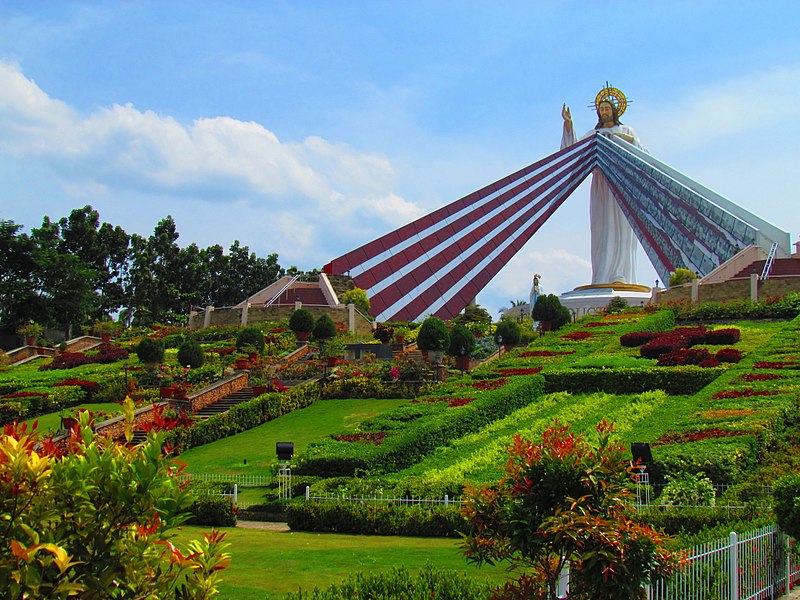
One can then understand why the celebration of the Divine Mercy has been placed on the Octave of Easter. During the 30th April 2000 (Sunday after Easter) canonization of the Polish nun, Sr. Faustina Kowalska who died in 1938, Pope John Paul II designated Sunday after Easter as Divine Mercy Sunday. Sr. Faustina was gifted with extraordinary visions and experiences of the Lord Jesus. The most famous of these was the Lord revealing his sacred heart from which came rays of light, red and white which she interpreted as the radiating forth of the Divine Mercy. Following the revelations Our Lord gave to Sr. Faustina, Jesus promised to grant forgiveness of all sins and punishment, even to the most hardened sinners who turn to ask for God’s mercy, especially on the Feast of Divine Mercy.
The message of the resurrected Jesus finds expression among his disciples in the signs and wonders that were being done through them among the people. The first reading reports that there is something that can be seen and verified in the Christian community born of faith in the risen Lord. It is the completely new kind of life that is being led in these communities that testifies that Jesus is alive and that he has sent his Spirit into the world. In the early times of the Church, Christians needed no identification badges because the fruits of the Holy Spirit (Galatians 5: 22-23) were evident in their lives and the communities they formed. Acts 4:32 described the interpersonal relationship among them as being united in “one heart and one soul”.
As we celebrate the Divine Mercy Sunday on this Second Sunday (Octave) of Easter, it is important to review to what extent we ourselves and our community mirror the merciful heart of Jesus: a heart of love, care and forgiveness. It is amazing to note that given the absence of Thomas during the first visit of Jesus to His disciples, Jesus had to repeat the visit to personally convince Thomas the he has indeed risen from the dead. That is in itself an invitation to imbibe the Good Shepherd’s attitude in reaching out to our brothers and sisters, even when they seem unwilling to cooperate. Jesus comes to us in a very special way during every Eucharistic celebration. We pray that as he comes today, he may find us -individually and collectively – as true agents of his love, mercy and forgiveness to the world around us.
As we celebrate the Divine Mercy Sunday on this Second Sunday (Octave) of Easter, it is important to review to what extent we ourselves and our community mirror the merciful heart of Jesus: a heart of love, care and forgiveness. It is amazing to note that given the absence of Thomas during the first visit of Jesus to His disciples, Jesus had to repeat the visit to personally convince Thomas the he has indeed risen from the dead. That is in itself an invitation to imbibe the Good Shepherd’s attitude in reaching out to our brothers and sisters, even when they seem unwilling to cooperate. Jesus comes to us in a very special way during every Eucharistic celebration. We pray that as he comes today, he may find us -individually and collectively – as true agents of his love, mercy and forgiveness to the world around us.
(Image source and caption: Wikipedia– The Divine Mercy Shrine in El Salvador City Misamis Oriental, Philippines.)
On March 24, 2019, the Board of the Filipino Catholic Community of Gouda (FCC-Gouda) and Surroundings headed by Amor van Os presented to the community a concise report for the year 2018 and the plans for 2019. Through this report, the FCC-Gouda Board aims to achieve transparency of all events and transactions for all its members.
FCC-Gouda 2018 Report of Finance & Activities
The Board Chairman, Amor van Os, began her report with the activities of the FCC-Gouda and surroundings in 2018.
Summary of FCC-Gouda Activities in 2018
Most importantly, Amor also reported the financial status for the year 2018, including sources of income and to where the money was spent. In 2018, FCC-Gouda had a lot of expenditures, including the fixed expenses for the monthly mass and church use. The Community also allotted financial support for its diaconal work and for all the other activities done last year. With the help of volunteers and generous donors, the activities in 2018 were realized.
FCC-Gouda 2019 Plans & Activities
The Chairman proceeded in reporting the activities and plans of FCC-Gouda and Surroundings to the Community for 2019. The monthly mass will continue every 4th Sunday.
In January 2019, the community has launched the Children´s Bible Corner (CBC). Its goal is to start the young members of the community to be actively involved in deepening their knowledge of God. Another service that started beginning of this year is the Detention Visitation, which is a part of the community’s diaconal work.
The Couple’s Blessing was initiated during the mass in February. FCC-Gouda plans to do this activity every year.
March marked the beginning of the annual Holy Retreat. On March 9, 2019, the FCC-Gouda and Surroundings sponsored and attended a Holy Retreat in Handel.
Some of the FCC-Gouda members are also doing a Pastoral Course on Initiation Sacraments with the modules on Baptism, First Communion and Confirmation (Initiatiesacrament: Module Doop, Eerste Communie en Vormsel als initiatie), for 5 consecutive Mondays starting from March 4 till April 1, 2019. This course will enable the members of FCCGouda and Surroundings to give information and hold seminars prior to the sacraments and to conduct these sacraments with the help of the priest during the FCC-Gouda Holy Mass.
Other planned activities for 2019 are presented below.
Aside from the above mentioned plans, Amor also announced that a Website Course for few members of FCC-Gouda and Surroundings is in the planning. This course will train interested participants in understanding at least the basics of website management, including the value of hosting and domain names. Furthermore, the Board is also busy with the application for ANBI (algemeen nut beogende instelling) status.
Members of the community expressed gratitude to all members of the FCC-Gouda Board after the reporting, which is the very first community report made. Community members were delighted to know the status of the Filipino Catholic Community of Gouda and Surroundings, especially the activities and financial standing. Some made valuable suggestions and further support for the betterment of FCC-Gouda. Some even complimented the works done by the whole team. Everyone left with appreciation and a happy heart.
The meeting was adjourned with happy faces and contented hearts.
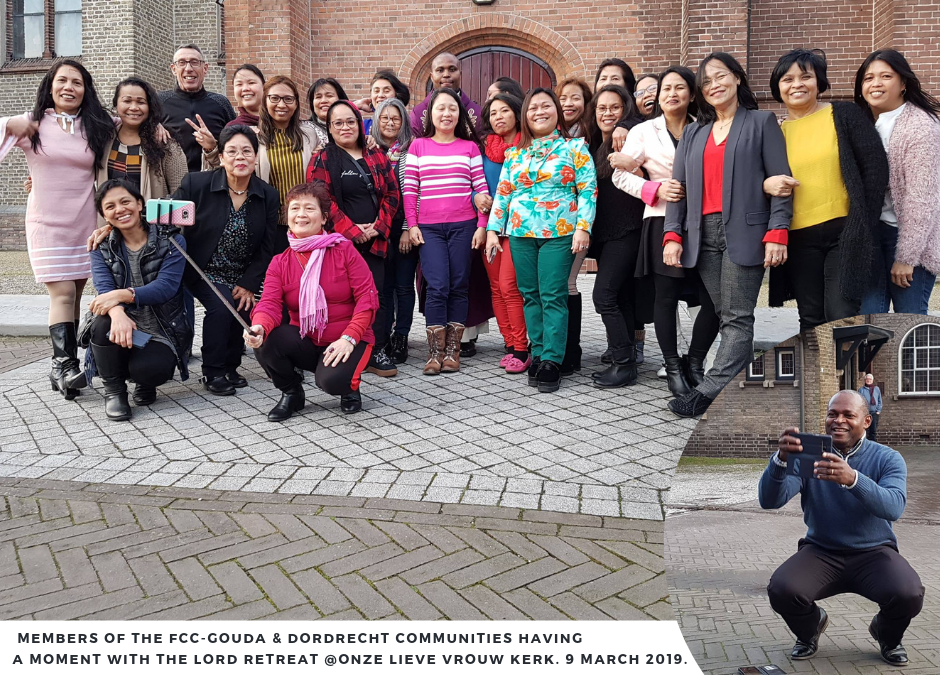
March 9, 2019 was not just a holy retreat. It was not only ‘a moment with the Lord,’ the theme of this day’s spiritual retreat. It was a full day divine encounter that has a lasting impact in the lives of those who came, who saw, and who went home victorious!
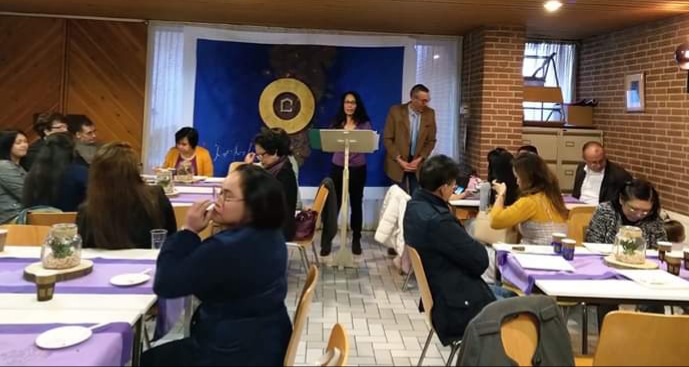
Early at 8AM, twenty-one of us from the Filipino Catholic Community of Gouda (FCC-Gouda) and Surroundings made it on time for our one and a half hour bus ride to Handel in North Brabant where the FCC-Gouda Board made plans for a spiritual retreat— the very first for the community! The group arrived before 10AM and three other members from the Filipino Catholic Community in Dordrecht joined us there at the Onze Lieve Vrouw Kerk where the retreat is taking place. Warmly welcoming us upon arrival was Fr. Marcel Uzoigwe, who then introduced us to our retreat master of the day, Fr. Charles Ajogi.
Getting started with introductions and cups of coffee and tea
“It’s easy to spend our time
shopping, working, visiting places, or chatting with friends. But it’s very
difficult to spend solitude with God,” uttered Fr. Ajogi as he wasted no time
getting us oriented of the day’s activity. “If having a solitude with God is
easy, then it would be one of our top things to do.” He went ahead and talked
about the importance of silence and that of prayer.
Prayer is simply a conversation
with God, our Heavenly Father and Creator. Just like speaking with our best
friend, such interaction is characterized by having full attention to the
person— especially when sharing secrets or our inner most thoughts and
aspirations in life. When conversing with a loved one, there’s that element of
listening, trust and respect; there’s no hiding and pretending. In the same manner,
we can tell exactly how we feel when we converse with God.
The week we went for a retreat was also timely for the first week of Lent. As we all know, Lent is a Christian penitential period that involves the disciplines of abstinence and fasting for the sole purpose of repentance. It is a time of the year that should be spent on preparing and strengthening our body and mind through prayers and reflections before Easter. Thus, we’re in the so-called 40-day period prior to Easter Sunday!
As Lent is the time of spiritual preparation before Easter, beginning this season with a spiritual retreat is like doing the right thing at the right time and at the right place with the right people. What could be more awesome than that, right?
But what is significant about these 40 days? What is it that we ought to be doing at this period before Easter? Why are we having this retreat in the first place? These were the questions that were thankfully answered during the first hour before we had our individual quiet times, group discussions and sharing, praying the Rosary, and the mass— all part of the well-planned program prepared for us by the Congregation Sancti Spiritus (CSSp) Community in Handel.
Retreat participants led by Fr. Charles Ajogi
“Numbers have meanings,” began
Fr. Charles as he explained the significance of what we were about to do that
day. “Just as number 1 signifies our unity with God and number 3 means
completeness and number 7 perfection, the number 40 often signifies a period of
growth. And before growth is manifested, there comes trials or challenges that
needed to be overcome.“
So what is it then that we should be doing during this 40-day period?
As we, the participants,
reflected on these questions on solitude, prayer and Lent, we came to realize
that we have been observing Lent for compliance sake; we haven’t really taken
it seriously as part of our personal spiritual growth. As Fr. Charles put it,
this is the best time to make resolutions and do something about it. For
instance, some people can make a pledge to do one act of kindness. For some
others who haven’t developed the habit of praying yet, they can tell themselves
to commit to prayer even for at least 5 minutes upon waking up in the morning
and another 5 minutes before going to bed. If say, for example, one managed to
get these done within the period of 40 days, then isn’t that something worth
celebrating as well in remembrance of the day our Lord Jesus Christ resurrected
from the dead?
To further equip us in our journey towards spiritual maturity, Fr. Charles also shared with us eight (8) steps to meet God in silence and in solitude.
1. Pay attention to what’s going on in your soul, in your life.
2. Overcome resistance or whatever it is that is pulling you back.
3. Seek rest for your body, mind and spirit.
4. Let your emptiness lead you to God’s fulfillment.
5. Face yourself as you really are, and allow God to help you.
6. Receive God’s guidance. It is a gift and it is up to you to receive it or reject it.
7. Let that love you receive in solitude helps you to reach out to others in life.
8. Make silence and solitude a part of your daily life.
Following lunchtime was a
fruitful and emotional group discussion; four teams were formed and were given
a set of three questions to talk about and reflect on…
Do you think it makes sense to take a step of faith, and why? How does hearing from God affect your daily life? Would you like to hear from God more? What is the importance of solitude in your life?
Could you share a personal story of a time when you experienced the value of solitude? Define prayer in your own words. What do you think it means to hear from God, and what are some of the ways you experience it personally?
Do you find solitude difficult or easy, and why? Could you talk about the importance of prayer in your life? Where do you look for guidance and inspiration when you need it, and why?
How do you balance solitude with your daily activities? Could you talk about a time when you’ve held unto your faith, or to a particular conviction, even when it was hard? What helped you to keep believing? What do you think about the value of prayer in your life?
To sum up what had transpired
during the group discussions, to be in solitude is a conscious effort. It’s
letting go of the nuisances in our hearts and minds, so we could enjoy that
special moment with God’s presence. It’s a time of silence, a time to speak to
God and also to listen.
Prayer is not an obligation; it
is a lifestyle. We can talk to God anywhere we are at any time of the day and
of about anything we have in our minds and in our hearts. In fact, prayer is
also something we could give as a gift to others, especially to those in our
community who are in utmost need.
In that afternoon, we did experience much more than expected. With thanksgiving in our hearts, below wordart shaped like a clover summed up all that every participant has shared as takeaways from this day’s holy retreat.
When participants were asked what their takeaways are from this one-day retreat, above clover-shaped wordart sums up the answers.
SPECIAL WORDS OF THANKSOnce again, we thank the members of the FCC-Gouda Board headed by Amor van Os for making this holy retreat happen. Thank you, Fr. Marcel Uzoigwe for coordinating all these with Martin van Moorsel and Callistus Offor at CSSp Community in Handel. Big thanks to our retreat master, Fr. Charles Ajogi, who did very well not only in facilitating the activity but also in addressing all posted questions. Above all, we give back all the glory to God, who made all these wonderful things possible.
(FCC-Gouda Board Secretary, Susan Horn-Perez, also contributed to this article.)