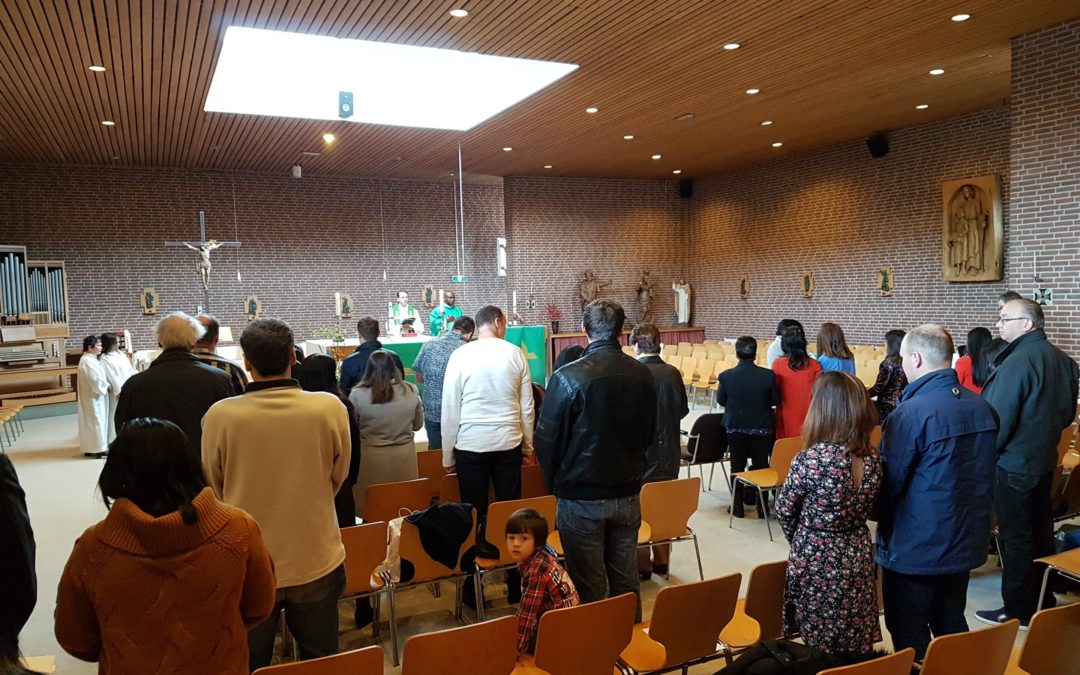
By Fr. Marcel Uzoigwe, CSSp. | Homily 3rd Sunday of Year Lent C
You may have experienced occasions when misfortune befalls those considered to be evil in the society and instead of being pitied, the dominant response you hear is something like, “that serves them right”, “good that they received what they deserve” or even “thank God for the evil that befell them”. We may have even said that one or more times. That is precisely the attitude displayed by the people who came to Jesus with the news of the slaughter of the Galileans by Pilate in this Sunday’s Gospel reading. We have witnessed a number of disasters and bloody killings in recent times: the Ethiopian flight disaster, the killing of Muslims in New-Zealand, the Mass killing of Christians by Muslims in Northern Nigeria, the horrible natural disaster of the Tropical Cyclone Idai in Mozambique and the Eastern borders of Zimbabwe and Malawi, etc. Could we say that the fate these victims met is a consequence of the sins they committed? No… not in any way. Any such condemnatory attitude embodies some level of self-justification and “better than thou” notion of self as against the victims of these disasters.
Jesus was clear with his rejection of such attitude in his response to the people who brought him the news of the disaster that befell the Galileans: “Do you think that because these Galileans suffered in this way, they were worse sinners than others? No, I tell you; but unless you repent, you will all perish as they did.” Similarly, about the eighteen who were killed when the tower of Siloam collapsed on them Jesus queries: “Do you think that they were worse offenders than all the others living in Jerusalem? No, I tell you; but unless you repent, you will all perish just as they did.”
The only good that misfortunes serve is the lesson we learn from them to ensure that such never repeats again. In the gospel, Jesus utilized the occasion to teach on the uncertainty of life; the necessity of being vigilant; of not being overly attached to that which we might easily lose at any moment. He noted that it could happen to anybody, and that if they don’t happen to us at this time, it is because of God’s mercy and love not because of what we deserve. It is the grace of God that keeps us alive and enables us to advance in our undertakings; and that grace must not be taken for granted or abused. Thus, the right attitude of living by the grace of God should rather help us to make the best of the opportunity God gives us everyday to make amends and become better human beings. Lent is a grace period to reflect on our lives and seek to understand the aspects of our life that God is calling each of us to pay closer attention to so as to become holy and ready for every good works He wishes to entrust into our hands. So, instead of wasting our limited time standing in judgment over those whom misfortune has befallen, such times should more wisely be invested in responding to the invitation from God to humble repentance and good works before our time on earth runs out.
Saint Paul echoes this warning in the second reading by calling on the Corinthians to learn from the misfortunes of their forefathers who were cherished by God but failed to utilize the opportunity given to them. His warning stems from the story of the liberation of the Israelites from slavery in Egypt which we find in the first reading. God took the initiative, having seen the affliction the people suffered in the hands of the oppressors. He chose a man called Moses who himself was forced to run for his dear life when his personal attempt to save his people hit the rock. He had killed an Egyptian oppressing an Israelitan, who later betrayed him by not keeping the secret (Exodus 2: 11-22). He was uncertain what his return to Egypt would have in stock for him. Despite being betrayed by the very person he fought to save, he needed to put behind the past and focus on the new creation that God was making of him and undertake the unsavoury task of going to speak to the Israelites about God’s decision to set them free from the Egyptians. When God revealed his name “I AM WHO I AM”, Moses realized that what his human effort could not achieve is possible with the divine presence and support. He only needed to make himself available and God will do the rest through him. Saint Paul noted that the people failed to maintain faith in the God who liberated them out of slavery in Egypt, and therefore many of them died without reaching the promised land. We, therefore, need to be careful not to misuse the opportunity the grace of God offers us for repentance and reconciliation.
Dear Friends, the urgency for repentance, reconciliation and gratefulness to God for his graces are the themes that run through the entire readings of today. That is to be expected given that Lenten period encouraged reflection in this necessary direction to salvation which is a core value of Christ’s death on the cross. Repentance and reconciliation are intimately intertwined. Repentance is possible because God is offering us reconciliation, and being reconciled with God involves the commitment to a new style of life and building the new creation made available in Christ. The parable of the fig tree that follows Jesus’ rebuff to the idea of misfortune as punishment in the gospel of today brings out the fact that God continually offer us the possibility of repentance. Honest repentance goes beyond mere words or emotional acts of sorrow for offenses committed to include evaluating our lifestyles, actions and attitudes. The call to repent is the call to turn over a new leaf, to begin afresh; reconciliation is the fruit of this turning around and links the personal new beginning with the work of the whole body of Christ to establish the kingdom of peace and love.
Call to mission follows genuine repentance. What God has done for us, we seek to extend to others through various forms of ministry (service) to them. God would not allow Moses to remain with the new life he had found in Midian but sent him back to extend liberation to his own people. Moses returned to Egypt, no longer as the carnal man with natural powers to fight for the liberation of the Israelitans but in the power of God. We need not be afraid to make ourselves available for whatever God calls us to do that will bring His love to those around us. God’s grace is ever sufficient for us. St. Paul, who experienced the power of God in the midst of hardships he endured during his missionary engagements, wrote in Romans 8:37 that in all things we are more than conquerors through Him (Christ) who loves us, and Philippians 4:13 that he can do all things by the power of Christ who is his strength. This is sufficient assurance of what God can do in us when we repent and reconcile with Him and with one another. May His grace lead us to answer His call this Lenten session. Amen.
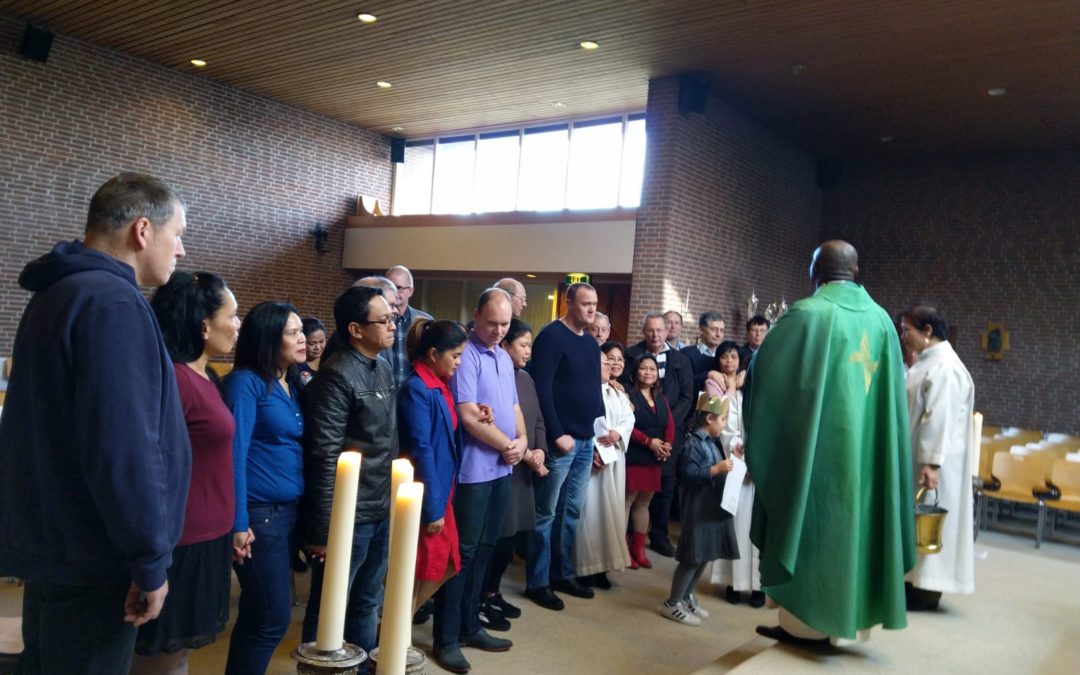
After the successful launching of the Children Bible Corner (CBC) last month, the Filipino Catholic Community of Gouda (FCC-Gouda) and Surroundings commenced the blessings of couples last February 24, 2019. For starters, the community leaders aim to have the Couples’ Blessing ceremony every year in the month of February. The primary purpose of having Couples’ Blessings is to ask God’s strengthening of relationships, marriages, and parenting in each family belonging to the community.
Fr. Marcel Uzoigwe prayed over the couples of the FCC-Gouda & Surroundings for God’s blessings and that may each couple’s love and unity be strengthened with Christ Jesus in their midst.
Meanwhile, the CBC continues with Maryjane Streefland-Osigan and Lovella van der Weiden-Modillas leading the children’s activities of the day and assisted by Lennart van der Weiden. In line with the Sunday’s gospel sharing and homily, the children also get to learn more about God’s love and forgiveness.
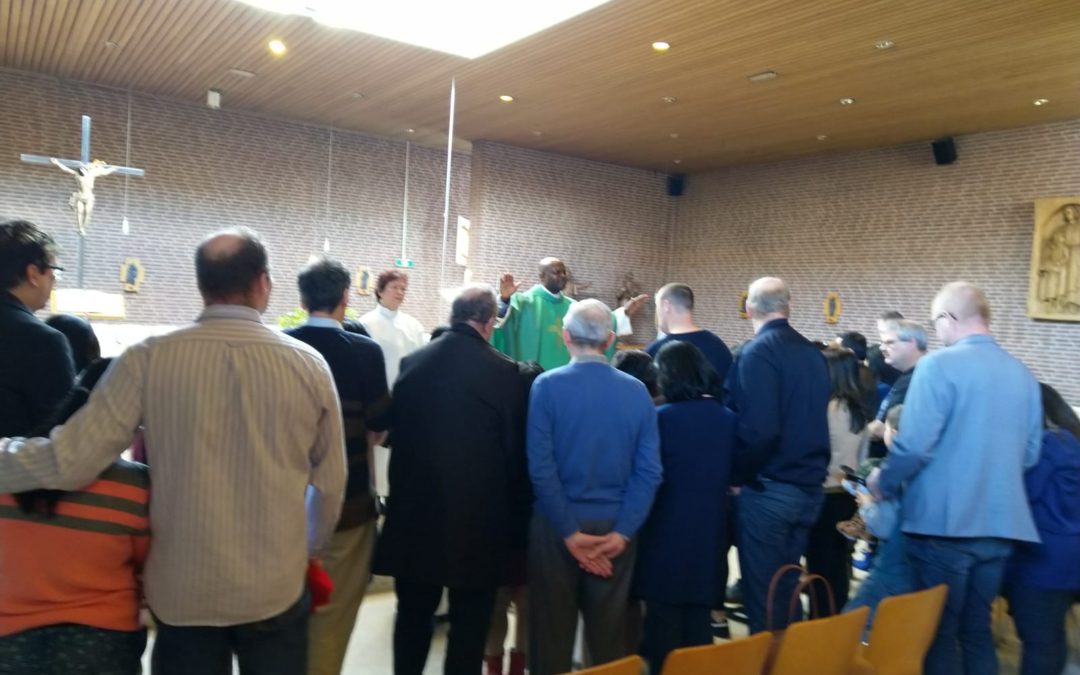
Furthermore, Fr. Marcel also prayed over for the sick members of the community. He called the people who are or have members of their families who are sick and anointed them with oil. Let us all include sick members of our community in our prayers.
The readings bring us to the very important theme of forgiveness. The whole issue of salvation is anchored on a forgiving God who seeks out his sinful children. The old testament is filled with God who relates with consistently disobeying people. Sometimes God allows them to suffer a little bit of the consequences of their wrong choices in a bid to make them reason differently before coming to their help. But the compelling picture of God in the relationship is that of a loving father tending his weak children, leading them to a better understanding of who they are as his children. Little wonder we say that to err is human, but to forgive is divine.
In the first reading, we see David who has been on the run because Saul seeks to kill him. Having been rejected as King of Israel due to his failure to adhere to the injunctions given to him through the prophet Samuel over the Amaleks (1 Samuel 15), David was chosen to replace him as the new king of Israel. Naturally, such action would raise jealousy in the heart of most normal persons. King Saul’s response was to seek out David and kill him so that the kingship would remain in within his household. In one of those pursuits, it was king Saul who ended up vulnerable to his enemy.
What would you ordinarily do when you discover that the very person seeking to end your life or your carrier or marriage has fallen into your net? You have all the opportunity and evidence needed to nail him or her. Would you let such occasion pass you by? That was the challenge before David. His servant Abishai said to him, “God has given your enemy into your hand this day; now therefore let me pin him to the earth with one stroke of the spear, and I will not strike him twice” (1 Samuel 26:8).
We always have such friends whenever such situation arises. They are ever willing to show us ways to avenge, even to do it themselves on our behalf. That is simply human. But David would not have king Saul killed, for the sake of the anointing that resides on Saul as the King of Israel. His love for God would not allow him to touch the Lord’s anointed.
Jesus went further in the Gospel to advocate love for the enemy. “I say to you who hear, Love your enemies, do good to those who hate you, bless those who curse you, pray for those who abuse you” (Luke 6:27-28). This goes far beyond the standard of the normal norm to treat others the way they deserve. You don’t just have to forgive or let go, but get involved in seeking the good of your enemies, praying for them and wishing them well. This would have sounded too theoretical if Jesus himself did not practice forgiveness at that length even while hanging on the cross (“Father forgive them for they do not know what they are doing” Luke 23:34) and his disciples did the same (“Father do not hold this sin against them”, said Steven while being stoned – Acts. 7:60). Even Pope John Paul II was glad to meet and forgive the man who shot him. There are other numerous examples that show us that forgiveness, even in worse situations, is possible.
As Christians, we recognize the need for forgiveness for ourselves and for others. However, looking at events in the society around us, we often discover that there are lots of hurts and effects of unforgiveness. We see families torn apart and people live cold over events that took place long ago. Worse still, a lot of Christians and men of other religions today are imprisoned by hate in the name of God, while others derive joy in destructively criticizing others. This proves that the understanding of God’s love that is rich in mercy and acceptance of the other is not yet a reality, and the negative consequences are readily visible.
The crippling effect of unforgiving hurts is so much that it not only constitutes a struggling with anger and resentment, but causes much difficulty both for the person who harbors it and those around him or her. It preoccupies the mind, interferes with present relationships and cripples self realization. A lot of stress related illnesses either stem from or are aggravated by anger and depression resulting from unforgiving hurts. And our loving God would not have us live that way. That is why Jesus asks us to let go, clean up the mind and enjoy the peace that forgiveness brings. Only thereafter that we can learn to extend true love to those we may have considered as enemies.
If unforgiveness hurts, why then do we have difficulty forgiving? Probably because we are still too logical about it. Popularly held consequences of forgiveness still influence us. We accept the belief that lessons are not learnt when forgiveness is readily granted. In other words, the culprit must be made to suffer something in other to ensure that he or she does not repeat similar actions the next time. So forgiveness becomes tentative and conditional upon future action. But this form of conditional forgiveness contradicts the love of God who died for us when we were still sinners and enemies of God (Rom. 5:8) and Jesus’ command to forgive in today’s gospel.
In Matthew 18:15 Jesus placed the initiative for forgiveness and reconciliation on the offended party to thereby demonstrating how necessary it is to forgive and live in peace and love with one another. Beyond conditional forgiveness, there are occasions we notice the desire to “get even” becoming so dominating that those unable to actualize their longing for vengeance resort to praying for the death of their enemies. Jesus would rather that we love our enemies (Today’s gospel; Matthew 5: 43-44).
Dear friends, do we realize that when one allow others to make him or her angry, for instance, what it really means is that someone else controls the person’s feelings? The person loses his or her freedom and concede to the other the power to decide when he or she should be happy or sad. Worse still, harboring the negative feeling keeps one continually chained to the influence of the other. The act of forgiving is, therefore, primarily beneficial to the forgiver. By forgiving, a person regains his or her freedom from negative emotional feeling to enjoy a more congruent and healthy mind-body relationship.
As Christians, we share in the divine nature through our baptism and the Holy Spirit strengthens our resolve to live as the children of God that we are. The Holy Spirit enables us to live such virtues as forgiveness which is ordinarily difficult under normal human circumstances. St. Paul reminds us in the second reading (1 Corinthians 15: 45-49) the very important distinction between Adam – the natural man of dust from the earth – , and Jesus – the spiritual man from heaven. Colossians 3: 3 affirms that we belong, not to the natural man, but to Christ who indeed is our life. What is naturally difficult is therefore supernaturally possible. Hence, forgiveness is a necessary condition for living the Christian faith. Whenever we pray the Lord’s prayer – The Our Father – we affirm this condition for the forgiveness of our own offenses (“forgive us our sins as we forgive those who offend us”, Matthew 6:12). Jesus added that unless we forgive our brothers and sisters from our hearts, our own offenses would not be forgiven (Matthew 6: 14-15).
As we advance in our daily walk with the Lord, let us ask for the grace to always forgive others in the manner that Christ has forgiven us (Lk. 23: 34; Col. 3:13). In this way, our love for God and humanity will be sincere and our Christian witness will be fruitful.
Homily 7th Sunday year c. 24-02-2019 by Fr. Marcel Uzoigwe, cssp.
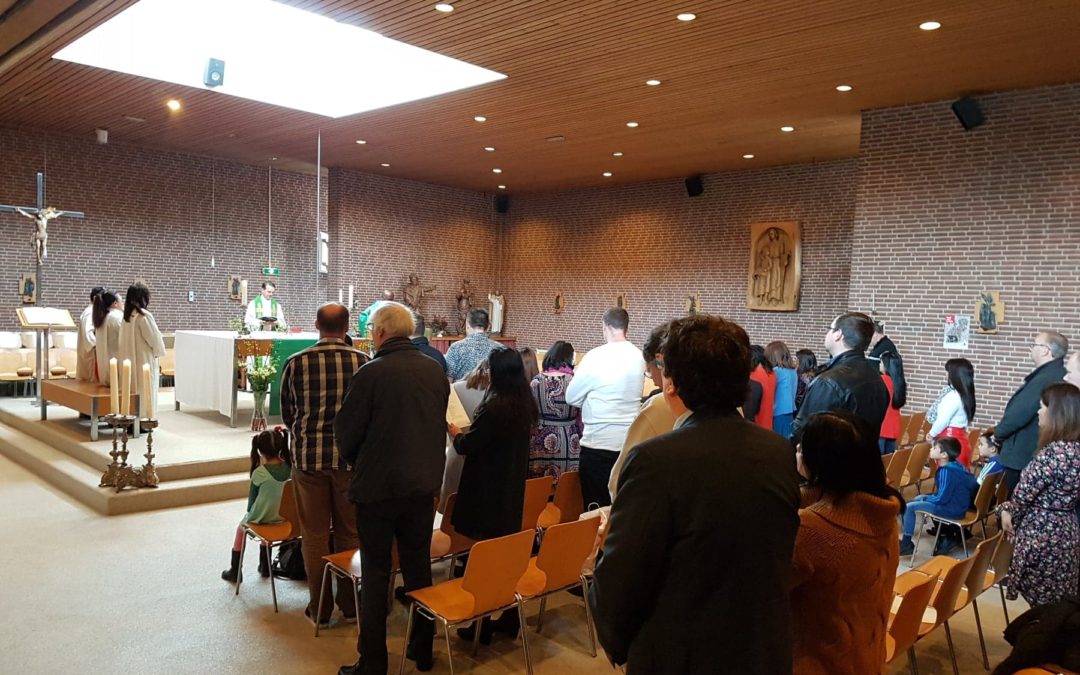
January 27, 2019 (Sunday) is the 4th Sunday of the month, and, therefore, is the first Sunday celebration of the year for the Filipino Catholic Community of Gouda (FCC-Gouda) & Surroundings. On this day, the members of the community happily gathered together to welcome the year with a fully packed agenda of the day.
The one-hour service started with early arrivals of church members, greeting one another and welcoming back two of the community’s valued priests– Fr. Marcel Uzoigwe and Fr. Mark Robin Hoogland as concelebrants of this Sunday service.
Fr. Mark Robin and Fr. Marcel
One of the highlights of today’s Sunday activity was the ‘launch’ or start of the FCC-Gouda’s Children Bible Corner (CBC), an initiative to also get the young ones actively involved and get started in deepening their knowledge of God.
Children reading today’s gospel in Luke 4:18-20– “The Spirit of the Lord is upon me because he has anointed me to proclaim Good News to the poor. He has sent me to proclaim freedom for the prisoners and recovery of sight for the blind, to set the oppressed free, and to proclaim the year of the Lord’s favor.”
Officiated by Fr. Mark, the community was also delighted to witness the Confirmation of Pascal Benjamin Hendrikus Kroeze. The confirmation ceremony comes in four acts: (1) the laying on of hands, a biblical gesture by which the gift of the Holy Spirit is invoked; (2) reciting of the creed to profess one’s faith; (3) the anointing of Chrism, which signifies that the person being confirmed is now sealed with the gift of the Holy Spirit; and (4) receiving the cross, which symbolizes the person’s Confirmation.
Laying on of hands on Pascal with his partner, Eve, by his sidePascal recites the Creed to profess his faith and renew his baptism vows.The Annointing of Chrism (consecrated oil): Fr. Mark Robin dips his thumb in the Chrism and makes a sign of the cross on the forehead of Pascal, signifying that he is being sealed with the gift of the Holy Spirit. Fr. Mark gives Pascal a cross to signify Pascal’s confirmation.
Meanwhile, on the other side of the room, the children were all enthusiastic in meeting the other kids, sitting face to face, and knowing each other by name. Above all, through CBC, the children get the chance to be heard as well as to share their thoughts, feelings and experiences.
The children listen to the story of creation, read by Isabelle Hameete and followed by Daphne Streefland, two of the four CBC volunteers of the day. The other two were Lovella Modillas and Myra Colis.Time for writing and colouring!
For the four volunteers helping out with this first CBC, they too find it delightful to have the children say something about who God is and why they are in the church. To sum up the brief but delightful conversations, CBC coordinator of the month, Myra Colis, taught the children an English song called, “My God is so Big” with the following lyrics saying, “my God is so big, so strong and so mighty… there’s nothing my God can not do.”
Attendees of the first ever Children Bible Corner (CBC) of FCC-Gouda showing their works, Bjorn reading Luke 4:18-20, and ending up their presentation with the song, “My God is so Big.”
As usual, the mass ended by greeting the birthday celebrants of the month, followed by the fellowship & salu-salo time to complete the day’s provision of food not only for the mind and spirit but also for the body.
Contributor: Susan Horn | Photo credits: Susan Horn, Kathy Grimme, Lovella Modillas
First reading: Nehemiah 8:2-6, 8=10 | Second reading: 1 Corinthians 12: 12-30 | Gospel: Luke 1: 1-4; 4: 14-2
Dear brothers and sisters,
As a president or prime minister takes up his post for the first time, he or she makes a public speech in which he or she outlines the key programs of his government. A few Sundays ago, we celebrated the baptism of Jesus during which the reading informed us that the heavens were opened, and the Holy Spirit descended upon him like a dove. Then there was the Father’s voice from heaven saying, “this is my beloved son in whom I am well pleased, listen to him” (Luke 3:22). Today, we see Jesus in his home synagogue making what looks like an inuagural speech about his mission. He went into the synagogue and was given the book of the prophet Isaiah to read. What he did was to find the place where it is written, “the Spirit of the Lord is upon me, because he has anointed me to preach the Good News to the poor, He has sent me to proclaim release to captives and recovery of sight tot he blind, to set at liberty those who are oppressed, to proclaim acceptable year of the Lord.” After reading that portion, he said, “today this scripture is fulfilled in your hearing” indicating that the prophesy is about him.
At that time, the people were anxiously waiting for a Messiah who would liberate them from the schakels of the Roman emperors. When John came to baptize, everyone thought he was the Messiah. But he made the people realize that the Messiah was already in their midst, only they did not recognize him. We can then understand why the people fixed their attention on Jesus when he said that the prophesy ‘is TODAY fulfilled’ in your hearing. Their longing for liberation was nearby, only that their understanding of liberation was basically concerned with the political dimension due to the situation they found themselves. But that was only an aspect to the total and integral liberation that Jesus offers.
The idea of political liberation features in the first reading as well. The Jews were under bondage in Babylon. God raised the king of Persia to make war against the Babylonians and defeated them. The king of Persia, whose cup bearer was Nehemiah, favored the Jews and allowed them to return to Jerusalem and rebuild their temple. In the process of rebuilding the ruined temple, Ezra the priest and scribe, found the Book of the Law. In the part of the reading we have today, we see Ezra reading and explaining the law of God to the people. They realized how far they have gone away from the Law of their God due to the various events that have marked their life in exile. That realization made them remorseful and unhappy. Ezra, on the contrary, encouraged them to cheer up, rejoice and make a feast because it is the day of the Lord. The Lord is in their midst, making himself known to them. He is a God of compassion and love. He has liberated them and was drawing them back to himself. They have a cause to rejoice rather than be sad.
The presence of God’s Spirit brings new life, liberation and goodness. It is God’s own life that he generously shares with his elect. God’s presence in his people. It is the Spirit of God that moved the prophets of old,, the Judges of Israel and the great men and women of God in the scripture. Jesus said ‘the Spirit of God is upon Him’ and went on to enumerate the mission for which the Spirit is upon him. When he rose from the death and was about ascending to heaven, Jesus instructed his disciples not to leave Jerusalen until they have received the Holy Spirit. The ‘timid and fearful’ disciples remained hidden in a locked room praying for nine day until the Holy Spirit came upon them on the Pentecost day. Those same timid and fearful disciples became totally liberated from fear and went out proclaiming Jesus the Lord to all people with boldness. They could work miracles, heal the sick, and proclaim the Good News to all nations. Over the centuries, the Spirit of God has continued to fill the people of God leading them to achieve great feats for God and humanity. You can imagine what the Spirit of God can do in the life of a believer.
St. Paul reminds us in the second reading that we all who have received the Holy Spirit have been bestowed with a special gift of the Holy Spirit. There are various gifts, but all are for the purpose of building up the body of Christ, the Church. He compares the various gifts of the Holy Spirit to the body . Different parts of the body perform different functions, but each of them is as important as the other because none can do the work that the other does. They are only different. Since we all who have received the Spirit of God are endowed with one gift or the other, there are two important question we ought to ask ourselves. The first question is about the gift: What gift of the Holy Spirit have I received? Each one of us should, in prayer, deep reflection and discernment, discover what gift he or she has received. It is unfortunate if one does not even know what gift he or she has. The second question has to do with how actively we put the gifts of God to use. In 2 Timothy 1:6 St Paul reminds Timothy to fan into flame the gift of God that he has received through the laying on of hands. If we do not nourish our relationship with God, the action of his Spirit in us diminishes and his gifts becomes dormant. Daily devotional scripture readings, prayer and good works bring alive the power of God’s word in us and moves us to employ his gifts for the purpose for which we have received them.
Remember the order of Jesus’ statement: the Spirit of the Lord is upon me (1), he has sent me to proclaim the Good News…(2). Thus, we need to always live under the guidance of the Holy Spirit and allow ourselves to be sent to fulfill a divine purpose/mandate. Living under the guidance of the Holy Spirit ensures our holiness (the Holy Spirit perfects us, guides us , inspires us, empowers us, etc.) and making ourselves available for the sending of the Holy Spirit makes us agents of the Good News using the gifts he has bestowed on us. Today, one of us will receive the gift of the Holy Spirit through the laying on of hands in confirmation. We rejoice and pray with him that God’s abiding presence through His Spirit will lead him to greater knowledge, love and devotion to God, and that he may become a great bearer of the Good News to all around him.
Beloved friends, Jesus invites us to share in his Spirit and mission. Let nothing prevent you from embracing this wonderful invitation to become an agent of the Good News. Our society is in dare need of what Jesus offers, though it may not know it. Let us, filled by the Spirit of God, be the Ezra, the Paul and indeed the disciples of the Good News for our world today. Amen.
Homily of Fr. Marcel Uzoigwe, cssp. 27 January 2019 at FCC-Gouda & Surroundings Sunday Mass Celebration.