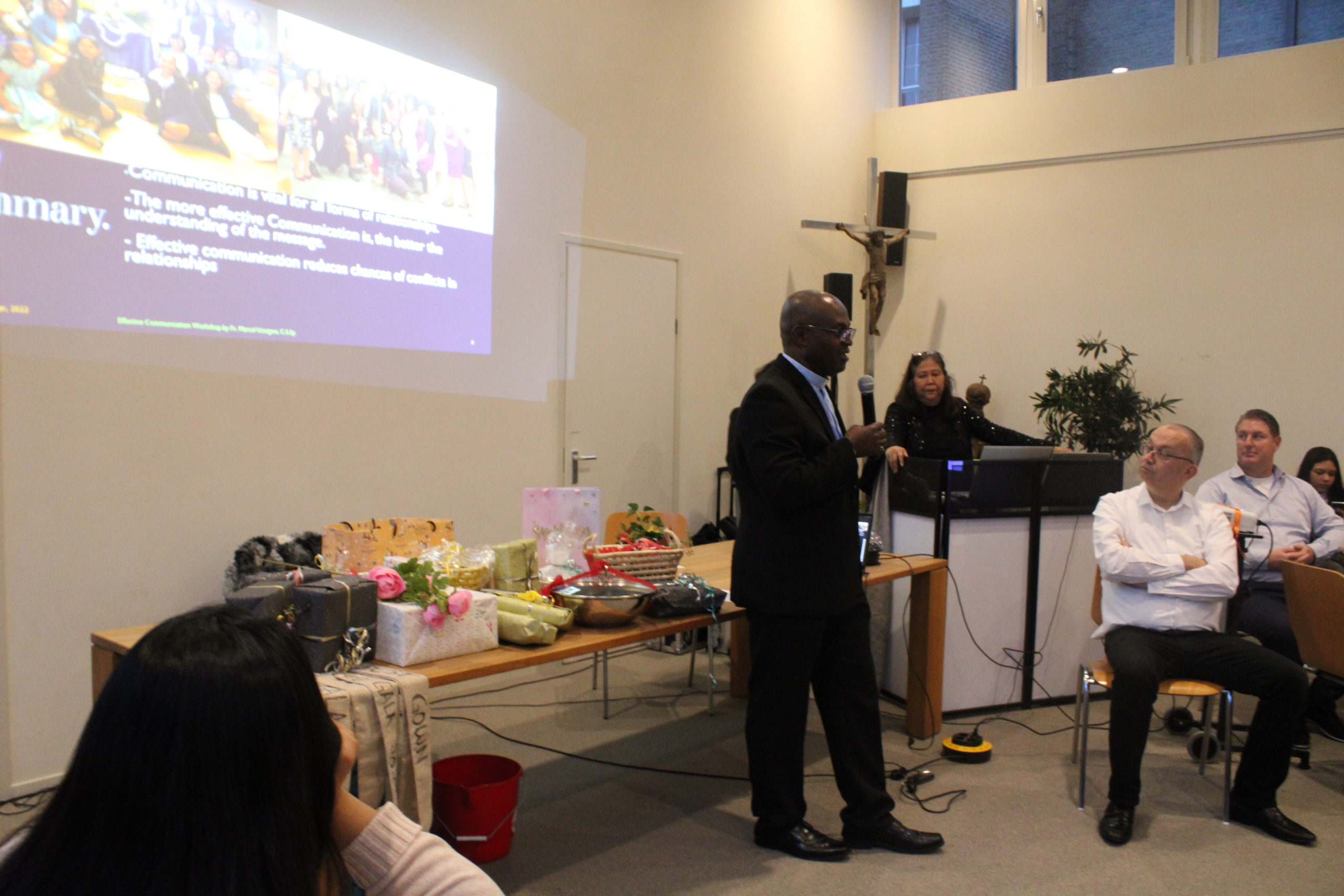
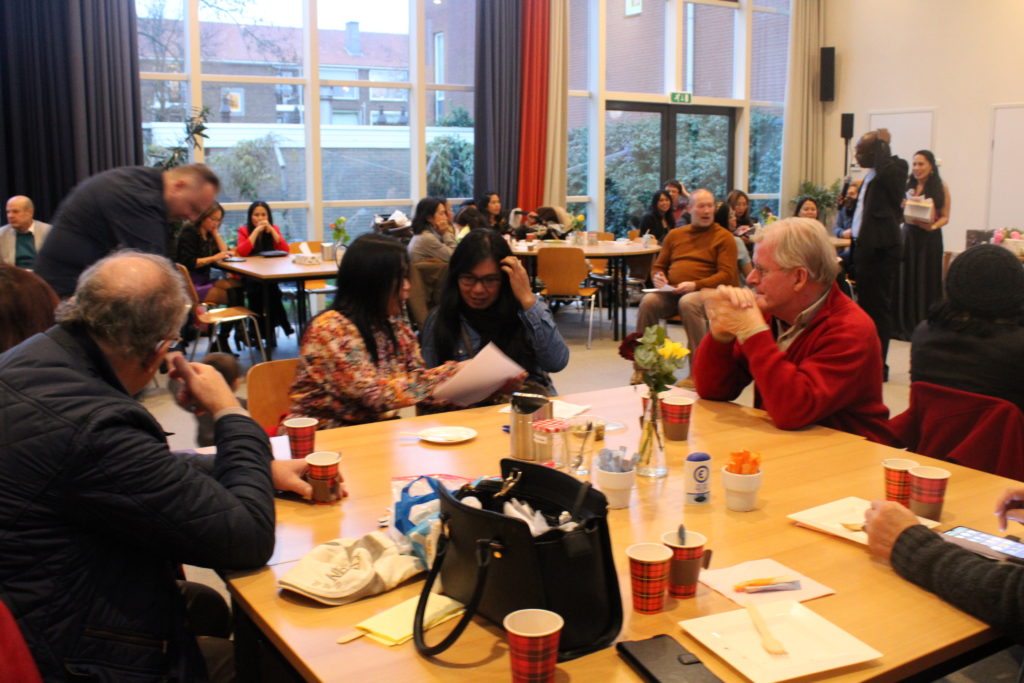
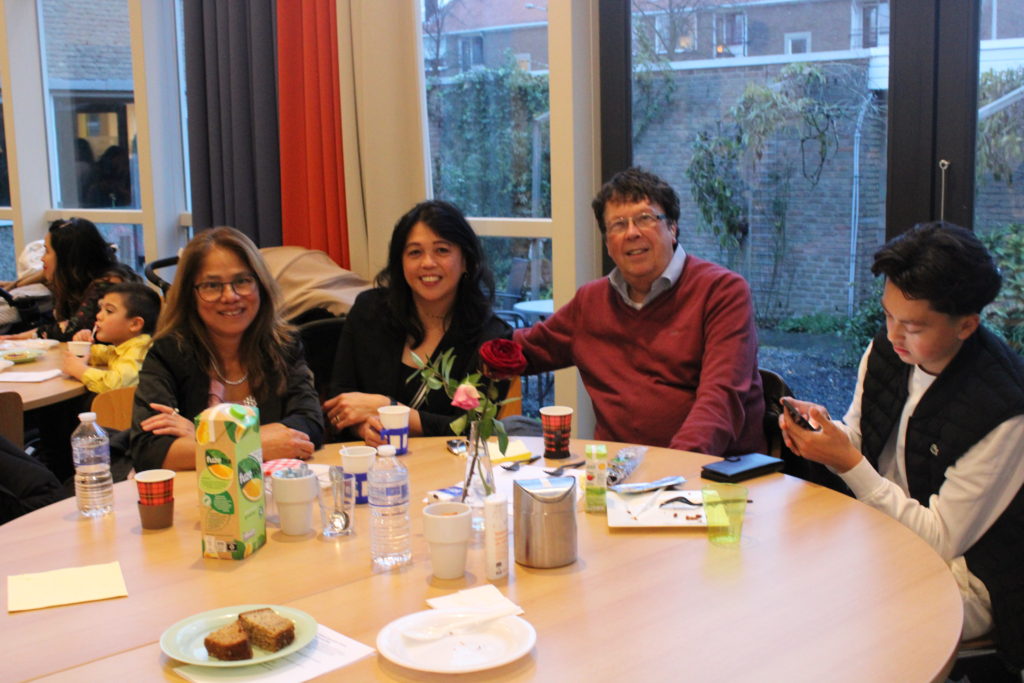
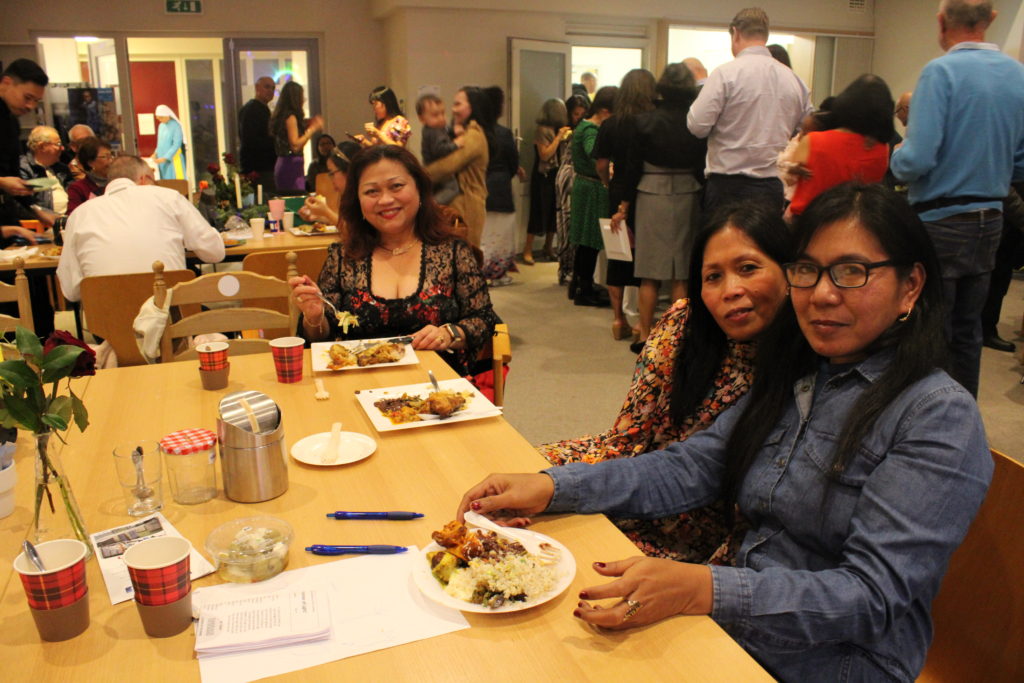
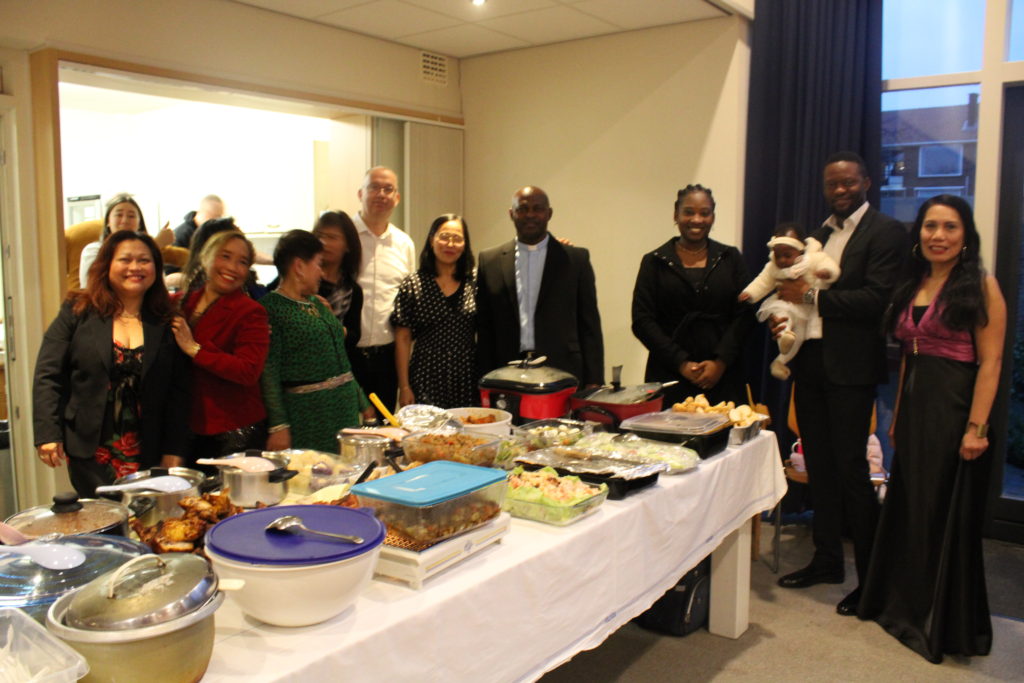
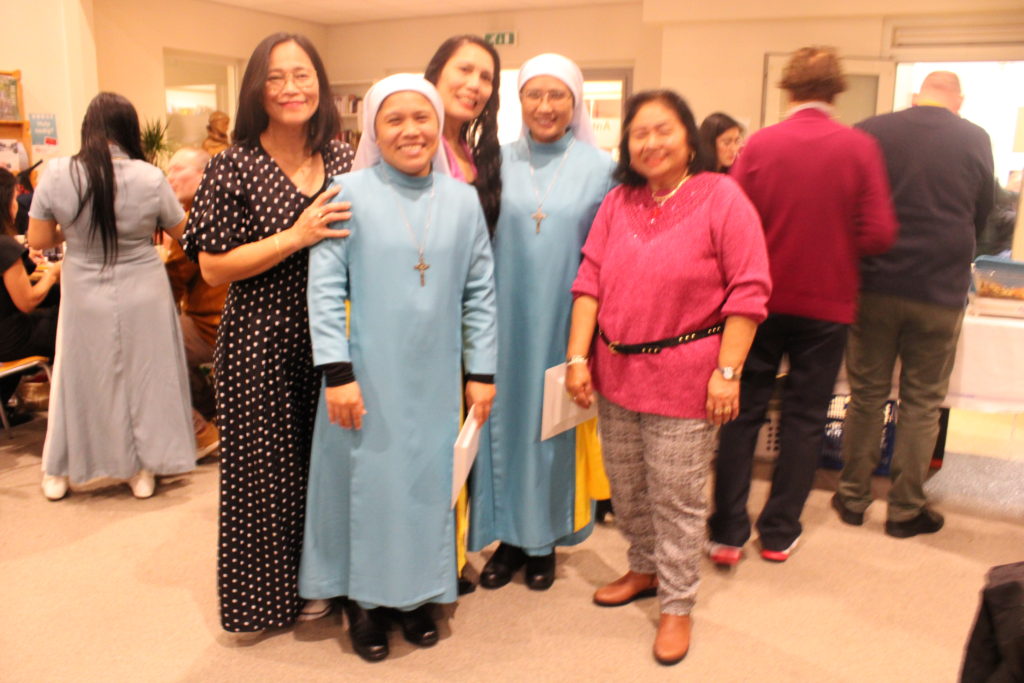
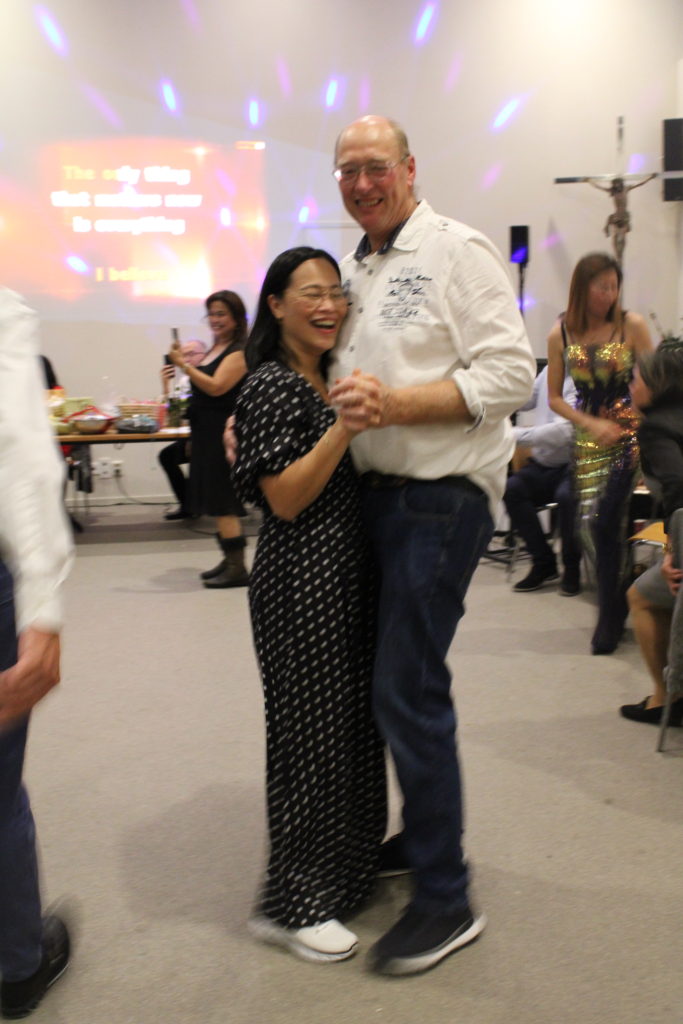
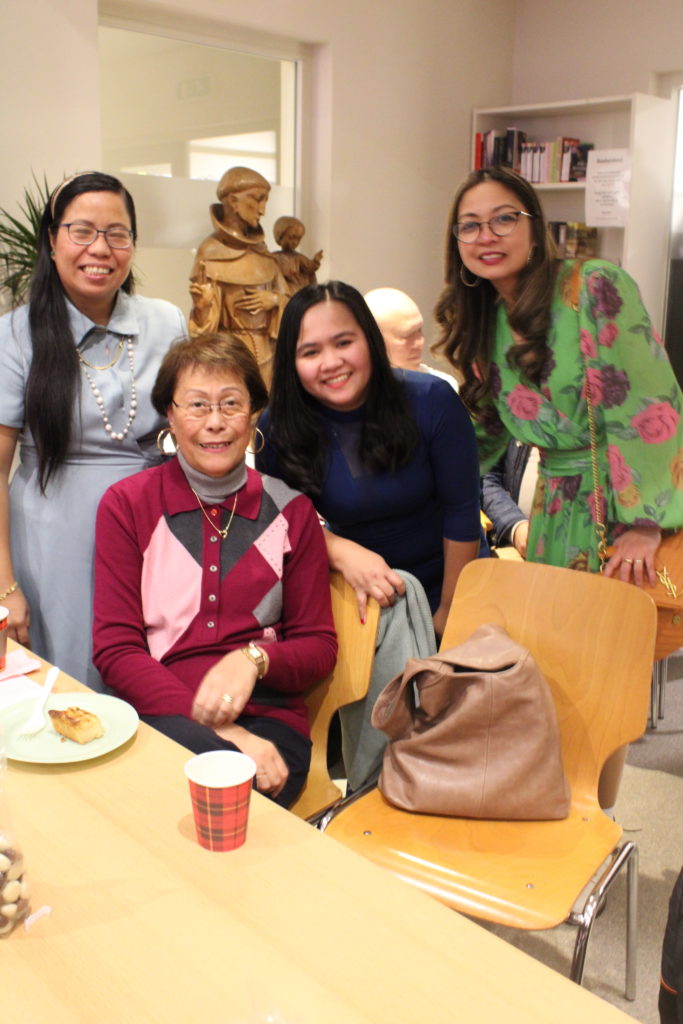
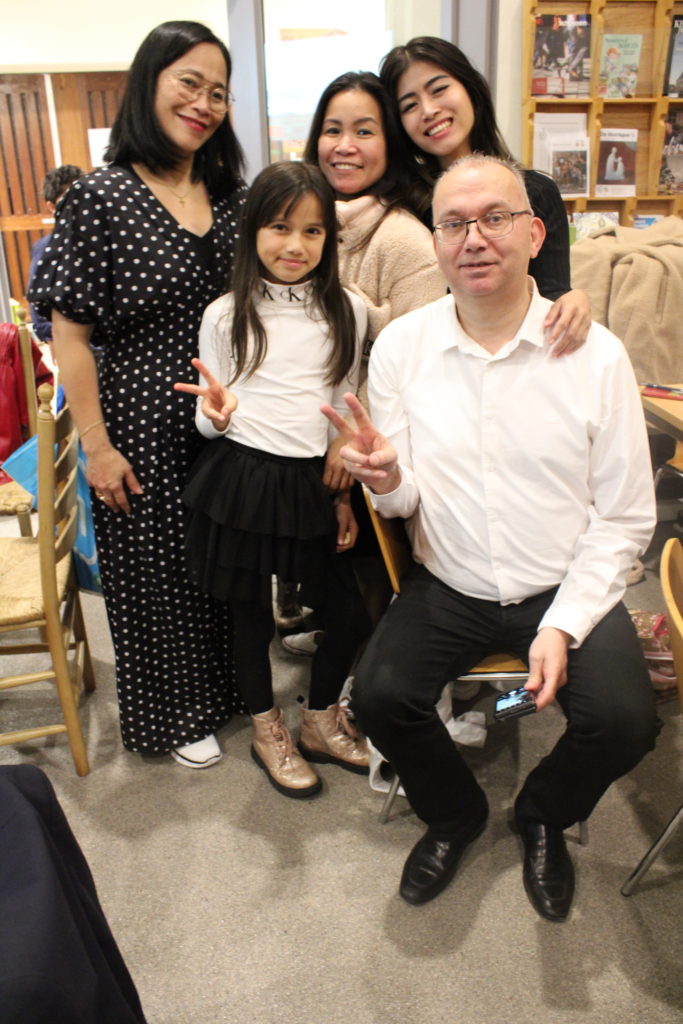
The Filipino Catholic Community of Gouda and Surroundings held its annual Socio-Gathering Event last November 27, 2022 at the Antonius Zaal in Gouda. It was a night, themed as Gala Night, filled with sharing, fun, laughter, music and warmth. The event started with a free workshop on Communication by Fr. Marcel Uzoigwe, followed by a sumptuous buffet dinner brought and shared by the attendees of the event. All the while, lively music was provided by the DJs Norie and Nova from FCC-Dordrecht.
After dinner, the party program started by giving tokens of thanks to the FCC-Gouda volunteers. This year, acknowledgements were given to Gio Quebral for his service as a mass servant boy and Nelleke Oosterwijk for always helping in the collation of the euchalette.
Everyone had a treat of hearing the golden voices of Sheryll Brocklehurst and Glenda Huisveld from FCC-Dordrecht. They did a very impressive duet that the audience clamoured for a second song.
FCC-Gouda ladies, Lea, Elpi, Christy, Luz and Marivic, performed a dance number for everyone to enjoy.
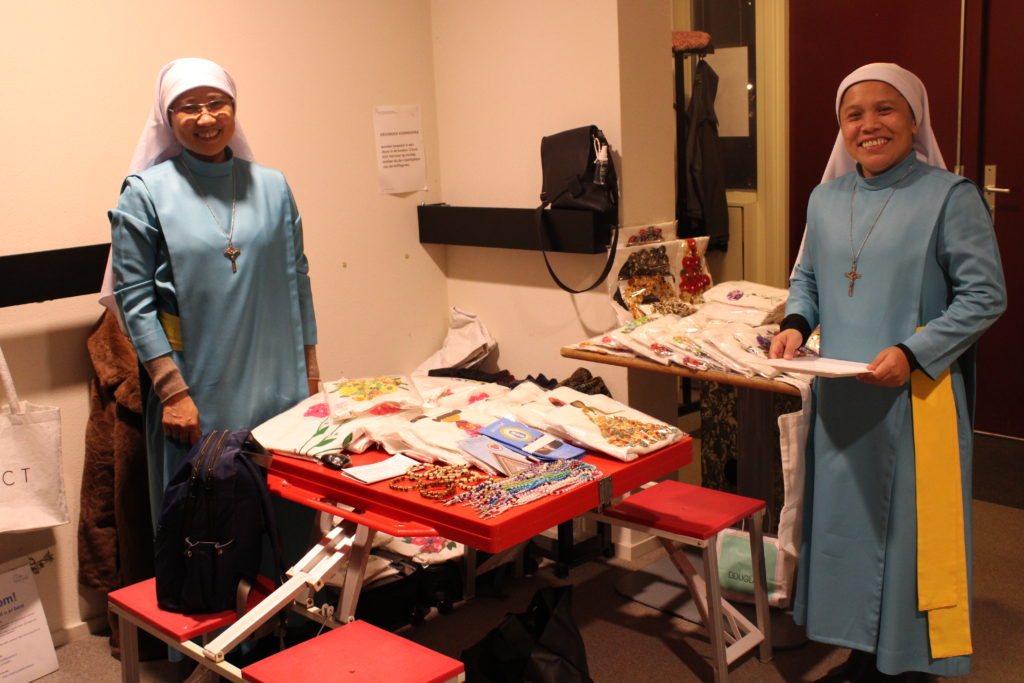
Sister Gloria (Jamayca Tagalog and Sister Margareth (Marjorie May Torion), who are visiting Missionaries from Cebu, serenaded all with Christmas carols.
Another dance number was performed by the members of the FCC-Dordrecht.
In between numbers the DJ provided music so everyone can enjoy dancing on the floor.
One of the highlights of the night was the awarding of Mr & Ms Gala and The Best in Gala Gown. Mr and Ms Emeka and Enene Abadon was hailed as the Gala Couple of the night. They were given sash and gift prizes by Fr. Marcel.
Meanwhile, Ms Janice Janapon is the winner of the best Gala gown of the night, She too was awarded a sash and gift by FCC-Gouda Members.
Another highlight of the night was the awaited FCC-Gouda Tombola Draw. Here are the list of the happy winners.
1st Prize €50 Sheryll Brocklehurst
2nd Prize €30 Mercy Ordiz
3rd Prize €20 Janice Janapon
Consolation Prizes Winners
Lita Henke
Norma Reyes
Charoes Schuurhuis
Kristian Janapon
Lea Van Rhijn
Congratulations to all the Winners.
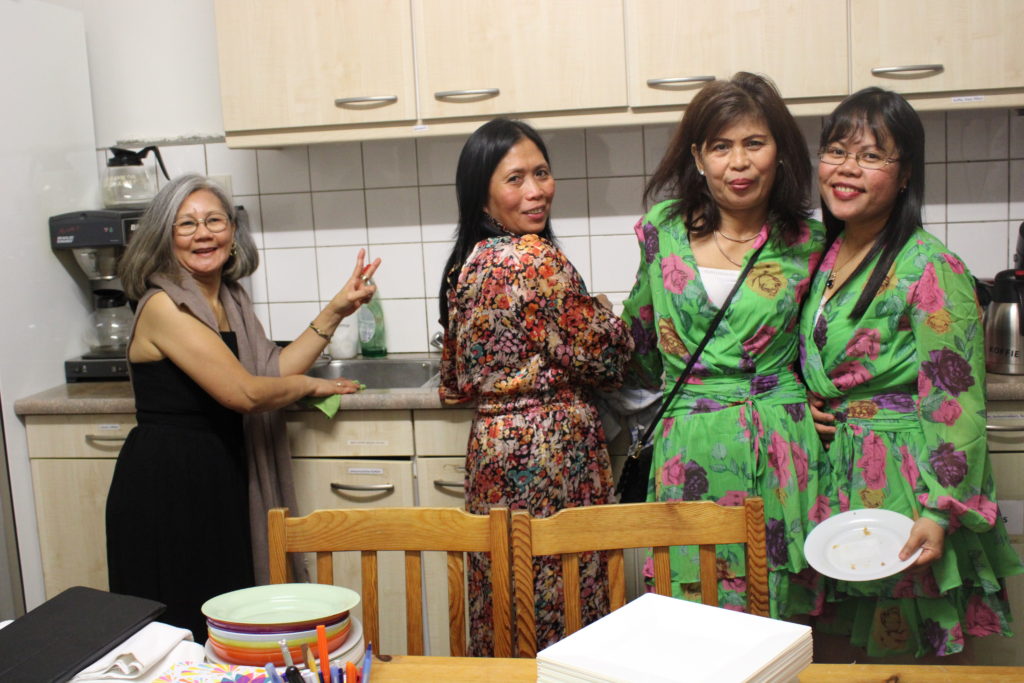
It was indeed one memorable night to remember. Everyone was a very happy in their singing and dancing mood even up to the cleaning of the Hall.
FCC-Gouda would like to acknowledge and thank the following sponsors and donors of the event.
FiHansieel Company
Elpi Asiatisch Kleding Reparatie
Mary Lynn Van Dijk
Mercy Ordiz Lea Van Rhijn
And to those who donated Anonymously
Thank you too to the members of the FCC-Dordrecht, for providing the music especially to Norie and Nova who were the DJs of the night. More Photos from the Socio-Gathering Event are attached below. Thank You and till next year.
MESSAGE FROM THE FCC-GOUDA BOARD
This year 2022 Socio Gathering with the theme “Gala” was again celebrated with a lot of surprising attendees of church members and families & visitors. The event was amazing and went very well . The moment to communicate to catch up between communities and friends ,love ones and friends after the pandemic.
It is also our special way to thank volunteers and Fr Marcel Uzoigwe for their hard work during the year. We also like to thank all the sponsors and donors, without them , we could not make it happen. Thank you for your help and generosity. We’re delighted to announce that our events raised Four hundred and forty two euro’s -netto. This amount will help us continue our work helping the needy.
We still in need of volunteers. Please get in touch with the board members and let our team help you find a tasks that would suit you – just email fcc.gouda@gmail.com. Any help is welcome and appreciated.
Homily of 1st Sunday of Advent Year 2022 by Fr. Marcel Uzoigwe, C.S.Sp.
Readings: Jer.2: 1-5, Ps.122, Romans 13:11-14 & Matthew 24:37-44
A new circle of the Liturgical year begins today with the First Sunday of Advent. It is interesting that the church’s calendar year always begins with this season which in itself is a period of expectation. The word “advent”, as we know it, is derived from the Latin word adventus, meaning “coming,” which is a translation of the Greek word parousia. In the Christian church calendar, it is the period of preparation for the celebration of the birth of Jesus Christ at Christmas and also of preparation for the Second Coming of Christ. Advent season, therefore, traditionally precedes Christmas and offers us the opportunity to prepare for the celebration of the coming of Jesus, born in a manger many years ago. This first coming was preceded by so many prophecies about the day of the Lord. It would be a time of liberation for the Jews and all who were suffering and the enthronement of God’s righteousness over all the nations. Those promises kept the Jews longing for the coming of the Messiah.
When Jesus came, he taught us about the kingdom of God and ended up giving his life for it on the cross of Calvary. His resurrection that followed began a new order. Upon his Ascension into heaven, Jesus promised that he will return. But this time, he will not be coming to teach us about the kingdom of God nor to give his life on the cross. Rather, it will be a period of judgment when the righteous will be rewarded and the sinner receives the just wage for their actions. The question of the second coming of Jesus occupied the early Christians so much that they thought that Jesus will be coming within their lifetime. Some people in Thessalonica, for instance, stopped working and waited for the coming of Jesus. Although Jesus comes to us every day in different ways through his word in the scripture, the sacrament, our relationship with people and so many other ways, the emphasis on his final coming in glory is what is meant with the term – the day of the Lord.
The day of the Lord is something uncertain. Isaiah writes about it as a day when all the nations will stream to the mountain of the Lord; a day when there will be no more wars; a day of everlasting peace (Isaiah 1:1-5). But while it will be a day of jubilation for the virtuous, it will also be a day when the vicious will tremble in fear. “Behold the day of the Lord comes, cruel, with wrath and fierce anger to make the earth a desolation and to destroy its sinners from it” (Isaiah 13:9-13; Joel 2:1-2; Amos 5:18-20; Zephaniah 1:14-18).
What makes the day of the Lord more interesting is that no one knows when it will be, like a thief in the night. Jesus emphasized this point in the Gospel reading. It will be like in the days of Noah. People were busy going about their businesses, eating, drinking, marrying, and doing whatever they wanted until Noah got into the boat and the flood came upon them. The point here is that the building of the boat took a whole lot of time and processes. Stepping into the boat was only the end of this long process. The people had sufficient time to reflect on what Noah was doing and repent. But they made other choices, focused on other things, and perished with those material choices they made. In like manner, the whole time of our life is meant for us to reflect and make proper choices that will result in a salvific end when Christ returns. Jesus went on to describe his coming as a day of separation when two people will be together, one will be taken and the other left behind. However frightening it might be to think of the day of the Lord in terms of these analogies, Jesus offered his listeners a solution: be awake, be prepared because if the owner of the house knows when a thief will attack his house, he would not sleep but be awake.
Being awake, prepared, or vigilant is something common in daily life. We are living in a period when so many things happen. The car of my confrere, Fr. John was broken into and nearly driven away before the security system in the car locked up everything. Police said the attempt was to steal it. If not for the security system in the car, it would have been stolen. We are in a season when it gets dark earlier and most houses are broken into, people are attacked and robbed. You only need to follow the “opsporing verzocht” program on television to see how people are robbed in this period of the year. That will tell you the importance of being vigilant, being security conscious, and being more careful.
There are three levels of vigilance that every child of God needs to keep according to their degrees of importance. First is the material vigilance which we have spoken about. The second is vigilance over our lives. God requires us to work and enjoy the fruits of our labor. Ecclesiastes 3:13 reads, “And people should eat and drink and enjoy the fruits of their labor, for these are gifts from God.” We sometimes forget that whatever material property we have is meant to serve us by improving our lives and that of those around us, and not vice versa. Sometimes people lose their peace, health, or even their lives for material reasons. There are so many cars, houses, clothes, etc, but you are irreplaceable. If people take pains to watch over their houses, cars and positions, if people spend so much to insure their property, how much more should we watch over ourselves? Don’t be discouraged by the things that are passing away, and do not be carried away by success, this too shall pass. Be grateful for who you are and take care of yourself. The most important moment in life is now, don’t lose the joy of now by worrying and complaining about the past and the future, or about what you have or what you do not have. The best way to deal with the past and the future is to do our best today starting from now. Be calm but vigilant. Focus on the important things. The third and most important is eternal life. Jesus warns in Mark 8:36, “what does it profit a man to gain the whole world and forfeit his soul?” The only thing that lasts forever is our life with God. That is what Jesus wants us to give the greatest attention to, to be vigilant about, and to get prepared for it. The question then is, how do we get prepared for the coming of the Lord?
Paul gives us a clue on how to get prepared for the coming of the Lord. “The night is gone, the day has come,” he wrote. “Let us leave the works of darkness and live like the children of light”. The symbols of light and darkness as opposites are used severally to distinguish right from wrong, virtue from vice, good from bad, and salvation from damnation. The works of darkness are sometimes referred to as the desires of the flesh that is in opposition to the demands of the Spirit (Gal. 5:19-22). Whatever choices we make in this regard determine where we will end up. Choosing to live in the light of Christ’s teaching presupposes that we are getting prepared to welcome him with joy, just as choosing to live in the darkness of sin signals the opposite. “the wages of sin is death, but the gift of God is eternal life in Christ Jesus our Lord” Paul writes in Romans 6:23. In all instances, the Bible warns that those who fail to live in the light of Christ’s teaching will have to regret when he comes in power and glory, while those who obey his words will go out to meet the Lord rejoicing.
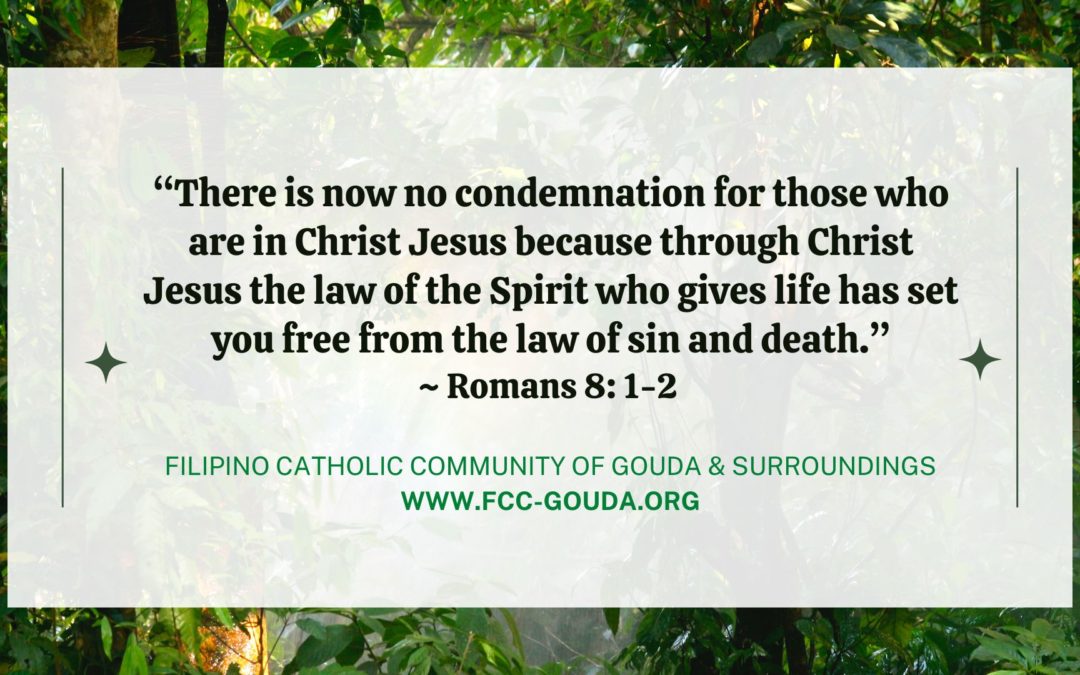
The coming of the Lord is, therefore, something to look forward to with joy for all who live in the light of Jesus’ teaching. As Paul wrote in his letter to the Romans (Rom. 8:1-2), “there is now no condemnation for those who are in Christ Jesus because through Christ Jesus the law of the Spirit who gives life has set you free from the law of sin and death.” Living in the light of Jesus’ teaching becomes the antidote for fear for the day of the Lord. That ensures that the coming of the Lord does not frighten us nor can it catch us unaware. Instead, it will be something that inspires us to be the face of Jesus to those around us who are oppressed, lonely, suffering, or seeking any form of liberation.
As we prepare for Christmas, let our neighbors see in us enough reason to believe in the Jesus we celebrate. That is the best way to prepare for the day of the Lord because it ensures that we are busy with the project for which Jesus came and gave his life. When he finds us doing this, he will confirm us as living in the light of his teaching and therefore prepared to welcome him.
Readings: Sir 35:12-14,16-19; Ps.32:2-3.17-19.23, 2Tim4:6-8,16-18 & Lk. 18:9-14
Dear friends in Christ,
For a bicycle to move properly, the wheel and the hub must work together. So also is it with prayer and humility. The gospel reading of last Sunday centered on prayer, with an emphasis on the need for faith and perseverance when one prays. In today’s gospel reading, Jesus moves further to focus on the centrality of humility for effective prayer.
Humility is said to be the mother of all virtues given the important role it plays in authenticating the rest of the virtues. Take for instance that someone who makes a gift to you goes about boasting that he or she is the one supporting you without which you cannot survive. In that situation, the gift loses the quality of a true charity. Remember that Jesus warns that when you give to someone in need, don’t let your left hand know what your right hand is doing (Matthew 6:3). So it is also when someone claims to love you but constantly puts you down. The true meaning of love is then lost. That gives us a clue to how central humility is in our relationship with God and our fellow human beings.
In the Parable that Jesus used to bring out his teaching in the gospel, he talked about a Pharisee and a Publican who went into the Temple to pray, just as we all gather in the Church today to worship and pray. The Pharisee in his pride and self-assuming started to appraise his good deeds, making a presentation of how often he fasts, pays his tithes, and gives to the poor. He went on to exonerate himself from all wrongdoings, claiming that he is not like the rest of other men who are sinners and evildoers. He even pointed at the Publican (the Tax-collector) at the other end, saying that he is not like him – a sinner. It seems he was trying to impress God and probably making a case for a reward for his presumed virtues and good deeds. The Publican, on the other hand, was fully conscious of his shortcomings and, in his humility and self-emptying, recognized his sinfulness and beats his chest in sorrow saying, ‘have mercy on me a sinner.’ Jesus ended by saying that the Publican went home justified while the Pharisee was not, because whoever exalts himself will be humbled, and the one who humbles himself will be exalted.
Let’s get closer to the identities of the subject that featured in this parable as narrated by Jesus. Both the pharisee and the publican were of Jewish origin and financially well off. So, it has nothing to do with material wealth or nationality. While the Pharisee enjoyed societal respect and honor as a religious role model of the time, the publican was detested for collaborating with the Roman occupiers. What gave the Pharisees the upper hand was their nationalistic and religious commitments against the Publicans who were seen as traitors and betrayers of their own people. This brief comparison helps us to place this parable in its context, and also to understand the meaning and context of the lowly as used in the first reading, “The prayer of the lowly pierces the clouds. It does not rest till it reaches its goal, nor will it withdraw till the Most High responds”
In this parable, Jesus shifts emphasis on the impact of paychecks or socioeconomic status in the definition of the poor and lowly. To make this point clearer, the second reading shows St. Paul imprisoned, awaiting execution, abandoned, and his life being poured out like a libation. Everything had been taken away from him, his family, friends, wealth, adequate food, and so on and so forth. Yet he was spiritually peaceful and able to write, “The time of my departure is at hand. I have competed well; I have finished the race; I have kept the faith. And from now on the crown of righteousness awaits me”. St. Paul was writing from a place of supreme material and emotional poverty. However, because of his faith, he could feel like the wealthiest man in the world. He displayed complete abandonment and trust in the grace of almighty God. Humility, therefore, has to do with the acceptance of truth concerning oneself and recognizing one’s capacities and weaknesses. Humility is not about humiliating oneself but rather about taking one’s rightful place and being grateful for who one has become through the grace of God. It is a way of saying, ‘I acknowledge who I’m before God. I depend on him and it’s only with his grace that I can do anything worthy of praise.’ This is what Paul means when he wrote: “What do you have that you didn’t receive? But if you did receive it, why do you boast as if you had not received it?” (I Co 4:7).
What separates the Pharisees and the Publican was the ability to look inward, recognize the truth about oneself in relation to God, and refuse to judge others using one’s strength against their weaknesses. The only strength the Pharisee could use against the Publican is his religious social standing, which in itself turns out to be hypocrisy. It is a known human tendency to constantly compare with others and try to portray oneself as better than one’s neighbors, friends, and colleagues. That is the root of gossip, backbiting, jealousy, and lack of contentment. This parable also deals with the question of pre-judging others. It warns against the quick judgments on which we often base our concepts on others. The word “prejudice,” comes from “pre-judging”. It is a prejudice to judge people or their actions without knowing who they are, what they think, or why they do what they do. We pre-judge people all the time. A new person who looks different comes into our neighborhood, into our office, into our school, or even in our church, and we quickly map everything about the person based on past experiences or what we know of similar persons in the past.
Judging and despising one’s neighbor closes the door to God’s heart. Expressing contempt and scorn for others is beyond mean and proud. It stems from the assumption that one would be qualified to sit in the seat of judgement and publicly shame those who do not conform to one’s own standards. Certainly, God does not listen to someone who boasts of his or her goodness as if he or she achieved it without God’s grace, and even worse if that person condemns others on that premise. What is important is that we recognize God’s goodness to us, humbly seek His mercy and show mercy to others as well.
The Gospel has a number of practical lessons for us. People who puff themselves up and try to put others down are obviously not the most loved of people. Rather, it is those that care for others, help them become better, build self-confidence, recognize their worth and talents, and are able to make something for themselves in life that is loved and appreciated. In the same manner, Jesus makes it clear to us that relating with God our Father requires us to recognize our place with him, and approach Him with humility because “whoever exalts himself will be humbled and whoever humbles himself will be exalted”. It is only in humility that our prayer can be heard, just as the wheel of a bicycle can only move if the hub is working properly. Prayer, therefore, becomes a conversation between two persons who are conscious of their positions and needs; a kind of relationship between parents and their children. Fear, pretense, puffed-up ego, and belittling others give way to love, respect, obedience, and worship. That is the position from which we can ask and enjoy God’s forgiveness in prayer.
Let us, therefore, cultivate the virtue of humility in our approach to God and in our relationship with our fellow human beings. Amen.
Readings: Amos 6:1.4-7; Psalm 146: 1 Tim 6:11-16: Lk 16:19-31
Dear brothers and sisters,
Every opportunity we have in life is meant to be used wisely. Wherever God has placed us in life, and whatever capacity we have to do something, are in themselves opportunities to be God’s presence that the people around us can feel and be grateful for. Paul said in his second letter to the Corinthians (5:20) that we are ambassadors for Christ. And the work of a good ambassador is to properly represent the one that sent him or her. When we fail to make good use of the opportunities we have, and it passes away, we end up in regret. That is the important theme of today’s readings.
In the first reading, the prophet Amos vehemently rails against the rich who are only concerned about their pleasure without showing interest in what can benefit others. They lay in beds of ivory and stretch themselves upon their couches. They do nothing except feast, and they do so in a totally immoral way. They do not slaughter adult animals, but lambs and calves, because their meat is more tender than that of adult sheep and cattle. So they eat their own future, so to speak because herds with too few young animals are doomed to extinction. For Amos, who was a farmer until God called him, this must have been a terrible experience. Eating lambs and calves also symbolically allude to acts that hurt young people and are capable of negatively affecting their sound and integral development. Whoever does not care about the effect of his or her action on the young people does not have an eye on the future, and any nation that fails to protect its youth is doomed. So, when Amos wrote that these men drank wine with large cups, used costly cream, and never cared about the destruction that was coming to their nation, he was obviously warning that the nation had no future. That is why these men will be the first to go into exile.
If Amos were to live in our society today, he would have a lot to condemn. The power of money and its abuse has become a daily occurrence. Money has become everything. Once you have money, you can buy anything, even a human being. You can even lobby to turn something immoral and absurd to become legal. Think of the hundreds of thousands of street children in the slums of the world’s cities, the hundreds of thousands of other children in Asia and Africa and so many other places that are forced into child labor, sixteen hours of work a day for a very little wage just to continually enrich the companies owned by the rich. And the owners of these companies could be based elsewhere, and we rush to buy the products of these child laborers because they are cheap. In that way, we patronize the practice. Think of child prostitution and human trafficking. If one would take a look at the various evils in the world today, the real people behind them are not often those poor boys and girls who are rather victims, but the rich who sponsor all kinds of organized crimes. Rather than use their wealth to lift up the poor out of poverty, the rich that Amos attacked used their wealth to destroy the future of the young ones.
While Amos concentrated on the temporal consequences of failing to make good use of wealth, Jesus warned in the gospel that it can lead to eternal damnation. To illustrate this point, Jesus told the parable of Lazarus and a certain rich man. Like the rich people in the time of Amos, he too dresses richly and celebrates lavishly every day, while poor Lazarus lies sore-covered at his gate. But the rich man takes no notice of him. It does not even occur to him to have the surplus of food delivered to Lazarus. Unlike the case of the people Amos condemned for their actions (sin of commission), the sin of the rich man in the gospel is that of doing nothing in a situation that he could actually help (sin of omission). Remarkably, Jesus did not give him a name. The poor man, on the other hand, is given a name, Lazarus, which means “God will help”.
Earlier in this chapter which was read last Sunday, Jesus warned us to make friends with the money we have by reaching out to those in need so that when the money fails, we can be admitted into heaven. This rich man paid no attention to such a warning. So when his wealth failed to keep him living, he realized that he has not made any friends in heaven. It is therefore not surprising that he has no name while Lazarus is always remembered because he is the man we sing about at the end of a funeral service: ‘To paradise the angels lead you. And as Lazarus, the poor of old, thou shalt be in the land of peace forever.’ The most important place we need to have our names written is in the Book of Life (cf. Rev. 20:15) which endures forever, and not just in the cheap popularity of the world. Unfortunately, Lazarus could not respond to the rich man’s cry for help because there is already a separation between them (cf. Matthew 25: 31-32) and there is no repentance in the grave.
Jesus did not tell this parable to praise poverty or to condemn wealth. No. Jesus himself had a number of wealthy friends while on earth, like Joseph of Arimathea on whose grave he was buried (cf. John 19:38). Rather he is warning us to make use of all that we have to win eternal life. Paul calls it “fighting the good fight” in his letter to Timothy in the second reading. What matters in life is not what we have but what we do with it, and how it positively affects others who cannot help themselves. The moment we concentrate only on ourselves, we do not build for the future. We do not make friends with heaven. We fail God who is the giver of all gifts, and we do not live to be remembered. It is people who felt loved and cared for by how we relate to them that often remember us. The apostles were not rich in wealth, instead, they gave up what they had for the gospel. Yet the impact the Gospel they preached and the example of their lives made on people’s lives keep their names still among us. If you should close your eyes for a moment and think of the one person that your heart quickly remembers, it might not be a rich person in terms of material wealth but someone that was there for you when you needed his or her help. And that is what the rich man failed to do for Lazarus. He failed to see him as a fellow human being in need. He failed to help. Jesus said, whatever you do to the least of these my brethren, you have done for me (cf. Matthew 25:40).
The readings invite us to reflect on our attitude to what we have and how it influences our relationship with those around us who are in need. Being rich is not just about material wealth. One can be rich in talents, knowledge, time, or in many other ways. We can see that each and every one of us is rich in some way. We also have a lot of migrants, asylum seekers, victims of war who have fled their homes, the aged who are lonely and sick, and the youth needing direction in making life choices. We have our fellow worshippers who are going through difficulties in their lives, families and work-situations. Do we make our time, knowledge, and talents available to reach out to them, to help those confused, or needing direction and care? Let us ask for the grace to always use our wealth positively to help those in need so that when that day comes, those acts of kindness will speak on our behalf.
By Fr. Marcel Uzoigwe, C.S.Sp. (Genesis 18.20-32, Colossians 2.12-14, Luke 11.1-13)
THE ONE WHO ASKS ALWAYS RECEIVES; THE ONE WHO SEARCHES ALWAYS FINDS.
The readings present us with an understanding of the nature of God that invites us to a closer relationship with him. He is a loving father who longs to be close to his children. Against the stifling idea of God that sits somewhere watching to see when someone has sinned so as to visit the person with punishment, the readings present a listening, caring, and tolerant father willing to change his mind, if need be, for the interest and the good of his children.
The first reading presents the meeting between God and Abraham in such an interesting manner that one might be led to ask where Abraham got the audacity to seek to change the plans of God. One would have thought that if God makes up His mind, no one would be able to make Him change. Afterall, he is God, He must have known everything and what do we have to offer that would make Him change His mind? The Prophet Isaiah asked, ‘who directed the spirit of God, what counsellor could have instructed Him, whom has He consulted to enlighten Him, to instruct Him in the path of judgement…? (Isaiah 40.12-15)’ With this idea in mind, we could feel that we do not have to offer God any suggestion or even beg Him to change things in our favour. Yet, we see Abraham doing exactly the same. God even agreed to Abraham’s intervention, at least he never felt that Abraham was insulting Him by trying to make Him change His mind.
It is not just in this instance that we have seen this side of God, when God wanted to destroy the people of Israel out of anger, Moses stood in the gap and even asked God to remove his name from the book of life instead of doing what he threatened (Exodus 32.8-14). Of course we all know the story of the Ninevites and how God relented from destroying them after they repented. Jonah himself knew that God might change his mind and was not prepared to warn the people. He actually wanted God to unleash His anger on the people and that was why he wanted to flee from the request to go and preach to the Ninevites (Jonah 4.1-3). The Ninevites prayed and fasted in order to make God change His mind and it worked (Jonah 3.8-10). Even God Himself often wanted people to stand in the gap between and people in order to save them from God’s wrath (Ezekiel 22.28-31).
What does this say to us about human relationships? Jesus asked, “Which of you fathers, if your son asks for a fish, will give him a snake instead?” (Luke 11:11). Where does the interest lie? Is it just what I want or what is good for the other? If the interest of the other is central, it will not be very difficult to make adjustments.
This standing in the gap is what Jesus did when He gave up His life on the Cross, He paid the ultimate price. He reconciled all things with God. He made away with the enmity and cancelled the debts. We hear this clearly in the second reading and also in many other writings of St. Paul. The second reading puts it this way; ‘he has forgiven us all our sins, he has overridden the Law, and cancelled every record of the debt that we had to pay; he has done away with it by nailing it on the cross.’ This is why the major task of Christianity is proclaiming what God has done because what God has done and is still doing is far more important than what we are doing and can even do. Religion is human participation in the Divine project. God wants us to become participant in this project, Jesus makes us agents of reconciliation which He initiated by his death on the Cross, it is all God’s work (2 Corinthians 5.18-21).
We can now understand why Jesus gave us the boldness to ask, seek and knock without being afraid of being rejected. This is because he has removed every obstacle that made us strangers to God. He had done away with the fear, the barrier, the tension, the uncertainty and enmity between us and God. He gave us the boldness to call God ‘Father’. This calling God ‘Father’ is not just mere words but a reality which comes with every right a child has. Children never get tired of making requests from their parents. While a child might feel reluctant to ask something from an outsider or a stranger, he or she can always make requests from the father and mother. As a matter of fact, if your children are afraid of asking you something as a parent, then something is very wrong somewhere. It is that confidence and trust to turn to you as the parent especially when any other source of help has failed them that makes you truly a parent.
Jesus even added something more in this attitude of trust in God’s providence. He teaches us not just to ask, seek and search, he equally encourages us to be persistent. This means that we should not relent when it seems our prayers are not being answered, we should add the character of persistence to our prayer. We see this same teaching in the writings of St. Paul who asked us to pray without ceasing (1 Thessalonians 5.17, Colossians 4.12). One thing about persistence is that it helps us actually know how important what we are seeking for is. If what we are asking is not so important, we might not find it necessary to persist. However, if we are seeking for something very important, we can stay awake all night, we can go the extra mile to get. We can equally see that Jesus acknowledges the power of persistence in seeking. He often stayed in prayer all the night (Luke 6.12), he equally praised the Syrophoenician woman for her persistence (Luke 18.1-8), on the night before he was betrayed, he prayed in agony and even sweated blood (Luke 22.44). we were equally told though he was a son, he offered prayer constantly with loud cries and tears (Hebrews 5.7-8).
Prayer is a relationship and our way of praying depends on how we understand our relationship with God. Jesus whose death has reconciled us to the Father is reminding us in a powerful way that we should pray with confidence, faith and trust. We should approach the throne of mercy with confidence. We should not pay attention to the voice of the accuser who accuses us day and night before God. This accuser has been thrown down with his accusations (Revelation 12.10). We should rather be mindful of the new position and status that Jesus has given to us (1 John 3.1-3). Our prayer life should bear witness to the fact that we are no longer slaves but sons and daughters of the Most High, if not, then it means that Jesus died for nothing. When the veil of the temple tore into two, it was to demonstrate that the barrier caused by sin has been broken.
With this attitude in mind, let us renew our relationship with God. Let us renew our perception about God Who is a Friend and a Father. Let us embrace the status given to us out of love. Let us remove all the doubts and negativity that distort the true image of God in us. Let us above all call on the Holy Spirit of God Who refines us and teaches us in the depths of our beings. May the Holy Spirit lead us to the truth, pray in us and with us, may He give us the ability to grow daily in fruitful and effective prayers through Christ our Lord. Amen.